The Great B2B Budget Realignment: ServiceNow, Sierra, and the Shift from Software Seats to Autonomous Outcomes

A momentous shift is currently underway in the enterprise software ecosystem, vividly highlighted by a striking juxtaposition of corporate financial results reported within a single 24-hour window. This dynamic illustrates a structural rotation of capital within the Business-to-Business (B2B) marketplace, moving decisively away from legacy Software-as-a-Service (SaaS) models toward agentic, outcome-based artificial intelligence solutions. Rather than signaling the death of software, this transition reflects a fundamental rewiring of enterprise budgets, where traditional seat-based software is taking a back seat to autonomous digital labor.
The timeline of this market-shaking event unfolded rapidly. On a Thursday following its Q3 earnings report, enterprise workflow titan ServiceNow experienced a staggering 27% single-day collapse in its stock price, marking its worst trading session since its 2012 initial public offering. Just hours later, on Friday morning, artificial intelligence startup Sierra—co-founded by tech veterans Bret Taylor and Clay Bavor—released its third-quarter performance metrics. The contrast was stark: Sierra revealed it had added over $150 million in Annual Recurring Revenue (ARR) during the single quarter, vaulting its total ARR past the $400 million threshold. This single three-month period generated more revenue growth for Sierra than the entirety of its previous fiscal year.
To fully understand this market reaction, one must examine the broader economic landscape of enterprise technology spending. ServiceNow remains a formidable financial machine. Operating at a monumental $16 billion scale, the company reported year-over-year subscription revenue growth of approximately 20%, alongside robust free cash flow margins of 36%. For most corporations, these metrics would be the envy of the industry. However, the market’s punitive response—leaving ServiceNow trading more than 40% below its 52-week high—signals that investors are no longer evaluating enterprise software companies through the lens of historical growth alone.
The immediate catalyst for ServiceNow’s stock tumble was not a catastrophic revenue miss. The company posted adjusted earnings per share of $1.00, falling just shy of the consensus analyst estimate of $1.02, while total revenue reached $4.11 billion, narrowly beating expectations. Instead, the market reacted to compression in forward-looking metrics. ServiceNow adjusted its remaining performance obligations (RPO) and backlog growth targets downward, signaling to Wall Street that its historical growth engine is maturing. Crucially, investors are increasingly concerned that the heavy capital expenditures required to deploy generative AI features are eroding operating margins faster than they are accelerating top-line expansion.
In stark contrast, Sierra’s exponential trajectory underscores the velocity with which emerging AI-native platforms are capturing market share. Having launched just 30 months prior, Sierra doubled its ARR from $200 million to $400 million in a mere five months. To put this velocity into perspective, ServiceNow, growing at an impressive 20% clip, requires nearly four years to double its revenue base. On a net-new dollar basis, Sierra’s $150 million quarterly ARR addition represents roughly 22% of ServiceNow’s total quarterly net-new recurring revenue—an extraordinary feat for a company that did not exist three years ago.
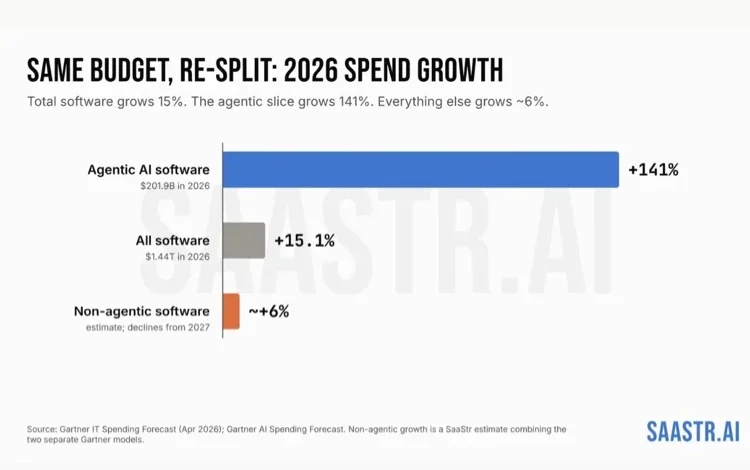
Industry analysts and market observers emphasize that this capital movement does not represent the injection of fresh corporate liquidity, but rather a zero-sum reallocation of existing enterprise budgets. Chief Information Officers and Chief Customer Officers are not expanding their technology budgets proportionally to accommodate AI; instead, they are shifting funds away from legacy IT, customer experience, and operational software categories to fund intelligent agent deployments. According to recent forecasts by prominent technology research firms, total enterprise software spending is projected to grow by roughly 15%, while specialized spending on agentic artificial intelligence is forecasted to surge by over 140%.
This budgetary cannibalization is intrinsically tied to evolving pricing architectures. Legacy SaaS providers have long relied on per-seat licensing models, charging enterprises for the number of human employees utilizing the software. ServiceNow executives, including CEO Bill McDermott, have defended this approach, arguing that corporate buyers prefer the financial predictability of seat-based structures supplemented by consumption meters. During recent earnings calls, leadership maintained that enterprise clients remain satisfied with hybrid pricing models and are not actively demanding alternative structures.
Conversely, AI-first platforms like Sierra are pioneering outcome-based pricing models. Rather than charging for user seats or raw computing tokens, Sierra bills enterprises based on completed business transactions—such as a successfully refinanced loan, a processed insurance claim, a closed sales deal, or a retained customer. This fundamental divergence in monetization strategies creates a profound competitive advantage. When an enterprise replaces a human-driven workflow with an autonomous agent, it reduces headcount, rendering traditional per-seat software licenses redundant. Outcome-based pricing allows AI vendors to capture a direct slice of the labor cost savings generated by their technology.
Despite structural differences in pricing and workflows, industry experts note that Sierra remains fundamentally anchored in the SaaS paradigm. It is built on recurring revenue models, multi-tenant architectures, and enterprise-grade security protocols. It sells directly to large corporate buyers through a comprehensive suite of applications tailored for agent management, analytics, and channel deployment. Furthermore, Sierra is actively cultivating a broader ecosystem through open protocols designed to integrate with major technology platforms across retail, financial services, and enterprise infrastructure.
For incumbent software giants like ServiceNow, the challenge lies in defending a massive legacy revenue base while aggressively transitioning into the agentic era. ServiceNow leadership points to encouraging metrics regarding its own artificial intelligence adoption, noting significant surges in AI-driven Annual Contract Value (ACV) and large-scale enterprise deals exceeding $1 million. However, while incumbents must carefully manage the migration of existing seat licenses without alienating their core customer base, agile startups operate unencumbered by legacy baggage.
The implications of this structural market realignment extend far beyond quarterly earnings reports. Venture capitalists and enterprise software founders are rapidly adjusting their underwriting criteria. Modern B2B software companies must now demonstrate the ability to command deal sizes significantly larger than their pre-AI predecessors. In an environment where enterprise technology budgets are effectively capped, successful software providers cannot merely share budgetary space with legacy systems; they must outright replace them.
Ultimately, the events surrounding ServiceNow and Sierra signal a maturing of the enterprise technology sector. Software as a service is not disappearing, but the era of passive, productivity-enhancing tools priced strictly by human headcount is rapidly giving way to autonomous digital labor priced by verifiable outcomes. As enterprises continue to redirect their technology spend toward systems that execute complex work independently, the market will continue to reward platforms that deliver measurable business results over those that merely assist human operators.
Related posts: