The landscape of modern political campaigning has undergone a seismic shift, moving from decentralized, paper-based operations to sophisticated, data-driven ecosystems. At the heart of this transformation lies the political campaign Customer Relationship Management (CRM) system. Unlike general-purpose business software, a political campaign CRM serves as the digital nervous system for a campaign, centralizing supporter data, volunteer coordination, and donor engagement. While it does not replace the specialized infrastructure required for voter-file management or federal compliance reporting, the CRM has become the essential bridge that allows campaign teams to harmonize disparate outreach efforts into a cohesive strategy.
Historical Context and the Evolution of Campaign Tech
The evolution of campaign technology can be traced back to the early 2000s, when data management was largely confined to static spreadsheets and disjointed databases. The 2008 and 2012 U.S. presidential election cycles marked a turning point, as campaigns began to treat supporter data with the same level of scrutiny as multinational corporations manage their customer bases. Today, a campaign team is expected to manage a complex stack of technology that includes voter-file databases, fundraising platforms, SMS broadcast tools, and email marketing suites. The modern CRM acts as the "source of truth" for campaign-owned interactions, ensuring that every touchpoint—from a volunteer’s first inquiry to a donor’s recurring contribution—is logged, analyzed, and acted upon.
Distinguishing Between Political and Commercial CRM Platforms
While the core architecture of a CRM remains similar across sectors—focusing on contact records, interaction history, and workflow automation—the requirements for political campaigns are distinct. A commercial CRM is designed to move a lead through a sales funnel toward a purchase. In contrast, a political CRM must account for the fluid and high-pressure environment of an election cycle, where the "product" is a candidate or a cause and the "customer" is a constituent or volunteer.

Political CRMs must navigate a complex web of jurisdictional requirements. For example, in the United States, federal campaigns are subject to strict Federal Election Commission (FEC) reporting standards. A general CRM lacks the native capability to handle the granular data required for FEC filings, such as the occupation and employer of donors over a certain threshold. Consequently, campaigns must integrate their CRM with specialized compliance software. Failure to maintain this separation can result in significant legal risks, as general-purpose platforms are rarely built to handle the unique data-retention laws or the specific consent requirements for political SMS and email outreach.
Chronology of a Standard Campaign Integration
To understand how a campaign integrates these technologies, one must look at the lifecycle of a typical election cycle. In the early "launch" phase, the priority is building the database. Campaigns deploy web forms and sign-up pages, often powered by the CRM, to capture initial contact information. During this phase, data hygiene is critical. Teams must scrub lists to remove duplicates and segment contacts based on geographic data—such as precinct or district—often imported from the official voter file.
In the "engagement" phase, the CRM facilitates the conversion of passive followers into active volunteers. By automating workflows, a campaign can send an automated email sequence to a new volunteer, follow up with a task assignment in the CRM, and track the volunteer’s progress through subsequent events. This phase requires tight integration between the CRM and communication platforms.
Finally, in the "get-out-the-vote" (GOTV) phase, the CRM shifts focus toward mobilization. Data must flow rapidly between the field team’s mobile apps and the central CRM to ensure that canvassers are hitting the correct doors and that contact records are updated in real-time. This requires a robust API or middleware layer that can handle high-velocity data updates without compromising the integrity of the master record.

Data Management and the Source of Truth
A common pitfall for campaigns is the confusion over the "source of truth." It is vital for campaign managers to distinguish between the official voter file and the CRM. The voter file—typically provided by state parties or commercial vendors—is the authoritative source for registration status and voting history. It is generally static or updated periodically. The CRM, however, is a dynamic reflection of the campaign’s direct relationship with the individual.
Effective data management requires a clear protocol for how these two sources interact. When a volunteer updates their email address in the CRM, should that update propagate back to the voter file? In most cases, the answer is no, due to the regulatory sensitivity of official voter data. Instead, the CRM should be viewed as a supplemental layer that enriches the campaign’s understanding of the individual without corrupting the official record.
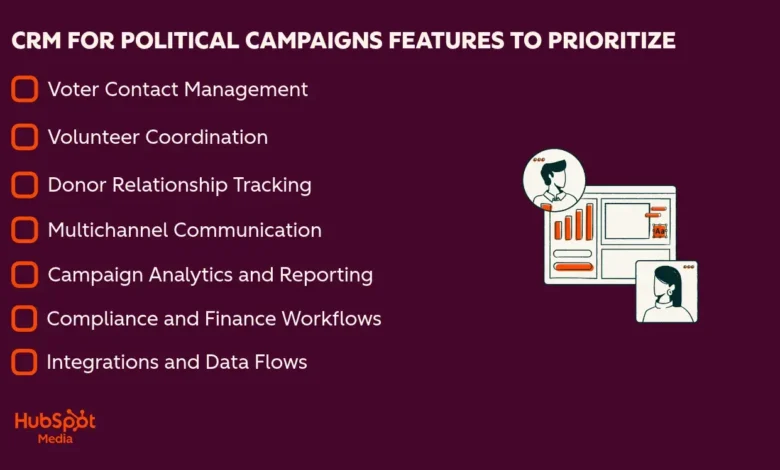
Key Features to Prioritize in Evaluation
When selecting a CRM for a political campaign, decision-makers should prioritize interoperability over all-in-one features. The ideal system offers:
- Robust API connectivity: The ability to push and pull data from specialized tools like ActBlue, WinRed, or NGP VAN is non-negotiable.
- Advanced Segmentation: The capability to create micro-segments based on behavior, such as "donors who have not yet volunteered" or "volunteers who reside in a specific swing precinct."
- Consent Management: Automated tracking of opt-ins for email and SMS to ensure compliance with the TCPA (Telephone Consumer Protection Act) and other relevant communication regulations.
- User Permissions: In a campaign, turnover is high and access levels must be granular. The ability to restrict access to sensitive donor or voter data based on the staffer’s role is a security imperative.
Implications of AI in Campaign Management
The integration of Artificial Intelligence (AI) into CRMs, such as the introduction of tools like HubSpot’s Breeze Assistant, is beginning to change how campaign teams operate. AI can now summarize thousands of interaction logs, provide predictive sentiment analysis on donor communications, and draft personalized outreach emails in seconds. However, these tools bring their own risks. The reliance on AI to generate campaign content requires rigorous human oversight to ensure that messaging remains aligned with the candidate’s platform and that no factually incorrect or inappropriate information is disseminated.

The Economic Impact of Proper CRM Selection
The financial implications of choosing the right technology stack are significant. A poorly integrated system leads to "data silos," where fundraising teams cannot see what the field team is doing, resulting in redundant outreach or, worse, conflicting messages sent to the same donor. Conversely, a well-implemented CRM allows a campaign to optimize its burn rate by ensuring that resources are allocated to the most engaged segments of the population. By improving the efficiency of volunteer recruitment and donor cultivation, a campaign can effectively lower its cost-per-acquisition for both money and votes.
Broader Industry Perspectives
Industry experts often argue that the "best" CRM is the one that the team actually uses. A highly sophisticated, custom-built system that is too difficult for a field organizer to navigate on their phone is less effective than a simpler, intuitive platform that encourages data entry. Because campaigns are temporary organizations that must scale from a handful of people to hundreds of staff and volunteers in a matter of months, the learning curve of the technology is a critical success factor.
Conclusion: A Foundation for Success
As political campaigns become increasingly digital, the CRM stands as the bedrock of organizational strategy. It is not a silver bullet; it cannot win an election on its own, nor can it replace the grassroots human connection that is the hallmark of effective campaigning. However, by providing a structured, data-informed environment for managing relationships, the CRM enables campaigns to operate with a level of precision that was previously impossible.
For campaigns evaluating their technology stack, the path forward is clear: define the boundaries of each system, establish a "source of truth" for every data point, and prioritize integrations that allow the campaign to move as fast as the election cycle demands. Whether using a specialized political CRM or adapting a commercial platform like HubSpot, the goal remains the same—to connect with the voter, inspire the volunteer, and empower the campaign to communicate its message effectively. As the digital landscape continues to evolve, those who master the art of data-driven relationship management will undoubtedly hold a distinct advantage in the democratic process.