The way consumers discover brands is undergoing a profound transformation, with Artificial Intelligence (AI) search engines now playing a pivotal role. A recent analysis of the 2026 HubSpot State of Marketing report reveals that 58% of marketers are observing higher conversion rates from visitors referred by AI tools compared to traditional organic search traffic. As platforms like ChatGPT, Perplexity, and Gemini increasingly influence purchasing decisions, achieving visibility within AI-generated answers is rapidly becoming a critical competitive advantage. This burgeoning trend has given rise to a new discipline: Answer Engine Optimization (AEO), which focuses on structuring content to be efficiently extracted, cited, and recommended by AI systems. While many marketing teams are experimenting with basic AEO tactics like lists and FAQs, a significant gap exists in understanding which strategies yield tangible business results.
This article delves into real-world AEO case studies across diverse sectors, including Software-as-a-Service (SaaS), marketing agencies, and legal services, to illuminate the patterns that drive AI citations, brand mentions, and ultimately, revenue. By examining these examples, we aim to demonstrate the demonstrable return on investment (ROI) of AEO in 2026, showcasing how companies have successfully increased AI-referred trials, boosted citation rates, and generated substantial revenue through AI-driven discovery.
The Shifting Landscape: What AEO Case Studies Reveal
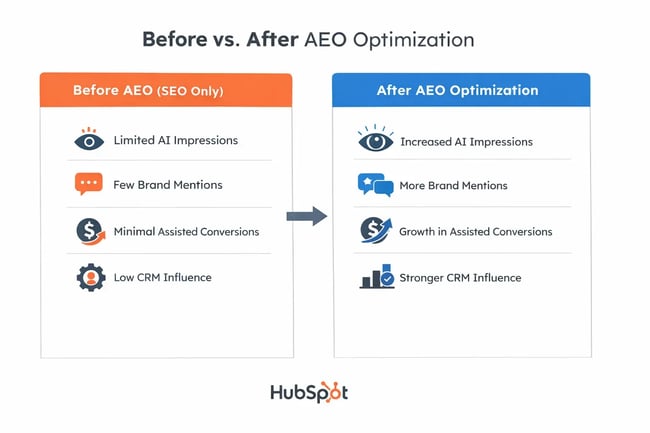
A consistent observation across recent AEO case studies is that visibility within AI-generated results often precedes significant increases in direct website traffic. Brands are experiencing earlier gains in AI citations, brand mentions, and what can be termed "assisted conversions" – instances where AI played a role in the customer journey before a direct click. This shift signifies a fundamental change in how users interact with information, moving from actively searching for keywords to passively receiving answers, with brands needing to be present and authoritative within those AI-generated summaries.
The metrics for success are also evolving. Pre-AEO, marketing efforts were primarily measured by traditional SEO metrics like search engine rankings and click-through rates. However, the advent of AEO necessitates a broader measurement framework. Marketers are now increasingly focused on AI Overview visibility, the frequency of brand citations in AI responses, and the influence of AI-driven touchpoints on customer relationship management (CRM) data. The value attributed to AI is shifting towards assisted deals, influenced revenue, and enhanced brand recall surfaced through generative answers, rather than solely relying on direct website visits.
The impact on sales is becoming increasingly apparent, albeit often indirectly. Agencies report a higher baseline brand familiarity during initial sales conversations, a reduction in fundamental "what do you do?" questions from prospects, and consequently, shorter evaluation cycles following an increase in AI citations. This aligns with the HubSpot report’s finding that over half of marketers see AI-referred visitors convert at higher rates than those from traditional organic traffic.
Answer Engine Optimization Case Studies: Proving AEO’s ROI
Answer Engine Optimization is proving to be a potent strategy for driving measurable ROI by enhancing brand visibility within AI-generated answers. This leads to the acquisition of higher-quality traffic and a stronger brand presence. The following case studies illustrate how companies across various industries have implemented AEO strategies to improve how AI systems interpret and cite their content, translating AI citations into tangible business outcomes.
Discovered: From 575 to 3,500+ Trials Per Month in 7 Weeks for a B2B SaaS
The story of Discovered, an organic search agency, and its client, a B2B SaaS company, exemplifies the dramatic impact of a well-executed AEO strategy. In just seven weeks, the agency achieved a remarkable six-fold increase in AI-referred trials, catapulting them from 575 to over 3,500 per month. This success underscores the potential for rapid and significant growth when a business prioritizes AI visibility.
The Before: The client, a company with a mature but stagnating SEO program, lacked a dedicated AEO strategy. This absence meant they were largely invisible within AI-generated answers, despite their strong online presence in traditional search. Potential buyers simply could not find them when seeking solutions via AI. The existing strategy’s focus on top-of-funnel informational content, which was not effectively converting, exacerbated the problem. An immediate, business-outcome-driven fix was imperative.
Execution Teardown: The AEO initiative commenced with a comprehensive technical SEO audit, augmented by an AI visibility audit. Critical issues were identified, including broken schema markup – a significant impediment to AI citations – duplicate content, and poor internal linking. Crucially, there was a complete absence of optimization for Large Language Models (LLMs).

Following the technical remediation, the focus shifted to content creation. Instead of their usual 8-10 monthly posts, Discovered published 66 AEO-optimized articles in the first month alone, targeting buyer-intent queries that LLMs were already addressing. The team employed a specific content framework designed to structure articles for AI consumption, prioritizing direct answers and clear, concise information. This framework included:
- Answer-First Structure: Beginning each article with a direct answer to the core query.
- Structured Data Implementation: Utilizing schema markup (e.g., FAQ, HowTo) to enhance machine readability.
- Question-Based Headings: Employing H2 and H3 tags that directly mirrored user queries.
- Concise Summaries: Providing brief overviews at the top of articles.
While the surge in AI citations within 72 hours of publishing this high-volume, buyer-intent content was significant, Discovered recognized the need to further solidify their client’s position as a top-of-mind solution for LLMs. To achieve this, they expanded their strategy beyond owned content and leveraged Reddit. Using established accounts, they strategically seeded helpful comments in relevant subreddits that were ranking highly for target discussions, effectively building trust signals and authority within AI’s trusted external sources.
The Results: The impact of this integrated AEO strategy was swift and substantial. Within a mere seven weeks, Discovered reported:
- 6x increase in AI-referred trials: Growing from 575 to over 3,500 trials per month.
- 2x increase in organic traffic: Indicating a positive spillover effect from improved AI visibility.
- 10% increase in conversion rate: Demonstrating the higher quality of AI-referred traffic.
- 4x increase in new MQLs (Marketing Qualified Leads): Directly attributable to AI discovery.
Apollo.io: Lifting Brand Citation Rate by 63% for AI Awareness Prompts
Brianna Chapman, who leads Reddit and community strategy at Apollo.io, spearheaded an initiative that significantly enhanced the company’s visibility in AI search, particularly for awareness and category-level prompts. Without altering their website content, Chapman leveraged Reddit as a primary information source for AI search engines, resulting in a 63% increase in brand citation rate for AI awareness prompts.
The Before: Chapman’s initial investigation into Apollo.io’s presence in AI search engines like ChatGPT, Perplexity, and Gemini revealed a critical mischaracterization. LLMs frequently positioned Apollo.io as "just a B2B data provider," overlooking its capabilities as a full sales engagement platform. Competitors were being cited for functionalities that Apollo.io possessed, and often executed with superior performance. The core issue stemmed from LLMs relying on outdated Reddit threads containing incomplete or inaccurate information, which, due to their crawlability, were treated as factual.
Execution Teardown: Chapman reframed AI visibility not as a purely technical SEO challenge, but as an exercise in narrative control. The objective was to proactively shape conversations in platforms that LLMs inherently trust, with Reddit being a prime example, without resorting to disingenuous tactics.
Her approach involved several key steps:
- Prompt Identification and Auditing: Chapman identified the most relevant prompts users were employing within LLMs and audited Apollo.io’s visibility across AI search engines for these prompts.
- Data Aggregation: She gathered first-party data from various sources, including customer feedback (Enterpret), social listening tools, and actual user prompts within Apollo.io’s AI Assistant. This yielded approximately 200 prompts per topic, such as:
- "What are the best sales engagement platforms?"
- "How to improve sales outreach efficiency?"
- "Top CRM for small businesses?"
- Citation Tracking: All identified prompts were tracked in AirOps to monitor Apollo.io’s citation frequency and identify areas of strength and weakness.
- Community Building and Content Seeding: Chapman established and actively managed the subreddit r/UseApolloIO, growing it to over 1,100 members with more than 33,400 content views in five months. A pivotal moment occurred when a detailed comparison post was published within r/UseApolloIO, outlining the advantages of choosing Apollo.io over competitors.
Within days, AirOps detected the new thread being indexed, and within a week, it had supplanted older, less informative content, resulting in over 3,000 new citations across key AI prompts.
The Results: The strategic use of Reddit as an AI information hub yielded significant improvements:
- 63% Brand Citation Rate for AI Awareness Prompts: A substantial increase in how often Apollo.io was mentioned in general AI discussions.
- 36% Brand Citation Rate for Category Prompts: Improved visibility for prompts related to sales engagement platforms.
- Increased Positive Reddit Sentiment: Leading to a more favorable brand perception.
- Boosted Beta Sign-ups and Demo Requests: Demonstrating a direct correlation between AI visibility and lead generation.
Broworks: Generating SQLs Directly from LLMs Post-AEO
Broworks, an enterprise Webflow development agency, explored a bold question: "Could we build a pipeline directly from AI tools, rather than solely relying on traditional search engines?" This inquiry led them to implement a comprehensive AEO optimization strategy across their entire website, ultimately enabling them to generate Sales Qualified Leads (SQLs) directly from LLMs.
The Before: While Broworks’ brand was occasionally cited in LLMs, these mentions lacked measurable business impact. There was no structured approach to influence AI-generated answers, and no clear attribution connecting AI-driven sessions to pipeline outcomes. This meant valuable AI interactions were going unmonetized.
Execution Teardown: Broworks identified schema markup as a foundational element for AEO. They implemented custom schema markup across key landing pages, case studies, and blog posts, including FAQ Schema, Article Schema, and Local Business and Organization Schema – all vital for LLM indexing.

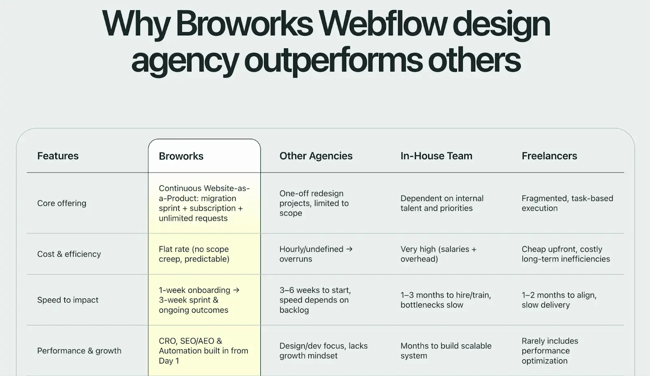
The agency also strategically incorporated comparison tables directly onto their landing pages. This provided AI systems with structured data for direct comparison, making it easier to extract and present information about Broworks’ services relative to competitors.
A critical second step involved aligning website content with prompt-driven search behavior. Instead of focusing on traditional keywords, Broworks optimized content around the actual questions users were posing to AI tools, such as: "Who is the best Webflow SEO agency for B2B SaaS?" They also integrated FAQ sections into most pages and provided concise summaries of key takeaways at the beginning of articles. Even their pricing page featured an FAQ section to address potential customer queries proactively.
The Results: Within three months of implementing their AEO strategy, Broworks observed tangible improvements in both their analytics and sales data:
- 70% increase in AI-referred leads: A significant surge in leads originating from AI interactions.
- 3x increase in AI-referred SQLs: Indicating that AI-generated leads were of higher quality and more likely to convert.
- $100,000+ in pipeline generated from AI discovery: A direct monetary impact attributed to their AEO efforts.
Furthermore, Broworks’ sales teams reported enhanced brand awareness among prospects and a reduction in the need for introductory conversations. Prospects arrived with a clearer understanding of the problem and potential solutions, thereby shortening qualification cycles.
Intercore Technologies: $2.34 Million in Revenue Attributed to AI Discovery
Intercore Technologies, a digital agency specializing in legal sector marketing, assisted a prominent Chicago personal injury firm in overcoming an "invisibility crisis" within AI search engines. Despite ranking #1 for "Chicago personal injury lawyer" and attracting over 15,000 monthly organic visitors, the firm’s lead volume had declined. The underlying issue was that the brand was not recognized by AI search engines, causing clients to be siphoned off to competitors who were more visible in AI-driven search queries.
The Before: The firm was virtually non-existent in AI search results. For the critical query "personal injury lawyer Chicago," it did not appear, even though competitors were cited 73% of the time. This lack of AI presence directly impacted their ability to attract new clients in a rapidly evolving search landscape.
Execution Teardown: Intercore Technologies approached AEO as a precision-driven endeavor, focusing on making the firm’s expertise legible and quotable for AI search engines evaluating legal intent. Their execution was structured around four key pillars:
- Entity Modeling: Establishing the firm as a distinct and authoritative entity in the AI’s knowledge graph. This involved clarifying its services, location, and areas of specialization.
- Content Structuring for AI Extraction: Rewriting and organizing website content to be easily digestible by AI. This included:
- Answer-First Content: Presenting direct answers to common legal queries upfront.
- Structured FAQs: Incorporating frequently asked questions and their concise answers.
- Comparison Tables: Directly comparing the firm’s services against competitors.
- Use of Entity Keywords: Integrating terms that AI systems associate with legal services and personal injury law.
- Schema Markup Enhancement: Implementing robust schema markup, including specialized legal schema, to provide AI with rich contextual information about the firm’s practice areas, attorney profiles, and case outcomes.
- External Signal Generation: Building authority and trust signals on platforms where AI systems actively source information. This involved:
- Building a dedicated Reddit community for legal discussions and firm insights.
- Contributing to Quora with expert answers to legal queries.
- Securing mentions and citations on reputable legal directories and industry publications.
The Results: The comprehensive AEO strategy yielded dramatic improvements in both AI visibility and revenue generation. AI visibility across platforms like ChatGPT, Perplexity, and Claude surged to 68%. This increased visibility directly translated into substantial revenue growth:
- $2.34 million in total revenue attributed to AI discovery over a six-month period.
- 68% increase in lead volume: A direct outcome of enhanced AI presence.
- 40% increase in conversion rate for AI-referred leads: Demonstrating the high quality and intent of these leads.
Key Takeaways for Implementing AEO
The case studies presented offer invaluable insights for developing a robust AEO strategy:
-
AI Visibility Compounds Before Traffic: Across all examples, AI citations, mentions, and brand awareness saw significant lifts weeks or months before any substantial changes in direct website traffic. This underscores the importance of treating AI visibility as a leading indicator of AEO success. Tools like HubSpot’s AEO Grader can help monitor this evolving landscape and identify content gaps that impact AI discovery.
-
Answer-First Content is Paramount: Content that prioritizes direct answers, summaries, and FAQs consistently outperforms traditional keyword-first content in AI citations. This approach flips the conventional SEO model by focusing on immediate clarity. By starting pages with direct answers, followed by supporting details, marketers can significantly increase the likelihood of their content being extracted and cited by AI systems.
-
Schema Markup is Non-Negotiable: Structured data is the foundation of machine-readable content, enabling AI systems to understand and cite web pages accurately. Implementing schema markup, including FAQ, HowTo, Product, Offer, Breadcrumb, and Organization schema, directly improves AI extraction and citation rates. Without it, even high-quality content risks being overlooked by LLMs due to parsing difficulties.
-
Narrative Control Extends Beyond On-Site Optimization: AEO success is not solely dependent on on-site optimization. LLMs draw from trusted external sources, making the management of a brand’s narrative on platforms like Reddit and Quora crucial. Actively shaping conversations in these communities by providing accurate and helpful content can significantly influence how AI systems perceive and recommend a brand.
-
Internal Linking to High-Intent Pages is Essential: Intentional internal linking signals context and relevance to AI systems. Connecting answer-first content to high-intent landing pages or product offers guides AI crawlers and ensures that AI-referred traffic moves efficiently through the conversion funnel. Descriptive anchor text that aligns with user queries is key to this process.
-
Page Speed is a Critical Factor: AI systems require fast and reliable access to content. Pages with slow load times (exceeding two seconds) may not be fully fetched or parsed by AI crawlers, limiting citations and visibility. Optimizing for page speed, particularly on mobile devices, is crucial for ensuring AI systems can reliably extract and cite content.
-
Question-Based Subheadings are Highly Effective: Using H2 and H3 tags that directly mirror user queries simplifies the process for AI systems to match content to user intent. Providing immediate answers below these headings ensures clarity and reduces the potential for misinterpretation by AI.
Conclusion
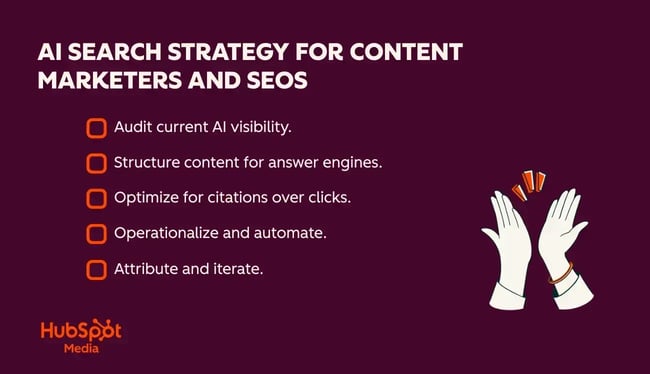
Answer Engine Optimization is no longer a fringe strategy but a critical growth lever for businesses seeking to thrive in the evolving digital landscape. By treating AI visibility as a primary objective rather than a byproduct of traditional SEO, marketers can unlock significant business impact. Tools like HubSpot Content Hub, which facilitate the creation of schema-ready, answer-first content, and visibility assessment tools like HubSpot’s AEO Grader, can accelerate AEO implementation and reduce guesswork, leading to faster iteration and more impactful results. As AI continues to shape consumer behavior, a proactive and strategic approach to Answer Engine Optimization will be paramount for sustained growth and competitive advantage.