Seth Rogen and Lauren Miller Rogen confront the complexities of the child-free life in their deeply personal new film Babies

The cinematic landscape has long been dominated by narratives centered on the nuclear family, typically culminating in the arrival of a child as the ultimate signifier of fulfillment. However, the new comedy-drama Babies, written and directed by Lauren Miller Rogen and starring Seth Rogen and Anna Kendrick, challenges this cultural script. Premiering at the Toronto International Film Festival (TIFF) at The Hollywood Reporter’s Studio at 1 Hotel, the film serves as a candid examination of the decision to remain child-free, drawn directly from the filmmakers’ own experiences.
A Decade in the Making: The Evolution of a Concept
The genesis of Babies dates back roughly ten years, triggered by a domestic shift in the Rogen household. A close friend of the couple—a divorced mother—moved in with them for a year, providing an intimate, front-row seat to the daily realities of single parenthood. For Lauren Miller Rogen, this period was not merely a living arrangement but a profound sociological study.
Initially, the project was envisioned as a television series. The premise—a couple navigating the ambiguity of their reproductive desires while cohabitating with a child—offered a rich vein of situational comedy and dramatic tension. Yet, the development stalled. As Miller Rogen explained during the TIFF press event, the project lacked a definitive resolution because her own life trajectory remained in flux. "I didn’t know the ending at that point," she noted.
The transition from a potential series to a feature film occurred only once the couple had reached a personal consensus regarding their own future. Following extensive internal dialogue and reflection, the narrative began to crystallize. The production timeline was remarkably efficient: the screenplay was drafted in January 2025, finalized by the spring, and moved into principal photography by the autumn of that same year.
The Anatomy of the Narrative
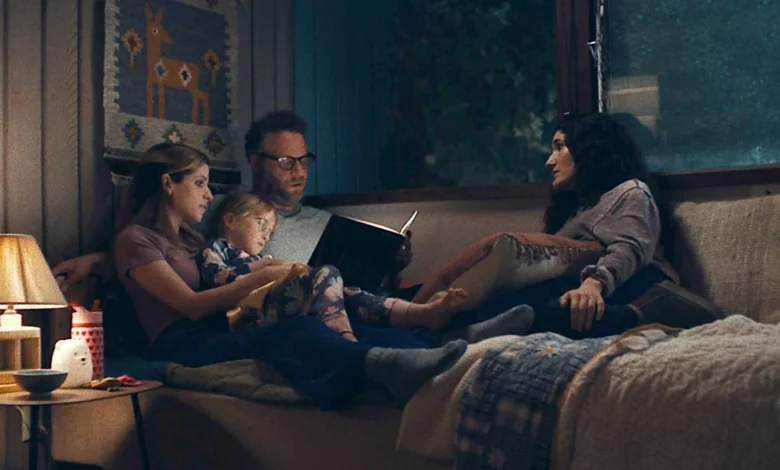
In the film, Seth Rogen and Anna Kendrick portray a happily married couple, Aaron and Annie—a subtle nod to the creators’ own middle names. The plot follows a familiar trajectory: their friend, played by Kate Berlant, moves in with her young daughter following a marital separation.
The film serves as a dual-track narrative. While the characters navigate the proximity of parenthood, the protagonist, Annie, simultaneously grapples with her mother’s battle with early-onset Alzheimer’s disease. This element is profoundly autobiographical, mirroring the 2020 passing of Miller Rogen’s mother due to complications from the same condition. By weaving these two experiences together, the film explores the weight of legacy, the fragility of life, and the differing ways individuals choose to spend their limited time on earth.
Shifting Cultural Demographics and the Child-Free Choice
The release of Babies arrives at a time when the decision to remain child-free is increasingly common yet remains socially contested. According to data from the Pew Research Center, the percentage of non-parents who say it is not too or not at all likely they will have children has seen a steady uptick over the last decade. Financial pressures, concerns regarding climate change, and a shifting cultural emphasis on individual autonomy have all contributed to this demographic shift.
Sociologists often point to the "parenting mandate"—the societal pressure to conform to the traditional family structure—as a primary source of anxiety for those who deviate from it. Seth Rogen’s critique of the term "dad duty" during the TIFF press conference highlights this tension. Rogen characterized the phrase as "obnoxious," arguing that it implies parenthood is a chore or a moral obligation rather than a chosen vocation.
"We hang out with our friends and their kids a lot," Rogen observed. "An interesting perspective the film has is that you can like kids and be good with them, be responsible, be in a happy marriage, and tick every box one would think you need to tick to be a perfect parent, and still just maybe not want it. That is a very under-shared perspective."
Performance and Vulnerability
For Anna Kendrick, stepping into the shoes of a character whose life so closely mirrors the director’s provided a unique challenge. Kendrick noted that the intensity of the subject matter, combined with the vulnerability required to portray those internal struggles, was daunting. She described the process as requiring a "dissociative" state, acknowledging that for an actor, playing a version of someone else’s life—particularly one involving grief and existential questioning—carries an inherent risk of emotional burnout.
The film’s reliance on the Rogens’ personal history serves to ground the comedy in reality. By avoiding the typical tropes of "child-free" characters—who are often depicted as selfish or immature in mainstream cinema—Babies attempts to offer a more nuanced portrayal. The film depicts the protagonists as responsible adults who have weighed the realities of child-rearing and concluded that it is not the path for them.
Broader Implications and Industry Reception
The industry’s reception of Babies suggests a growing appetite for stories that interrogate unconventional life choices. By positioning the film as a bridge between two worlds—those who choose parenthood and those who do not—Miller Rogen seeks to avoid alienating either demographic.
"We’ve been around our friends who have had beautiful families. We have amazing relationships with their kids," Miller Rogen stated. "I think it was about not just making the film feel real and grounded to us, but also honoring what we’ve witnessed so many times, and how beautiful that relationship is."
The film’s arrival in theaters in 2027 will likely spark further discourse on the "child-free" movement. Historically, films that touch on these themes are often relegated to the indie circuit, but with the star power of Rogen and Kendrick attached, Babies is poised to reach a broader, more mainstream audience. The impact of the film may extend beyond entertainment, potentially providing a validation point for those who feel their personal life choices are misunderstood or marginalized in mainstream media.
Conclusion: A Brave Exploration of Modern Life
The collaborative nature of Babies underscores a shift in how personal narratives are being handled in Hollywood. As creators increasingly pull from their own lives to inform their work, the line between art and autobiography continues to blur. Seth Rogen’s comment that he found it "shocking" how personal the film was serves as a testament to the courage required to translate such private internal debates into a public, cinematic experience.
As society continues to evolve, the definition of a "complete" life is becoming increasingly subjective. Babies does not attempt to declare that one path is superior to the other; rather, it makes the case for the validity of intentionality. By documenting their own journey—from the initial confusion of the early years to the clarity they have reached today—the Rogens have crafted a film that prioritizes honesty over traditional sentimentality. As the audience waits for the 2027 release, the anticipation remains high for a project that promises to treat the decision to remain child-free with the same gravity and complexity usually reserved for parenthood itself.