Securing Multi-Tenant Enterprise Kubernetes: How ReadyOn Built a Four-Layer Defense on Amazon EKS

Enterprise adoption of cloud-native infrastructure has accelerated dramatically over the past decade, yet the underlying security paradigms for shared environments continue to evolve. As organizations increasingly migrate mission-critical workloads to multi-tenant architectures, the challenge of maintaining absolute data isolation has taken center stage. ReadyOn, an Amazon Web Services (AWS) Partner specializing in intelligent labor orchestration for Fortune 100 enterprises, has confronted this architectural hurdle head-on. Managing a sophisticated multi-tenant platform on Amazon Elastic Kubernetes Service (Amazon EKS) that processes sensitive payroll records, complex organizational hierarchies, and large-scale operational analytics for hundreds of thousands of employees requires an exceptionally rigorous security posture.
The core vulnerability of standard container orchestration platforms lies in their out-of-the-box configuration. Historically, upstream Kubernetes permitted anonymous requests to reach the API server, defaulted to running pods as root, and lacked native network policies until explicitly defined by administrators. While hardening a single-tenant Kubernetes cluster remains a well-documented engineering challenge, introducing multi-tenancy fundamentally alters the underlying threat model. The primary security concern shifts dramatically from simply preventing unauthorized external access to ensuring strict lateral containment—specifically, guaranteeing that Tenant A can never under any circumstances access the data or compute resources of Tenant B.
Historically, many multi-tenant Kubernetes implementations have relied heavily on a single isolation mechanism: the namespace. However, Kubernetes architects never originally designed namespaces to function as an impenetrable security boundary. Recognizing that a cross-tenant data breach would trigger severe regulatory liabilities across multiple jurisdictions and irrevocably shatter enterprise client trust, ReadyOn’s engineering leadership determined that a single wall of defense was fundamentally insufficient. The company subsequently engineered a comprehensive, multi-layered architecture known as the "Four Walls" model, combining Kubernetes namespaces, Karpenter-managed dedicated node pools, Amazon Virtual Private Cloud (Amazon VPC) security groups, and per-tenant Amazon Aurora databases into a unified, compound defense system.
Background and Context of Enterprise Multi-Tenancy
The evolution of containerization has transformed how modern enterprises build and scale software applications. Kubernetes has emerged as the undisputed industry standard for orchestrating containerized workloads, offering unprecedented agility, resource efficiency, and scalability. However, these operational benefits traditionally came with complex security trade-offs. In shared enterprise environments, achieving strict multi-tenancy—where multiple distinct clients or internal business units share the same physical or virtual infrastructure cluster—has historically been fraught with peril.
In a default Kubernetes environment, the namespace acts primarily as a logical organizational tool rather than a hardened security sandbox. Shared control planes, common underlying node compute resources, and flat networking models frequently expose organizations to lateral movement risks. If a malicious actor or an automated exploit successfully compromises a single container within a shared cluster, they can often leverage vulnerabilities in the container runtime, kernel, or network policies to pivot across namespaces. For technology providers handling sensitive human resources, financial, and operational data for Fortune 100 corporations, such security gaps are completely untenable. Regulatory frameworks such as the General Data Protection Regulation (GDPR), the California Consumer Privacy Act (CCPA), and various global financial compliance mandates impose strict penalties for data commingling and unauthorized access.
ReadyOn’s Harmony platform operates at the bleeding edge of workforce intelligence. Processing payroll data and corporate organizational charts for massive global enterprises means the platform is a high-value target for sophisticated cyber threats. To neutralize these risks, ReadyOn moved away from relying on monolithic security boundaries and instead adopted a defense-in-depth philosophy rooted in AWS native primitives and advanced Kubernetes orchestration practices.
The Anatomy of the Four Walls Model
ReadyOn’s architectural framework establishes four independent, overlapping barriers between tenants. Each barrier operates at a distinctly different layer of the technology stack, requiring an attacker to employ fundamentally different techniques and exploits to breach each successive layer. This compound defense ensures that even if one layer experiences a security compromise, the remaining barriers hold firm.
Wall 1: Namespace Isolation and GitOps-Enforced Consistency
At the foundational layer, ReadyOn utilizes Kubernetes namespaces as the initial logical boundary. While acknowledging the inherent limitations of namespaces as standalone security barriers, ReadyOn treats them as the structural foundation upon which higher-level controls are built. To eliminate human error and configuration drift, the entire provisioning lifecycle is governed by an automated GitOps workflow powered by Argo CD.
When ReadyOn onboards a new enterprise tenant, engineers simply add a single entry to a centralized configuration manifest stored securely within a Git repository. Argo CD’s ApplicationSet controller automatically provisions all requisite resources, including the dedicated namespace, associated network policies, Role-Based Access Control (RBAC) bindings, resource quotas, and secret configurations. This automated pipeline ensures that there are no "legacy" tenants operating under older, weaker security policies; every single tenant receives an identical, hardened security posture by construction.
Furthermore, RBAC configurations strictly restrict API access, ensuring that tenant-specific principals can only interact with resources residing within their assigned namespace. An automated admission control framework evaluates all incoming resource configurations against rigorous policy sets, actively blocking privileged container configurations, preventing root execution, and prohibiting the creation of unauthorized cluster-wide resource types such as DaemonSets or ClusterRoles. To maintain state integrity, the GitOps controller continuously reconciles the live cluster state with the declared configuration in Git, automatically reverting any manual modifications or unauthorized alterations within seconds. In ReadyOn’s production environment, human operators never execute manual kubectl apply commands.
Wall 2: Compute Isolation via Karpenter
Moving downward from the Kubernetes API layer, Wall 2 addresses the physical and virtual compute layer—the underlying virtual machine instances where tenant code actually executes. In the Harmony architecture, tenants are strictly prohibited from sharing compute nodes.
ReadyOn utilizes Karpenter, a high-performance, flexible Kubernetes cluster autoscaler, to dynamically provision dedicated node pools governed by a rigorous dual-taint strategy. Every node created by Karpenter is assigned two specific taints: a tenant-identifier taint (e.g., tenant=acme-corp) and a workload-type taint (e.g., workload=frontend). Consequently, a pod must successfully tolerate both taints to be scheduled on a given node. This ensures that Tenant A’s frontend workloads are physically separated from Tenant A’s batch processing nodes, and both are entirely isolated from Tenant B’s underlying infrastructure.
Even if a malicious actor attempts to deploy a pod with forged tolerations, an advanced admission controller intercepts the request, cross-referencing the requested tolerations against the namespace’s verified tenant identity to prevent unauthorized cross-tenant scheduling. Additionally, all application nodes strictly enforce Instance Metadata Service Version 2 (IMDSv2) with a reduced hop limit, effectively preventing containerized applications from querying the instance metadata endpoint. The AWS Identity and Access Management (IAM) role attached to each node is scrupulously scoped to a single tenant’s resources, limiting the potential blast radius of any theoretical container escape.
Wall 3: Network Isolation at the Amazon VPC Layer
While Walls 1 and 2 operate primarily within the abstractions of Kubernetes, Wall 3 drops below the container orchestrator entirely, enforcing strict network boundaries at the Amazon VPC and security group levels. This infrastructure is managed directly by AWS and remains entirely out of reach of the Kubernetes control plane or compromised container pods.
Every tenant’s dedicated Amazon Aurora database cluster is protected by an exclusive Amazon VPC security group that permits inbound TCP connections solely from the security group specifically attached to that exact tenant’s application worker nodes. As a result, Tenant A’s compute nodes are physically incapable of opening a network socket to Tenant B’s database. This network-level rule is enforced by the underlying AWS software-defined network, meaning an attacker would need to subvert the AWS networking layer itself to bypass this control.
The VPC architecture is rigorously segmented into four distinct tiers:
- Public Perimeter Tier: Houses exclusively public-facing load balancers.
- Application Tier: Contains EKS worker nodes operating securely within private subnets.
- Database Tier: Comprises dedicated Amazon Aurora database clusters completely isolated from internet access.
- Control Plane Tier: Enforces private EKS API endpoints accessible exclusively via secure VPN connections authenticated through OIDC and multi-factor authentication (MFA).
Additionally, Kubernetes network policies enforce a strict default-deny posture for all inter-namespace traffic. Tenant pods are restricted to communicating solely with pods residing within their own namespace and explicitly approved, whitelisted platform services. All unauthorized network traffic is summarily dropped and logged, while Amazon VPC Flow Logs continuously capture network telemetry for anomaly detection.
Wall 4: Data Isolation with Amazon Aurora and IAM
The final and most critical barrier addresses the ultimate target of any malicious actor: the enterprise data itself. While Walls 1 through 3 are designed to prevent unauthorized traversal across the network and compute layers, Wall 4 ensures absolute data containment even if all preceding perimeter defenses were somehow breached.
Many multi-tenant architectures rely on a shared database model, placing the entire burden of data isolation on application-layer query logic. In such environments, a single developer oversight—such as a missing WHERE tenant_id = ? SQL clause—can result in catastrophic cross-tenant data exposure. ReadyOn completely eliminates this risk by provisioning dedicated, isolated Amazon Aurora database clusters for every individual tenant. Because there is no shared database, there are no row-level security filters to accidentally omit. Tenant A’s application code cannot even formulate a connection string to Tenant B’s database, as it lacks the required database endpoint, credentials, and network path.
Furthermore, dedicated Aurora clusters enable the utilization of unique AWS Key Management Service (AWS KMS) encryption keys per tenant. Data at rest for each tenant is encrypted using a distinct, customer-managed KMS key. Consequently, even in the highly improbable scenario of raw storage media being inadvertently exposed, one tenant’s cryptographic key cannot decrypt another tenant’s files.
To govern interactions with AWS services, ReadyOn implements IAM Roles for Service Accounts (IRSA), completely eliminating long-lived workload credentials. Workloads authenticate to AWS APIs using short-lived, cryptographically secure credentials issued dynamically by the AWS Security Token Service (AWS STS) via OIDC federation between the EKS cluster and IAM. Each tenant’s workloads assume a uniquely scoped IAM role with permissions restricted strictly to that tenant’s designated resources. These credentials expire within minutes, ensuring that application pods hold no persistent access keys that could be harvested and exploited later. Similarly, all tenant metrics, logs, and traces are strictly segregated and routed to dedicated observability backends via OpenTelemetry, ensuring that operational telemetry remains entirely private.
Threat Modeling and Adversarial Validation
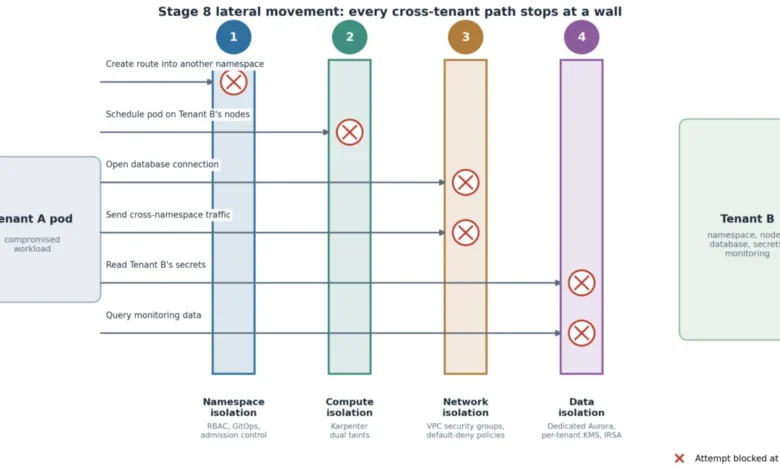
To rigorously evaluate the resilience of this multi-layered architecture, ReadyOn maps its security controls directly against its internal 10-stage multi-tenant threat model, aligning each stage with corresponding MITRE ATT&CK techniques. The critical inflection point within this model occurs at Stage 8: Lateral Movement. In this simulated scenario, an unauthorized user who has successfully compromised a low-privileged pod within Tenant A attempts to pivot and access the resources of Tenant B.
ReadyOn’s empirical threat modeling demonstrates that an unauthorized process attempting lateral movement faces an insurmountable wall at every single stage:
- Namespace Boundary: Attempting to forge API requests or establish routes into another Kubernetes namespace is instantly intercepted and blocked by RBAC and admission controllers (Wall 1).
- Compute Boundary: Attempting to schedule malicious workloads or pivot onto compute nodes belonging to another tenant fails due to Karpenter’s strict dual-taint scheduler validation (Wall 2).
- Network Boundary: Attempting to initiate cross-namespace TCP traffic or open database connections to another tenant’s infrastructure is blocked by default-deny network policies and Amazon VPC security groups (Wall 3).
- Data Boundary: Attempting to query database tables or retrieve stored secrets associated with another tenant fails completely due to dedicated database endpoints, isolated AWS KMS encryption keys, and strictly scoped IRSA permissions (Wall 4).
To ensure continuous security validation, ReadyOn routinely conducts aggressive adversarial red-team exercises. During these simulated security audits, engineers assume complete administrative control over a compromised tenant pod and attempt every conceivable lateral movement path across the cluster infrastructure. To date, internal testing reports a 100% success rate in containment, with zero adversarial simulations succeeding in crossing tenant boundaries.
Workload Hardening and Operational Implications
Beyond architectural isolation, ReadyOn enforces stringent workload hardening at the container runtime level. Every container deployed within the Harmony platform strictly adheres to the Kubernetes Pod Security Standards at the "restricted" profile level. Containers are explicitly configured to run as non-root users, disallow privilege escalation, mount their root filesystems as read-only, drop all Linux capabilities by default, and enforce default seccomp security profiles. These rigorous constraints prevent containerized applications from installing unauthorized software binaries, modifying system files, or exploiting kernel interfaces commonly required for container escape exploits.
The integration of GitOps as the primary security control plane further guarantees operational integrity. Because cluster state is entirely declared within version-controlled repositories, any configuration drift or malicious tampering is immediately identified and neutralized. Furthermore, the complete absence of static secrets within Git repositories—handled dynamically via the External Secrets Operator interacting with AWS Secrets Manager—ensures that even a compromised code repository yields zero usable credentials.
Industry Implications and Future Outlook
The architectural blueprint established by ReadyOn offers significant implications for the broader cloud-native software industry. As enterprises increasingly demand the cost efficiencies and operational agility of multi-tenant SaaS platforms without compromising on security compliance, traditional single-layer isolation models are proving increasingly inadequate.
By demonstrating that robust defense-in-depth can be successfully engineered on Amazon EKS through the intelligent combination of native AWS services and advanced Kubernetes orchestration tools, ReadyOn provides a valuable reference architecture for organizations handling sensitive enterprise data. The Four Walls model proves that strict zero-trust tenant isolation is not only achievable at scale, but can be implemented without sacrificing the performance, scalability, and economic benefits that modern cloud infrastructure delivers. As regulatory scrutiny intensifies globally, architectures that treat security as a compound, multi-layered continuum rather than a single perimeter wall will undoubtedly become the benchmark for enterprise software engineering.
Related posts: