RefluXFS Vulnerability Disclosed in Linux Kernel XFS Implementation Exposes Enterprise Systems to Local Root Privilege Escalation Risks

Cybersecurity researchers have identified a critical security flaw within the Linux kernel’s XFS filesystem implementation that could allow a local, unprivileged user to obtain full administrative control over a target system. Disclosed on July 22 and tracked under the identifier CVE-2026-64600, the vulnerability—dubbed "RefluXFS" by the discovery team at Qualys—stems from a complex race condition in how the kernel manages file mappings during copy-on-write operations. By exploiting this flaw, an attacker can bypass standard file permissions to overwrite root-owned files, effectively granting them persistent root access. The vulnerability is particularly significant due to its presence in default installations of several major enterprise Linux distributions, including Red Hat Enterprise Linux (RHEL), Fedora Server, and Amazon Linux, where XFS is frequently utilized as the primary filesystem.
The technical core of the RefluXFS vulnerability lies in the interaction between XFS "reflinks" and direct I/O operations. Reflinking is a storage-saving feature that allows multiple files to share the same physical data blocks on a disk until one of them is modified, at which point a "copy-on-write" (CoW) operation occurs. The researchers found that a stale mapping error occurs when the kernel attempts to fill a CoW "hole" while the filesystem’s internal locks are momentarily cycled. This brief window of time allows a secondary, malicious process to manipulate the file mapping, leading the kernel to mistakenly write attacker-controlled data into a block belonging to a protected system file. Because this overwrite occurs at the block layer, it bypasses the standard security checks associated with the target file’s inode, meaning the file’s ownership, timestamps, and security bits—such as the setuid bit—remain entirely unchanged.
The Mechanics of the Stale Mapping Race
To understand the severity of CVE-2026-64600, one must examine the specific sequence of operations within the XFS driver. An attacker begins the process by creating a "clone" of a sensitive, root-owned file—such as the system password file or a high-privilege binary—using the FICLONE ioctl. This operation requires only read access to the source file, a permission typically granted to all users for files like /etc/passwd. Once the clone is created, both the original file and the attacker’s scratch file point to the same physical disk blocks.
The exploitation phase involves a high-speed race. The attacker initiates a write operation using the O_DIRECT flag against their cloned file. During this process, the Linux kernel must determine where the data should be written. It reads the data-fork mapping under an internal lock known as the ILOCK. However, to reserve the necessary transaction space for the write, the kernel must temporarily release and then reacquire this lock within the xfs_reflink_fill_cow_hole() function. In the microsecond gap where the lock is released, a second thread controlled by the attacker can complete a separate write, causing the filesystem to remap the cloned file to a new block.

When the original thread reacquires the lock, it fails to realize that the block address it previously captured is now "stale." It continues the write operation using the old address, which still points to the physical block occupied by the original, protected root file. Consequently, the attacker’s data is written directly into the root-owned file on disk. This is a classic Time-of-Check to Time-of-Use (TOCTOU) error, but one occurring at a deep level within the kernel’s filesystem logic. Because the write is performed via direct I/O, it skips the system’s page cache and avoids any secondary validation hooks, leaving no trace in system logs or kernel warnings.
Distribution Impact and Exposure Criteria
The RefluXFS vulnerability does not affect all Linux systems equally, as its exploitation depends on specific filesystem configurations. According to the Qualys advisory, three primary conditions must be met for a system to be vulnerable: the system must be running an affected kernel version (ranging from 4.11 to the recently patched versions), the filesystem must be XFS with reflink support enabled, and an attacker must have the ability to run local code.
The default configurations of several prominent distributions meet these criteria out of the box. Red Hat Enterprise Linux 8, 9, and 10 utilize XFS with reflinks enabled by default for their root partitions. Similarly, CentOS Stream, Oracle Linux, Rocky Linux, and AlmaLinux are affected. Fedora Server versions 31 and later, as well as Amazon Linux 2 and Amazon Linux 2023, also fall within the danger zone. In contrast, distributions that typically favor the ext4 or Btrfs filesystems, such as Debian, Ubuntu, and openSUSE, are only vulnerable if a system administrator manually chose XFS with reflink support during the installation process.
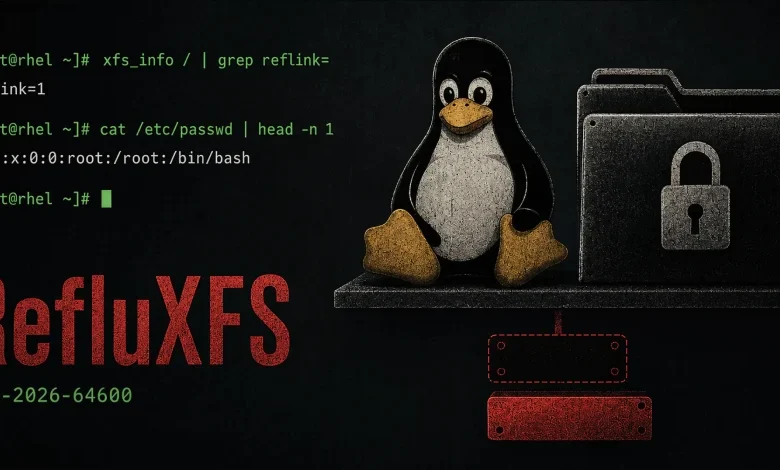
To assist administrators in assessing their risk, researchers have provided a simple command-line check. By running xfs_info / | grep reflink=, users can determine if their root filesystem is susceptible. A result of reflink=1 indicates that the necessary filesystem features are active. This check should be performed on any mounted volume where untrusted users have write access to directories, as the vulnerability can be used to pivot from a shared data partition to sensitive system files if they reside on the same filesystem.
Chronology of Discovery and the Role of Artificial Intelligence
The discovery of CVE-2026-64600 marks a notable milestone in the evolution of vulnerability research. Qualys revealed that the flaw was initially identified not by human manual auditing alone, but through the assistance of an advanced AI model. The research team utilized "Claude Mythos Preview," a restricted-access frontier model from Anthropic, and tasked it with analyzing the Linux kernel source code for vulnerabilities reminiscent of the famous "Dirty COW" exploit from 2016.

The AI model was able to pinpoint the specific lock-cycling pattern in the XFS drivers that led to the stale mapping. Furthermore, the model assisted in drafting the initial technical advisory and conceptualizing the race condition strategy. Following the AI’s lead, human researchers at Qualys verified the logic, developed a working proof-of-concept on a standard Fedora Server 44 installation, and initiated the coordinated disclosure process with the Linux kernel maintainers.
The timeline of the disclosure indicates a rapid response from the open-source community. The flaw was reportedly auto-imported into Red Hat’s bug tracking system on July 10, initially categorized as a potential data corruption issue. By July 14, Red Hat began issuing kernel updates for various RHEL streams. The official upstream patch was merged into the Linux kernel on July 16, with a "Fixes" tag pointing back to a commit from 2017, confirming that the bug had remained latent in the kernel for nearly nine years. The public disclosure and the assignment of the RefluXFS name followed on July 22, once the primary vendors had their patches ready for distribution.
Vendor Responses and Mitigation Challenges
In the wake of the disclosure, major Linux vendors have moved quickly to release errata. Red Hat has classified the vulnerability as "Important," issuing multiple security advisories (including RHSA-2026:39179 and RHSA-2026:39494) covering its active RHEL releases. Amazon and the developers of various RHEL derivatives have followed suit, shipping backported kernels to their respective repositories. Debian’s security tracker indicates that fixes have been integrated into the unstable and testing branches, though some older stable versions may still be awaiting updates.
One of the most concerning aspects of RefluXFS is the lack of effective temporary mitigations. Unlike some kernel vulnerabilities that can be mitigated by disabling a specific module or changing a sysctl parameter, the reflink functionality in XFS cannot be disabled once a filesystem has been created. Researchers tested several common security frameworks, including SELinux in Enforcing mode, seccomp filters, and kernel lockdown modes, and found that none were able to prevent the exploitation of this block-layer race. Furthermore, because the vulnerability involves legitimate filesystem operations rather than memory corruption, standard protections like Kernel Address Space Layout Randomization (KASLR) or Supervisor Mode Execution Protection (SMEP) are ineffective.
The only definitive protection against RefluXFS is the application of the official kernel patches followed by a full system reboot. Security experts emphasize that simply installing the updated kernel package is insufficient, as the vulnerable code remains active in the system’s memory until the machine is restarted.

Broader Implications for Linux Security
The discovery of CVE-2026-64600 highlights the ongoing challenges of securing complex filesystem drivers within the Linux kernel. As filesystems like XFS add advanced features to meet the demands of modern data centers—such as reflinks, deduplication, and sophisticated copy-on-write mechanisms—the attack surface grows accordingly. The fact that RefluXFS persisted for nearly a decade underscores the difficulty of identifying race conditions in code that involves intricate locking hierarchies and asynchronous I/O.
Moreover, the successful use of an AI model to discover a high-impact kernel vulnerability suggests a shifting landscape for both defenders and attackers. While AI can act as a force multiplier for security researchers seeking to harden open-source software, it also lowers the barrier for finding deep-seated logic flaws that were previously the sole domain of expert kernel developers.
For enterprise environments, RefluXFS serves as a reminder of the risks inherent in multi-tenant systems. Whether in a cloud environment where multiple users share a single host or a corporate server running diverse workloads, the ability for a local user to escalate privileges to root remains one of the most critical threats to system integrity. As of the time of reporting, there have been no confirmed instances of RefluXFS being exploited in the wild, but the availability of detailed technical descriptions in the oss-security mailing lists means that administrators must act with urgency to secure their infrastructure.
The RefluXFS incident reinforces a fundamental tenet of system administration: the importance of timely patching and the necessity of reboots in the maintenance of a secure Linux environment. As the industry continues to digest the implications of AI-driven vulnerability research, the focus remains on the rapid deployment of these critical kernel updates to mitigate the risk of local privilege escalation.
Related posts: