Introducing enhanced custom event buses in Amazon EventBridge for enterprise-scale event-driven applications | Amazon Web Services

The Evolution of Event-Driven Scaling
For years, organizations adopting serverless architectures on AWS have relied on Amazon EventBridge as the primary orchestrator for decoupling microservices. Typically, these architectures begin with a single, custom event bus housed within a single account. However, as cloud maturity grows, industry best practices dictate a shift toward multi-account structures to enforce security boundaries and resource isolation.
In this multi-account paradigm, organizations previously faced a "routing tax." Teams were required to configure intricate cross-account rules or link multiple buses together, creating a web of dependencies that often resulted in operational fatigue. This legacy approach created visibility gaps, as platform teams struggled to track which downstream services were consuming specific events, and led to compounding costs due to redundant routing configurations. Furthermore, the lack of native event ordering meant developers often had to integrate additional technologies—such as Amazon SQS or custom state-management logic—to ensure data integrity, thereby defeating the primary purpose of a lean, event-driven model.
Chronology of the Enhanced Custom Event Bus
The release of the enhanced custom event bus marks a pivotal milestone in the lifecycle of Amazon EventBridge, which has evolved from a simple rules engine to a sophisticated event-bus backbone. The timeline of this progression reflects the increasing demand for enterprise-grade features in serverless systems:

- 2019: AWS rebrands CloudWatch Events as Amazon EventBridge, introducing the ability to ingest events from SaaS applications and custom sources.
- 2020–2022: AWS introduces features such as event replay, schema registry, and API destinations, solidifying EventBridge as a critical integration layer.
- 2023–2025: As multi-account adoption surges, the operational complexity of managing "bus-to-bus" connections becomes a common pain point for DevOps and platform engineering teams.
- September 2026: AWS officially unveils the enhanced custom event bus, addressing the scaling bottlenecks through unified cross-account sharing via AWS Resource Access Manager (RAM).
Technical Innovations: Ordering, Deduplication, and Delivery
The new enhanced custom event bus introduces three technical pillars designed to resolve the most common friction points in distributed systems:
1. Deterministic Event Ordering:
By implementing the EventGroupId parameter, developers can now enforce sequential processing. This is a critical requirement for industries such as logistics, finance, and healthcare, where the order of operations—such as updating a balance or tracking a shipment’s physical location—is non-negotiable. The bus now supports synchronous invocation for targets like AWS Lambda, allowing for a confirmation-based delivery model that eliminates the need for intermediary queueing services in many use cases.
2. Intelligent Deduplication and Content-Based Transformation:
The platform now includes native content-based deduplication, which automatically drops duplicate events within a five-minute window. This provides "exactly-once" delivery semantics, a major departure from the standard "at-least-once" model, providing developers with cleaner data streams. Additionally, the integration of JSONata for event shaping allows teams to modify payloads on the fly, ensuring compatibility between diverse producer and consumer schemas without requiring custom middleware.
3. The Subscriber Resource Model:
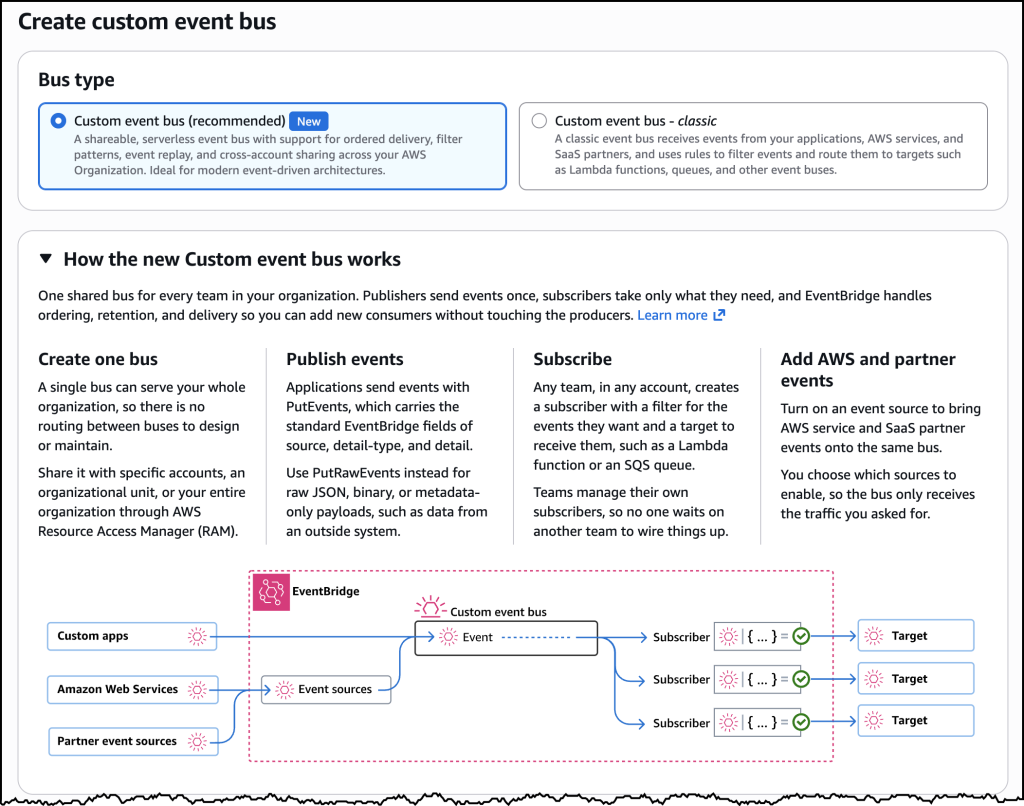
Perhaps the most significant structural change is the transition from individual rules to a consolidated "Subscriber" object. A single Subscriber resource now encapsulates filtering, target configuration, retry policies, and dead-letter queue (DLQ) definitions. By treating the subscriber as a first-class citizen, AWS has simplified the management of complex, multi-subscriber event topologies.

Economic Implications and Cost Allocation
A primary driver for this update is the need for more predictable cost structures. Under the previous model, cross-account and inter-bus routing incurred separate charges, which could lead to "bill shock" as an organization’s event volume scaled. The new pricing model shifts the focus to throughput-based ingress and egress, with publishers paying for ingested events and subscribers paying for delivered events.
This shift simplifies cost allocation for CFOs and platform leads. Because a single bus can now support up to 10,000 subscribers—a massive increase from previous fragmentation limits—organizations can consolidate their infrastructure. This consolidation reduces the number of administrative resources needed to manage cross-account permissions, effectively lowering the Total Cost of Ownership (TCO) for event-driven systems.
Industry Context and Strategic Analysis
Market analysts note that this release positions AWS to better compete with specialized event-streaming platforms that have historically touted superior ordering and deduplication capabilities. By baking these features into the core EventBridge offering, AWS effectively lowers the barrier to entry for developers who require high-consistency systems but prefer to remain within the serverless, managed-service ecosystem.
From an organizational perspective, the ability to share buses across AWS accounts using RAM aligns with the "Platform Engineering" trend. It enables a "self-service" culture where publishers can emit events to a central backbone, and downstream teams can subscribe to what they need without requiring platform-team intervention to configure complex IAM policies or cross-account connections.
Operational Impact
For platform teams, the transition to the enhanced bus is designed to be gradual. The "Classic" custom event bus remains fully supported, allowing existing workloads to persist without modification. However, the operational benefits—such as centralized visibility, simplified management via the Subscriber resource, and the elimination of custom workaround code—are expected to drive rapid adoption among new greenfield projects.
With availability spanning multiple global regions, including US East, US West, Europe, and Asia Pacific, AWS has provided a broad launch platform. Developers can begin leveraging these features immediately via the AWS Management Console, CLI, or API. As organizations continue to migrate from monolithic architectures to granular, event-driven microservices, the ability to maintain order, integrity, and cost-efficiency at scale will be the defining factor in successful cloud-native delivery.
The enhanced custom event bus represents more than a feature update; it is an acknowledgment of the complexity inherent in modern cloud environments. By moving the burden of orchestration from the developer to the platform, AWS is signaling a new phase in serverless computing where architectural scale no longer requires a sacrifice in operational simplicity. As organizations continue to iterate, the ability to rely on a robust, ordered, and unified event backbone will likely become a standard component of the modern enterprise tech stack.