How Rakbank Modernized Its Retail Digital Banking Observability Platform to Achieve 55 Percent Cost Savings with Amazon OpenSearch Service

The demand for high-performance, resilient, and secure digital banking infrastructure has accelerated dramatically across the global financial sector. As financial institutions migrate core workloads to cloud-native environments, the volume of operational telemetry generated by containerized microservices has surged, presenting unprecedented challenges in log management, compliance storage, and cost control. National Bank of Ras Al Khaimah (Rakbank), one of the prominent financial institutions in the United Arab Emirates, faced this exact architectural challenge as its retail digital banking platform experienced a massive expansion in data ingestion. To address these operational hurdles, Rakbank re-engineered its centralized observability platform using a cross-account, Multi-Availability Zone (Multi-AZ) Amazon OpenSearch Service architecture. By leveraging intelligent hot, warm, and cold storage tiering, the institution successfully ingested approximately 150 GB of daily telemetry while realizing roughly 55 percent in cost savings compared to traditional all-hot cluster topologies.
Background Context and Evolution of the Workload Profile
Rakbank’s retail digital banking ecosystem operates on Amazon Elastic Kubernetes Service (Amazon EKS) utilizing containerized microservices. Before the architectural transformation, the platform generated a modest 5 GB of logs per day. However, rapid digital adoption, expanding customer bases, and the introduction of new financial products drove daily log generation to approximately 150 GB per day. This exponential growth meant that over a standard 60-day operational window, the platform accumulated roughly 9 TB of data within OpenSearch Service, with the most recent 30 days kept directly searchable for active troubleshooting and real-time operational alerts.
Compounding the ingestion volume are rigorous regulatory mandates. The Central Bank of the UAE (CBUAE) and Rakbank’s internal data-retention governance frameworks require financial institutions to securely archive transaction and operational logs for a period of seven years. At an average intake of 150 GB daily, the platform archives approximately 54 TB of log data annually, culminating in roughly 383 TB of historical data retained over the mandatory seven-year lifecycle. Despite these heavy data volumes, user consumption patterns remain focused: approximately 25 dashboards serve about 25 concurrent operational and technical users.
A critical property of the telemetry data is its append-only nature. Once a log document is written to the index, it is never modified or deleted, eliminating the performance overhead typically associated with update-by-query operations. Furthermore, this append-only behavior allows engineers to perform a force-merge on indices down to a single segment per shard prior to warm migration, maximizing storage efficiency without incurring update penalties as logs transition through the infrastructure tiers.
Telemetry Pipeline and Cross-Account Topology
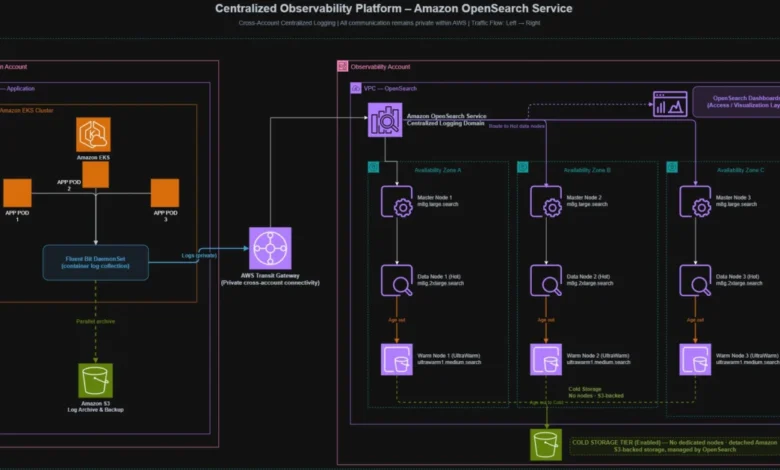
To maintain architectural cleanliness, security, and operational isolation, Rakbank implemented an "instrument once, standardize everywhere" model using Fluent Bit across all banking domains, including retail, business, and wholesale banking. The architecture deliberately separates the containerized application workloads from the centralized observability plane by utilizing a strict two-account security model: the Application account and the Observability account.
Within the Application account, application pods running on Amazon EKS deploy a Fluent Bit DaemonSet that collects logs at the source. This telemetry data is dispatched simultaneously along two paths: a primary stream routed privately over an AWS Transit Gateway to the Observability account, and a parallel stream archived directly to an Amazon Simple Storage Service (Amazon S3) log archive and backup bucket equipped with S3 Object Lock for strict write-once-read-many (WORM) regulatory immutability.
The Observability account houses the centralized Amazon OpenSearch Service domain, which spans three Availability Zones (Multi-AZ) to ensure high availability and resilience. Network communication between the application VPC and the observability VPC remains entirely within the AWS global network via the Transit Gateway, ensuring that no sensitive operational traffic ever traverses the public internet. Access controls are rigorously enforced at the VPC perimeter using security groups and network ACLs that permit only mandatory HTTPS (port 443) ingress traffic.
Granular Cluster Topology and Storage Tiering Strategies
To balance high-performance querying with long-term cost optimization, Rakbank deployed a heterogeneous node configuration across its three Availability Zones. The infrastructure utilizes AWS Graviton-based (m8g) instance families, known for delivering exceptional price-to-performance ratios for cloud workloads.
The cluster topology per Availability Zone incorporates dedicated cluster-manager nodes utilizing m8g.large.search instances to manage cluster state and shard allocation without bearing any data processing loads. Hot data nodes utilize m8g.2xlarge.search instances backed by high-performance Amazon Elastic Block Store (Amazon EBS gp3) volumes, maintaining the most recent 0 to 15 days of data for real-time dashboards, active troubleshooting, and alerting integrations via email and Microsoft Teams.
As indices age beyond the active window, automated Index State Management (ISM) policies migrate them into the UltraWarm tier, which utilizes ultrawarm1.medium.search instances backed by Amazon S3 with local caching. Spanning the 15- to 30-day retention bracket, the UltraWarm tier provides read-only historical analysis capabilities at a significantly reduced cost. For data aging between 30 and 60 days, indices transition into a cold storage tier that is entirely node-free, leveraging detached Amazon S3 storage with zero compute costs at rest. When historical data requires investigation, these cold indices can be dynamically attached back to the UltraWarm tier on demand.
Identity Management and Cross-Account Authorization
Security governance across the multi-account architecture relies on a multi-layered model encompassing network isolation, resource-based access policies, and fine-grained access control (FGAC). End-user authentication for OpenSearch Service Dashboards is integrated with Rakbank’s corporate Active Directory via Security Assertion Markup Language (SAML) 2.0 single sign-on. This federation ensures that user permissions align directly with corporate identities and group memberships without requiring standalone credentials within OpenSearch Service.
Concurrently, log ingestion pathways from the application account are authorized via distinct, least-privilege AWS Identity and Access Management (IAM) roles. By decoupling the write path from the read path, Rakbank maintains strict operational boundaries, ensuring that automated telemetry ingestion processes operate independently of human user queries and administrative sessions.
Financial Implications and Comparative Cost Analysis
When planning the production sizing of the observability platform, Rakbank evaluated a target ingestion of 150 GB per day with headroom capable of absorbing 200 GB peak daily spikes over a 60-day operational retention window. The bank compared two distinct architectural approaches: an all-hot cluster topology versus the recommended hot, warm, and cold tiered model.
In an all-hot cluster configuration, maintaining the entire 9 TB active working set across high-performance compute and EBS storage resulted in prohibitive operational expenditures. Conversely, the implementation of OpenSearch Service multi-tier storage recognized that the vast majority of historical log data experiences negligible query frequency after the initial two weeks of operation. By offloading aging indices to S3-backed UltraWarm and cold tiers, Rakbank successfully eliminated the need to provision expensive hot node capacity for archival data, achieving an approximate 55 percent reduction in total infrastructure costs compared to an all-hot deployment. These savings are further optimized through the inherent durability of Amazon S3, which allows the warm and cold tiers to operate with zero secondary replicas while maintaining high availability.
Resilience, High Availability, and Operational Trade-Offs
Rakbank’s deployment operates within a Multi-AZ framework that provides robust out-of-the-box availability and automatic failover capabilities. When evaluating high-availability configurations, engineering teams weighed the standard Multi-AZ deployment against the Multi-AZ with Standby option. While Multi-AZ with Standby offers an elevated Service Level Agreement (SLA) of 99.99 percent with automated failover in under one minute, it reserves one-third of the data node capacity exclusively for standby failover, reducing active search capacity by 33 percent and mandating a minimum of two index replicas.
To maximize active computing resources for real-time telemetry querying, Rakbank elected to run its production domain in a standard Multi-AZ configuration across three data nodes with replica shards distributed across Availability Zones. This design achieves high resilience and a reliable 99.9% SLA without sacrificing active query performance or incurring unnecessary storage overhead.
Future Outlook and AI-Driven Observability Integration
As the digital banking platform continues to mature, Rakbank is actively evaluating advanced machine learning and agent-driven capabilities natively supported by Amazon OpenSearch Service. These emerging features include vector search capabilities, neural search models, and automated anomaly detection algorithms designed to layer on top of the existing tiered storage architecture. By integrating AI-powered observability, the institution aims to transition from reactive troubleshooting to predictive operational intelligence.
Outcomes and Engineering Lessons Learned
The successful deployment of the standardized Fluent Bit and OpenSearch Service architecture has delivered profound operational benefits across Rakbank’s organizational structure. Support operations teams benefit from accelerated incident triage and guided troubleshooting workflows, while software engineering teams utilize centralized logs for rapid root-cause analysis across complex microservice call paths. Concurrently, executive and business stakeholders leverage actionable telemetry insights to monitor customer journey trends and platform performance.
Through successive platform upgrades, Rakbank has recorded significant latency improvements, achieving single-digit-millisecond response times for both lexical and complex vector queries. Key engineering takeaways from the implementation emphasize the critical importance of enforcing telemetry standards early through tools like Fluent Bit, decoupling application accounts from observability planes via private transit networking, and leveraging automated index lifecycle management policies to align data value with appropriate storage costs. As financial institutions increasingly navigate the complexities of cloud-native scale, Rakbank’s observability framework serves as a scalable benchmark for balancing high-volume telemetry ingestion, stringent regulatory compliance, and fiscal prudence.