How Mux Rebuilt Its Sales Strategy by Automating Hyper-Personalized Product Demos Using Web Scraping and AI

For decades, the software-as-a-service (SaaS) industry has relied on a standard, albeit flawed, playbook for customer acquisition: the generic product demonstration. Sales teams worldwide have dutifully walked prospective clients through feature lists, pre-recorded dashboard walkthroughs, and idealized sandbox environments. While these presentations often showcase a platform’s raw technological capabilities, they consistently suffer from a fundamental psychological hurdle—the imagination gap. When prospective buyers are forced to mentally translate a generic software tool into the specific context of their own enterprise, the impact of the demonstration diminishes significantly. Recognizing this systemic friction in the sales pipeline, video infrastructure platform Mux undertook a radical overhaul of its demo strategy for Mux Robots, leveraging web-scraping technology and automated workflows to deliver hyper-personalized, context-driven sales presentations.
The Genesis of the Demo Problem: Bridging the Imagination Gap
The challenge facing Mux was not a lack of interest in its product offering, but rather a disconnect in translation. Mux Robots—advanced automated video workflows designed to handle complex processing tasks—represented a significant leap forward in video technology. Yet, when the company’s sales representatives demonstrated the feature set to prospective clients, the reception was polite rather than enthusiastic. Prospects could see that the technology functioned as advertised, but they struggled to map its abstract utility onto their own unique video ecosystems, operational workflows, and business models.
In the high-stakes environment of enterprise software sales, leaving the contextual heavy lifting to the customer is a recipe for stalled pipelines. Executives and technical buyers are inundated with software solutions daily; if a vendor cannot immediately demonstrate tangible, tailored value within the first few minutes of an engagement, momentum stalls. Mux leadership realized that if the core value of their product was intrinsically tied to a customer’s specific content and context, that context needed to be hardcoded into the demonstration experience itself. Rather than continuing to refine the verbal explanation of Mux Robots, the company shifted its strategic focus toward a product-led sales methodology: building a dynamic demo environment that automatically adapts to each individual prospect in real-time.
Harnessing Web-Scraping Intelligence to Decode the Enterprise
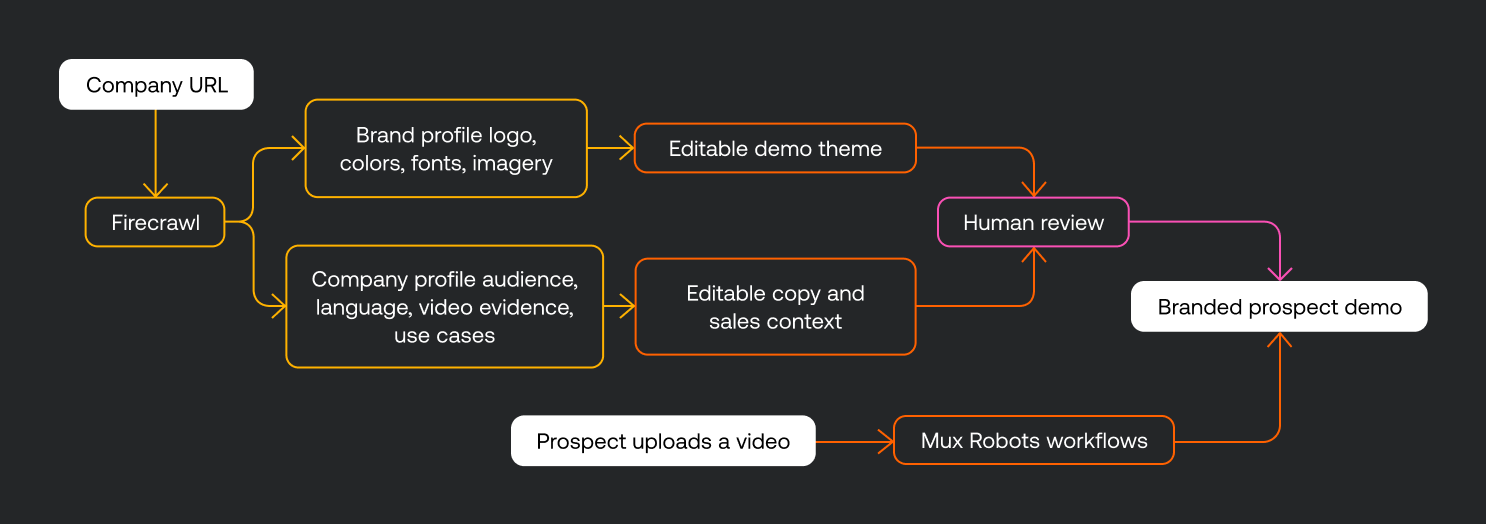
To eliminate the manual labor traditionally required to customize enterprise sales materials, Mux integrated advanced web-scraping infrastructure into its pre-sales workflow. Specifically, the engineering and sales enablement teams utilized Firecrawl, a sophisticated web-scraping API capable of extracting structured data from corporate URLs. By inputting a prospective client’s web address into the system, Mux’s backend automation extracts critical organizational data across three distinct operational layers.
The first layer focuses on brand architecture. The scraping tool instantly captures aesthetic and visual identifiers, including corporate logos, primary and secondary color palettes, typography guidelines, and media imagery. The second layer evaluates corporate positioning by analyzing the prospect’s public-facing digital footprint. This includes identifying their target audience demographics, parsing the specific language and industry jargon they use in their marketing copy, and cataloging existing video assets embedded across their site. The third layer maps out explicit and implicit use cases, giving the Mux sales team immediate insight into how the prospect currently leverages video technology within their own operations.
This automated intelligence-gathering process transforms what was once hours of tedious manual pre-call research into an instant, data-rich dossier. When a Mux sales representative prepares for an introductory call, they are no longer approaching the conversation from a position of discovery; they are stepping into the dialogue with a comprehensive understanding of the prospect’s digital identity, market positioning, and operational vocabulary.
Automating the Transformation: From Raw Data to Branded Experience
Once the web-scraping API extracts the necessary telemetry from a prospect’s domain, the data flows directly into Mux’s internal demo generation pipeline. The system synthesizes the scraped insights to dynamically construct a bespoke, client-facing sandbox environment.
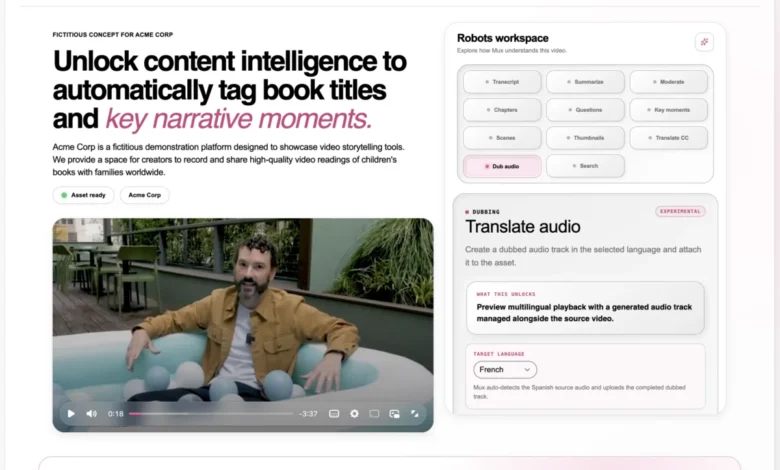
The mechanics of this automated generation are streamlined yet powerful. A baseline template—selected from a curated set of styled structural layouts—is instantly infused with the prospect’s brand assets. The primary color palette is applied to the user interface, corporate typography is rendered across the page headers, and customized headlines and introductory copy are generated using the linguistic style harvested from the prospect’s own website.
However, Mux recognized the inherent risks of letting fully automated artificial intelligence handle the final stages of a high-value sales interaction. To maintain absolute quality control and strategic narrative alignment, the system incorporates a mandatory human-in-the-loop review stage. Before any personalized demo link is transmitted to a prospective client, a human sales representative reviews the generated story, refines the contextual framing, and ensures that the narrative aligns with the specific commercial objectives of the account. This hybrid approach marries the unmatched speed and scale of automated web scraping with the nuanced emotional intelligence and strategic calibration of experienced human sales professionals.
Empowering Prospects with Low-Friction Content Integration
A visually customized interface with a corporate logo and matching color palette represents only half of the personalization equation. To achieve the elusive "wow" moment, Mux needed to solve the ultimate challenge in video software sales: getting the prospect’s own content into the testing environment without imposing administrative or technical friction.
Traditionally, requiring a prospect to upload proprietary video files for a demonstration involves cumbersome security reviews, file-size limitations, and technical hurdles that can kill momentum. Mux streamlined this bottleneck by pairing its dynamic demo pages with a secure, branded private upload mechanism. During the pre-call coordination, the sales representative provides a dedicated, client-specific upload link.
Once the prospect drops a raw video file into the portal, the file is instantly ingested into the page and simultaneously triggers the backend Mux Robots workflows. By the time the formal sales call commences, the prospect is not looking at a generic stock video or a canned marketing asset. They are looking at their own proprietary content undergoing live, automated processing directly within their own branded interface. Within minutes, the platform generates real-world outputs derived from the uploaded file—including automated summaries, clip extractions, translated audio tracks, and contextual query responses.
The psychological impact of this workflow shift is profound. The conversational barrier instantly shifts from abstract skepticism ("Could this technology possibly work for our specific use case?") to concrete validation ("This technology is actively working on our video right now"). Consequently, introductory sales calls naturally evolve from defensive feature evaluations into proactive technical discussions regarding enterprise integration and deployment timelines.
Equipping the Sales Force with Contextual Conversation Briefs
While the client-facing branded demo page serves as the visual centerpiece of this new strategy, the internal enablement of the sales team is equally critical to its success. Mux designed the backend automation to generate detailed "Conversation Briefs" alongside the client demo pages.
These briefs provide sales representatives with structured talking points that directly connect the capabilities of Mux Robots to the specific business challenges identified during the initial web scrape. Utilizing a formalized Find, Focus, and Outcome framework, the briefs supply reps with concrete data points to open the conversation. For example, if the scraped data indicates that a prospect operates a high-volume short-form video catalog, the brief provides targeted talking points regarding automated thumbnail ranking, timestamped scene detection, and instantaneous clipping APIs.
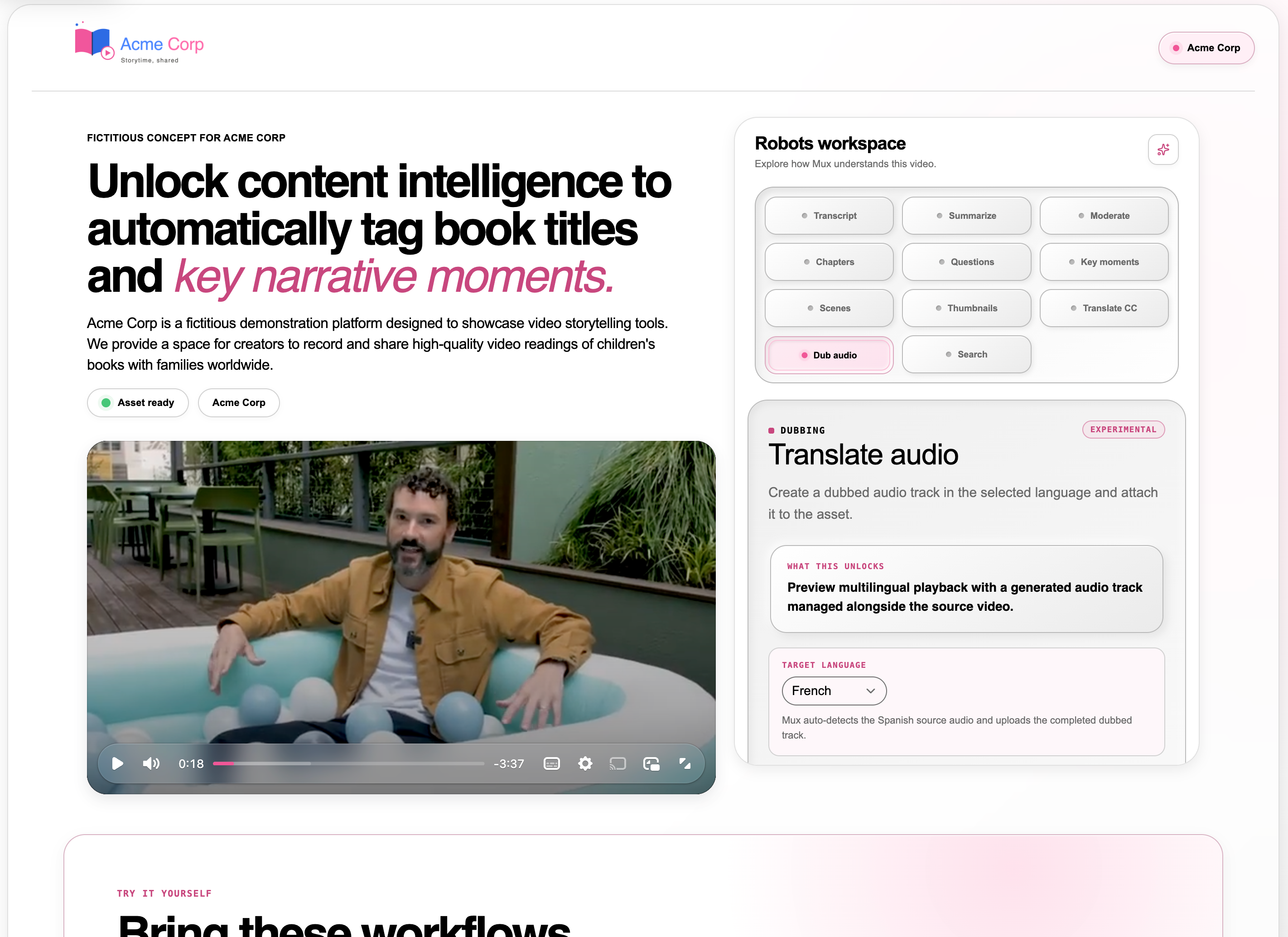
Crucially, these conversation briefs are not treated as rigid, immutable scripts. Sales personnel retain full editorial control, allowing them to adapt their delivery based on real-time verbal cues and emerging priorities during the live discussion. Furthermore, if a particularly compelling moment is discovered within the uploaded video during the call, the integrated platform allows the representative to leverage Mux’s instant clipping API on the fly, generating short, highly shareable clip links that can be immediately dispatched to stakeholders across the prospect’s organization.
The Broader Implications for B2B Software Sales and Product-Led Growth
The strategic pivot executed by Mux highlights a broader evolutionary trend across the enterprise software sector. As buyer sophistication increases and attention spans shorten, traditional static marketing collateral and generic product demonstrations are suffering from diminishing returns. The future of B2B sales lies firmly within hyper-personalized, context-aware product-led growth (PLG) strategies that minimize the cognitive load placed on the buyer.
By combining modern web-scraping APIs like Firecrawl with robust media infrastructure and human-in-the-loop sales execution, Mux has effectively engineered a repeatable framework for eliminating the imagination gap. The company’s methodology demonstrates that automation should not be deployed merely to reduce operational overhead, but rather to deepen empathy and relevance at every touchpoint of the customer journey.
As Mux continues to refine its automated demo pipelines, the ultimate metric of success remains grounded in traditional commercial outcomes: increased prospect engagement velocity, accelerated pipeline progression, and higher conversion rates. By ensuring that prospects experience the utility of Mux Robots using their own brand identity and proprietary content before a contract is ever signed, Mux has transformed the sales demonstration from a routine theatrical presentation into an undeniable proof of performance. For an industry long accustomed to asking buyers to imagine what could be, Mux’s approach offers a compelling blueprint for proving what actually is.