How Mux Built a Custom Video Intelligence Agent Using Vercel Eve to Solve Slack Content Fragmentation

In the modern digital workplace, communication platforms like Slack have become the central nervous system for remote and hybrid engineering teams. However, despite their utility as collaboration hubs, these channels frequently double as digital graveyards for rich media assets. Video updates, product demonstrations, and technical walkthroughs shared in fast-moving chat threads are notoriously difficult to index, search, and retrieve after the initial notification fades. For Mux, a premier video infrastructure platform where video is the fundamental currency of communication, this fragmentation presented a persistent operational friction point. Internal teams constantly exchanged project updates and screen recordings, only for those valuable insights to slip into the void of chat history.
Addressing this organizational challenge required more than simply pointing a general-purpose artificial intelligence assistant at raw code repositories or document stores. It demanded a purpose-built solution capable of transforming unstructured video streams into actionable, searchable enterprise context. To bridge this gap, engineers at Mux embarked on an internal experiment: building a proprietary agent harness rather than relying entirely on off-the-shelf developer tools like Codex or Claude. By leveraging Vercel’s emerging eve framework—frequently characterized in developer circles as Next.js for agents—Mux successfully deployed an omniscient, private video library historian directly inside Slack. This initiative underscores a fundamental realization in modern software architecture: while off-the-shelf toolkits are invaluable for exploratory prototyping, owning the agent harness is critical for delivering reliable routing, robust security permissions, asynchronous progress tracking, and an integrated product experience.
The Evolution of Agent Architecture: APIs Versus Orchestrated Harnesses
The explosion of large language models and foundational AI APIs has dramatically lowered the barrier to entry for building automated software routines. Developers can easily fire up local terminal environments, provision command-line interfaces, and prompt models to interact with cloud infrastructure. Yet, there remains a vast chasm between calling an application programming interface and maintaining a reliable, production-grade agent. APIs provide the raw functional building blocks—such as transcription, facial recognition, vector embeddings, and job state management—but they do not inherently understand context, tenant boundaries, or user intent.
In the early stages of the Mux experiment, the core technical team evaluated whether standard developer assistants could shoulder the workload. While tools like Claude or Codex excel at local, developer-centric tasks, they fall short when deployed into shared corporate channels where deterministic domain work must seamlessly intersect with conversational interfaces. A terminal-based prompt session cannot inherently serve as an asynchronous, collaborative team historian.
This realization established a critical architectural divide. Off-the-shelf harnesses are exceptional for discovering what underlying toolsets are capable of achieving. Conversely, owning the harness becomes paramount when routing logic, security compliance, real-time progress indicators, and user experience design form the core value proposition of the software. For Mux, building an internal harness ensured that requests originating from a Slack thread remained strictly scoped within the correct organizational and technical context, tracked asynchronously through API processing pipelines, and reliably delivered back to the precise conversation where they initiated.
Bridging the Gap with Vercel Eve
To bypass the immense overhead of constructing an entire agent runtime from scratch, Mux turned to Vercel’s eve framework. Billed colloquially as Next.js for agents, the framework provided a familiar paradigm for developers already steeped in modern web development tooling. Crucially, eve allowed the engineering team to decouple the agent’s core capabilities from the specific communication channels delivering messages to and from the runtime.
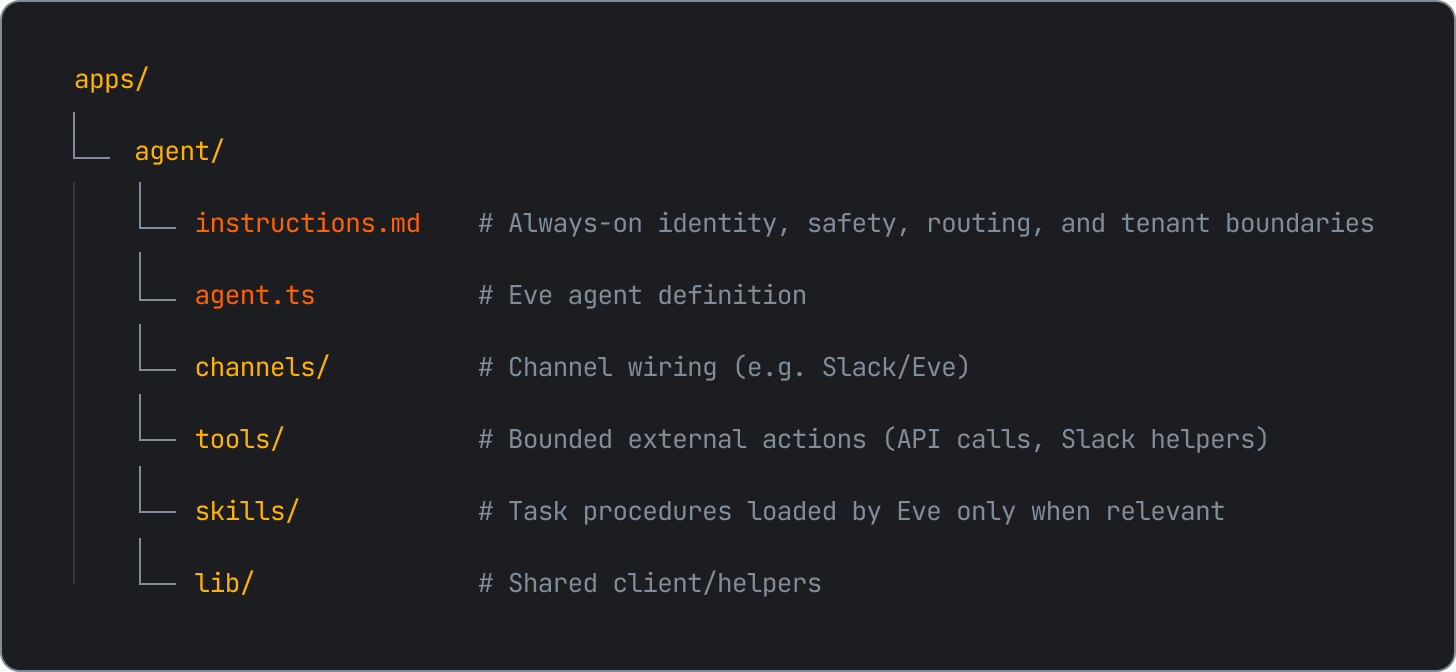
Within the project’s directory structure, the agent’s intelligence is organized into distinct, inspectable files. A foundational instructions file dictates identity, safety protocols, tenant boundaries, and routing rules. Separate directories house the agent definition, tools, skills, and backend libraries. Surrounding this core engine are modular channel integrations. Slack acts as the initial primary interface, but the underlying agentic logic remains entirely agnostic, capable of connecting to terminal environments or web applications without requiring a complete rewrite of the agent’s core competencies.
This architectural separation of concerns offers profound benefits for software scalability. By ensuring that what an agent does remains entirely distinct from where it lives, development teams can port identical behavioral models across multiple platforms. In the context of video intelligence, this means the same underlying logic that indexes a Slack video demo can eventually power customer-facing search interfaces directly within external applications or native web dashboards.
Transforming Passive Video Sharing into Active Enterprise Context
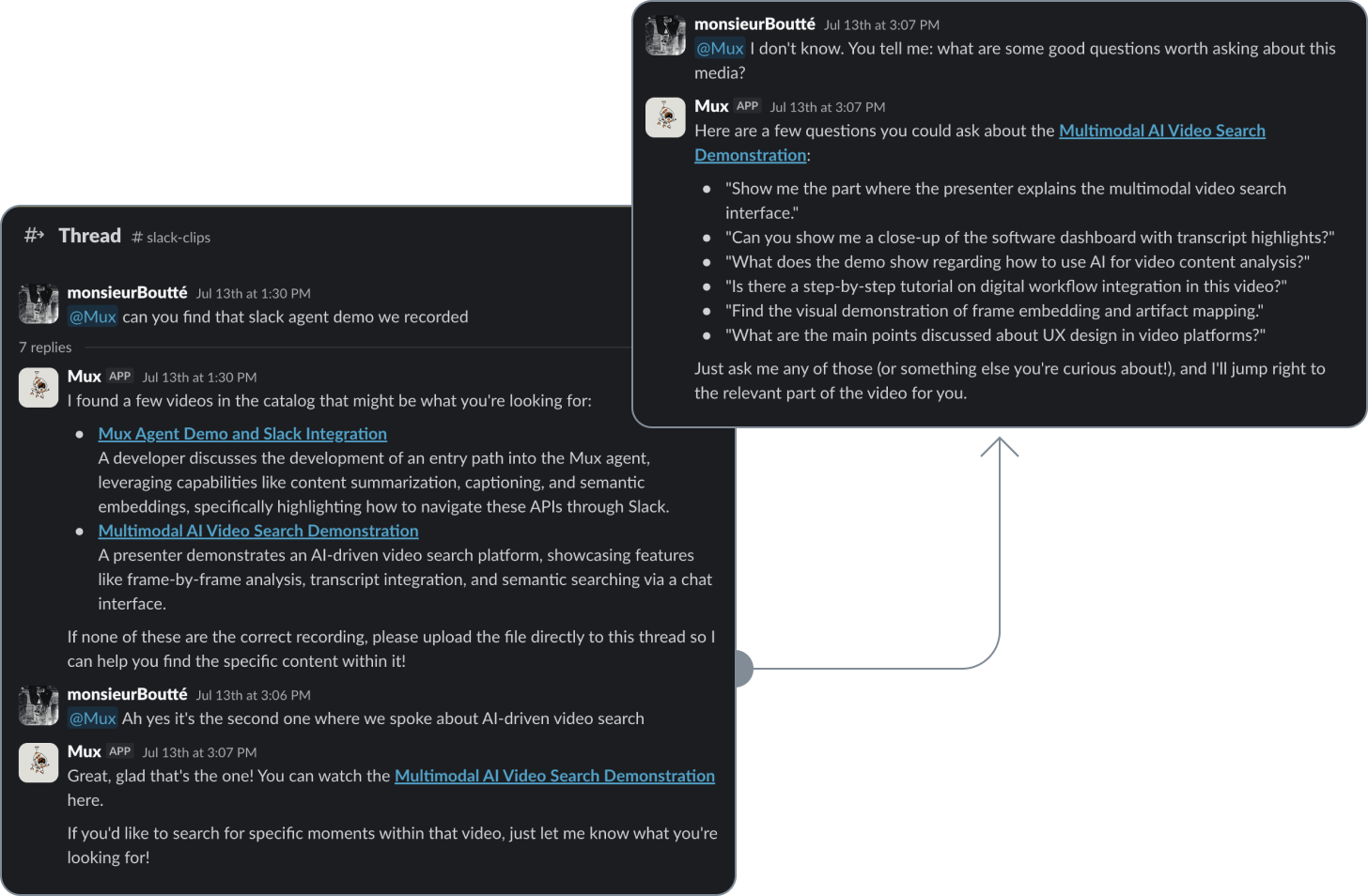
The operational workflow enabled by the Mux Video Agent fundamentally alters how internal teams interact with recorded media. Previously, a developer sharing a high-definition product walkthrough in Slack relied entirely on human memory or manual bookmarking to locate the asset later. Under the new agent-driven paradigm, the workflow is entirely automated and conversational.
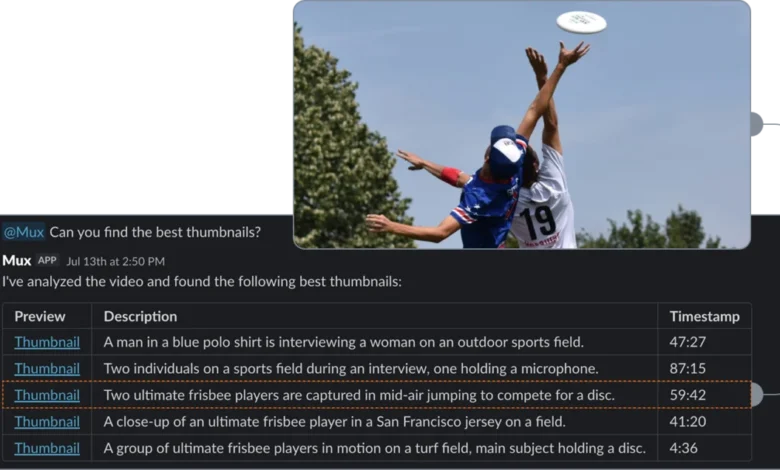
When a user posts a video into a tracked Slack thread, they can simply mention the Mux Agent. The system ingests the video into Mux’s established processing pipeline, feeding real-time progress reports back to the thread as transcription and indexing jobs execute. Once the video is fully indexed, the asset transforms from a passive media file into an active, searchable knowledge base. Team members can query the thread to locate specific moments, such as the exact timestamp where pricing models were discussed, request comprehensive textual summaries, or ask technical questions regarding features highlighted in the recording.
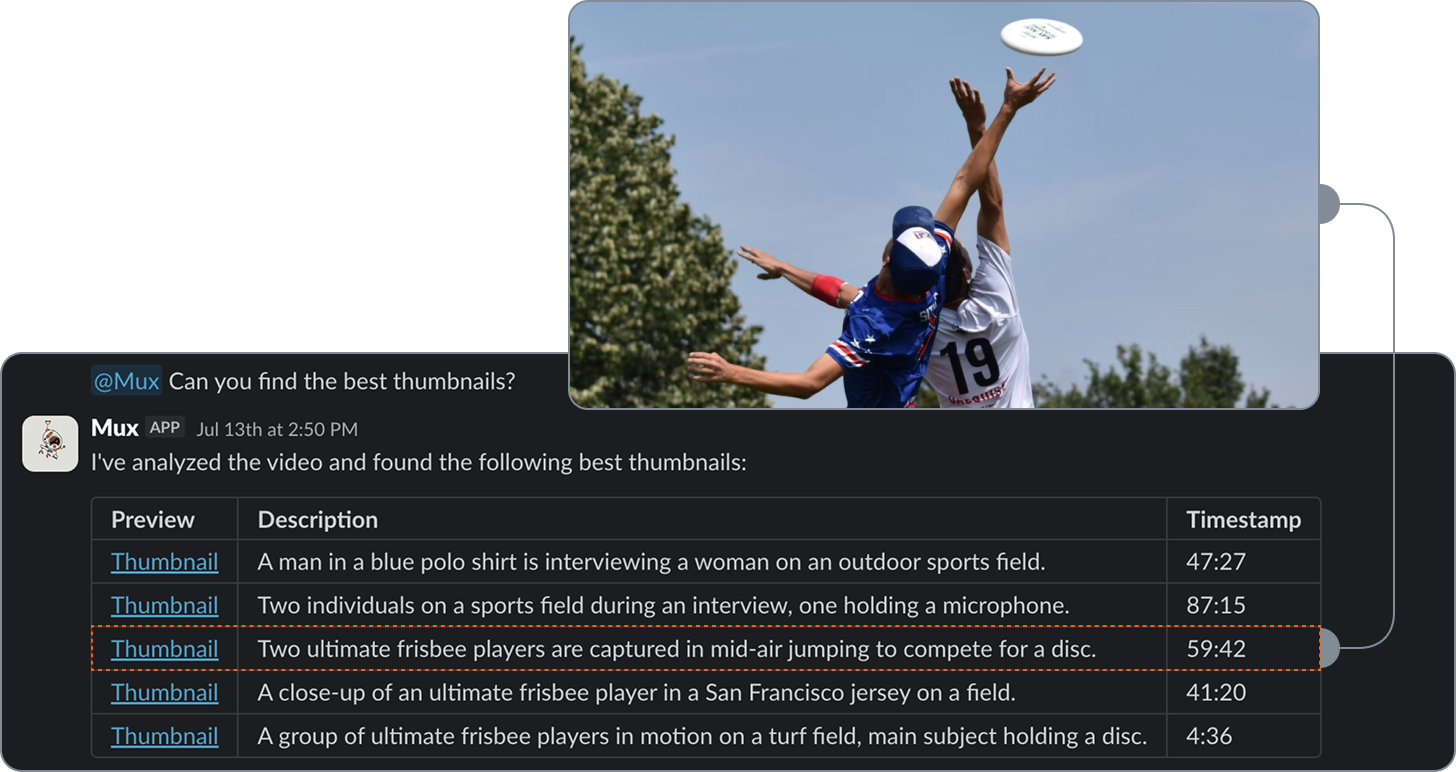
Furthermore, the agent supports advanced multimodal search capabilities. If a team member remembers a visual detail from a video shared weeks prior, they can upload a screenshot or describe specific visual elements—such as a sideline interview or a particular UI component—and prompt the agent to retrieve the exact second in the recording where that visual occurs. This capability effectively eliminates content fragmentation, turning ephemeral chat media into a persistent, easily queryable corporate asset.
The Division of Labor: Deterministic APIs and Probabilistic Agents
A foundational design principle that emerged during the development of Mux’s video agent is the strict separation between deterministic domain logic and probabilistic agent orchestration. In complex AI architectures, attempting to make language models handle heavy computational lifting or precise state management often introduces volatility and hallucinations.
Mux avoided this pitfall by delegating deterministic tasks entirely to its established APIs. Low-level operations—including video transcoding, audio transcription, vector embedding generation, asynchronous job orchestration, and database state verification—are handled by deterministic backend services. The agent itself is strictly confined to higher-level responsibilities: interpreting human intent, selecting appropriate tools, managing conversational context, and formatting communications for the end user.
This division of labor significantly simplifies debugging and system iteration. When an error occurs, engineers can easily isolate whether the failure stems from a flawed API execution or an incorrect tool selection by the agent. Moreover, owning the orchestration layer provides unprecedented visibility into how users actually combine enterprise tools. By instrumenting the sequences and outcomes of agent interactions, Mux gained empirical data on compound workflows—chaining capabilities in ways developers did not initially anticipate—providing a roadmap for formalizing new product features.
Implications and the Future of Enterprise Video Intelligence
The successful deployment of the Mux Video Agent on the Vercel eve framework highlights a broader shift in how modern software companies approach internal tooling and artificial intelligence integration. As foundational models become commoditized, competitive advantage increasingly shifts toward how effectively a company can orchestrate those models around its proprietary data and domain-specific infrastructure.
While the experiment originated as a localized solution to clear up Slack clutter within Mux’s internal engineering channels, the long-term implications extend far beyond a single messaging platform. By mastering the art of owning the agent harness, Mux has validated a blueprint for turning raw video infrastructure into intelligent, conversational media archives.
For organizations grappling with information overload, the lesson is clear. Off-the-shelf tools provide a vital sandbox for exploring the outer boundaries of technological possibility, but building and owning the agent harness is where organizations truly shape the user experience around their unique operational needs. By starting small, focusing on high-friction workflows, and strictly separating agent intent from backend API execution, engineering teams can unlock unprecedented value from enterprise data assets that might otherwise vanish into the digital void.