How a Lean Three-Person Team Scaled Sponsorship Revenue 2.1x Using 21 Custom AI Agents

The modern landscape of B2B sales and revenue operations is undergoing a quiet, structural revolution, moving away from bloated human pipelines toward hyper-efficient, agent-driven architectures. A striking case study of this transformation comes from a recent deep dive on The Agents podcast, where team members Amelia and Jason dismantled the exact mechanics of their proprietary sales stack. Operating with a lean team of just three humans backed by a fleet of 21 specialized AI agents in production, the organization has achieved a staggering 2.1x year-over-year growth in sponsorship revenue, handling 17,000 actual customer conversations and booking 600 qualified meetings over a 12-month period.
The Core Infrastructure: Headless Salesforce and the 10K Dashboard
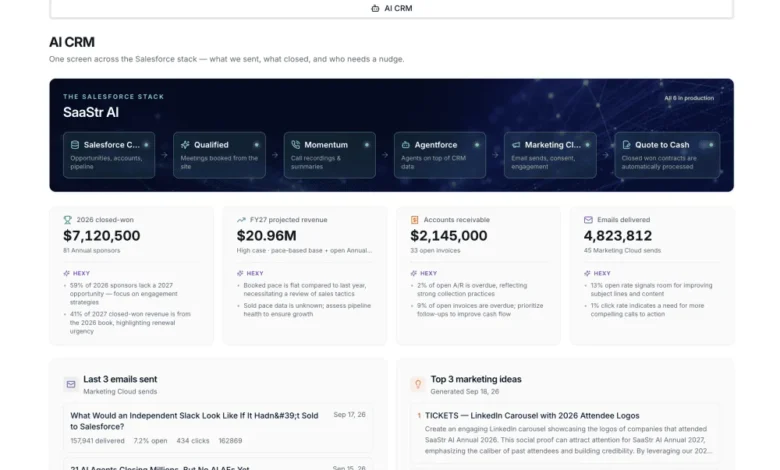
At the heart of this operational leap is an AI Vice President of Revenue named 10K, originally built on Replit. Rather than forcing human operators to navigate clunky administrative interfaces, 10K functions as the central command center, overseeing queues, renewal trackers, accounts payable, and automated data entry.
Crucially, Salesforce has been relegated to a headless system of record. While platforms like Momentum (for call recording), Qualified, Marketing Cloud—now integrated with Salesforce Agentforce—Sales Cloud, and Slack capture daily operational data, human employees rarely interact with the native Salesforce user interface. Instead, the 10K agent acts as an omniscient aggregator, pulling data simultaneously from approximately 30 disparate sources. This headless approach allows the AI to synthesize comprehensive prospect profiles instantly, circumventing the data silos that typically plague traditional sales teams.
The Evolution of the Inbound Funnel: From Static Forms to Real-Time AI Avatars
Thirteen months ago, the organization relied on a conventional inbound model: a static "Contact Us" page featuring a lengthy form routed via a human round-robin system. Standard follow-up emails routinely suffered from a 24-hour lag and relied on generic templates informing prospects that they appeared to be a good fit.
Today, the inbound architecture has been entirely replaced by a dual-door system designed to eliminate friction. Door one features an interactive AI avatar deployed on Qualified. This agent engages inbound prospects in real-time, qualifying them based on budget, primary objectives—such as lead generation, brand awareness, or speaking slots—and tracking competitor interest before booking meetings on the spot.
For buyers who prefer not to converse with an avatar, door two provides a self-serve tokenized prospectus. Rather than offering a static PDF or generic Google Slides link, the system deploys a dynamic, living document. Within ten minutes of a user downloading the material, the prospectus automatically updates to reflect the prospect’s specific identity, prominent competitors, and customized package recommendations based on their digital footprint and browsing heat maps.
Closing the Scheduling Gap: Custom Calendar Infrastructure
To eliminate lingering inefficiencies, the engineering team bypassed conventional third-party scheduling tools like Calendly and Read AI, choosing instead to build a proprietary calendar system via an AI agent in just 20 minutes.
This custom booking link dynamically embeds company metadata, tracks user engagement on the booking page, and correlates directly with the prospectus the prospect was previously reviewing. If a user visits the scheduling page and bounces without booking, the agent immediately alerts the internal team and drafts a targeted follow-up communication. Furthermore, inbound lead routing is entirely automated: leads are intelligently assigned to internal owners based on category ownership and historical agent performance.
Transforming Account Retention Through Automated Renewal Agents

Perhaps the most dramatic financial impact stems from the implementation of a specialized renewal agent, which has propelled renewal rates 60% ahead of historical baselines. Operating on a strict protocol of comprehensive outreach, the agent ensures that every customer—regardless of Annual Contract Value (ACV)—receives proactive engagement.
Rather than relying on sporadic, end-of-term conversations, the renewal agent synthesizes real-time performance metrics, lead volumes, impressions, and media coverage into tailored slide decks generated via Gamma. Crucially, the agent adapts its output based on internal audience segmentation. For instance, an enterprise renewal presentation for Replit generated marketing-specific slides highlighting leaderboard status for the events team, while providing the CEO with a high-level summary emphasizing total annual impressions across all brand touchpoints.
In scenarios where historical performance has declined, the agent proactively flags anomalies before meetings occur. Rather than pushing an optimistic narrative, it formulates analytical rebuttals examining broader category trends and specific sponsorship shifts, effectively re-engaging accounts that might otherwise have lapsed.
Refining Outbound Strategies and Data Enrichment
While outbound sales was the earliest agentic workflow deployed by the team, it has evolved into the slowest-growing channel relative to the explosive gains seen in inbound and renewals. Recognizing that automated multi-touch sequences often result in wasted replies, the team inverted the outbound model. Agents now execute a maximum of one to three touchpoints; the moment a prospect responds, human-AI collaboration takes over to deliver bespoke prospectuses and decks rather than generic calendar links.
To feed this outbound engine, the team utilizes a sophisticated data enrichment stack combining tools like Clay, Core Signal, and Exa. Because industry professionals frequently change roles, maintaining accurate contact data is treated as an ongoing, automated background process governed by a Claude-powered skill that verifies lists prior to deployment.
The Strategic Imperative of Proprietary Data
A central lesson emerging from this operational evolution is the limitations of off-the-shelf third-party tools. While external signals from web scrapers and LinkedIn databases provide exceptional baseline data, they remain fundamentally external.
The primary competitive advantage achieved by the team stems from integrating deep, proprietary historical data—spanning years of past event agendas, podcast transcripts, community interactions, and historical return-on-investment metrics. Because commercial CRM and sales engagement platforms are architected for generalized use cases, they cannot natively synthesize years of proprietary multi-channel interactions. By building an internal layer over these disparate inputs, the organization has unlocked conversion rates unattainable through standard commercial software.
Broader Implications for Revenue Operations
The broader implications of this lean, agent-driven model point toward a fundamental restructuring of B2B go-to-market teams. Proving that an organization of three humans can scale revenue exponentially by deploying specialized AI agents challenges traditional headcount assumptions in the technology sector.
As foundational models continue to advance—exemplified by architectural improvements in recent model rollouts—building modular, stair-step internal agent stacks has moved from an experimental endeavor to a viable commercial strategy. For enterprises seeking to replicate this success, industry experts recommend beginning with data plumbing and renewal workflows, where proprietary context is densest, before expanding outward into inbound qualification and outbound prospecting.