Guitar Center’s Resurgent Harmony: How a Focus on Core Musicianship and Experiential Retail Orchestrates a Post-Bankruptcy Comeback.

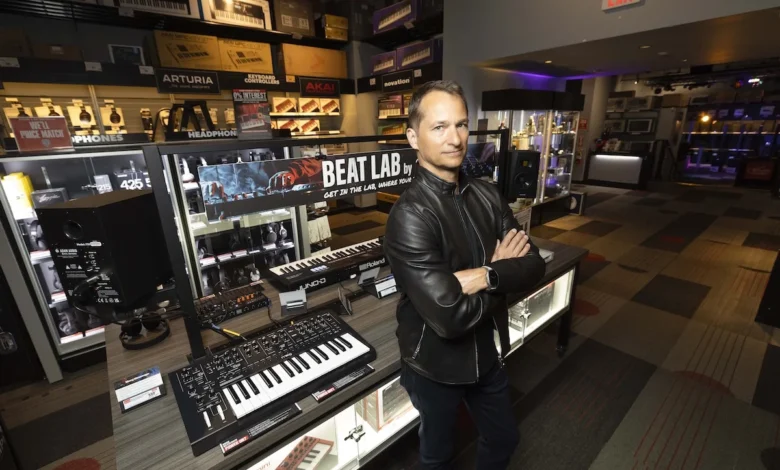
Nearly six years after declaring bankruptcy, Guitar Center, the iconic music instrument retailer, is confidently reporting that its comprehensive turnaround efforts are resonating strongly with customers and yielding significant financial results. The privately held company has successfully charted nine consecutive quarters of positive growth, a testament to a strategic pivot under the leadership of CEO Gabe Dalporto. Its most recent quarterly sales surged by 5.2% to a robust $635 million, according to data highlighted by Bloomberg. Beyond the financial figures, the revitalized strategy is evidently connecting with its customer base: store traffic has seen an uptick for the first time in over a decade, while the average time customers spend within its 300 retail locations has increased by an impressive 16% year-over-year. The company also anticipates a substantial boost to its balance sheet with an expected $16 million in tariff refunds, further bolstering its recovery trajectory.
A Tumultuous Financial History and the Road to Recovery
The path to this current resurgence has been anything but smooth for Guitar Center, a brand deeply embedded in the cultural fabric of music since its founding in California in 1959. Over decades, it cultivated a reputation as a haven for musicians, from aspiring beginners to legends like Eddie Van Halen. However, its financial stability began to fray significantly after a pivotal acquisition in 2007. Private equity firm Bain Capital acquired the company for a staggering $1.9 billion in a leveraged buyout, a move that inadvertently burdened the instrument seller with approximately $1.6 billion in debt. This colossal debt load became a persistent albatross, siphoning off crucial capital that could have been invested in store improvements, inventory, and digital infrastructure, thereby stifling organic growth and operational flexibility.
By 2014, the weight of this debt necessitated a change in ownership, with Ares Management Corp. assuming controlling interest. While this transaction helped restructure some of the debt, it ultimately failed to ignite the sustainable growth required to fully stabilize the company. The lingering financial fragility, combined with the unprecedented challenges of the COVID-19 pandemic, pushed Guitar Center into Chapter 11 bankruptcy in November 2020. This filing, a stark reflection of the severe pressures on brick-and-mortar retail and the company’s pre-existing debt issues, led to a swift, fast-track reorganization. By December 2020, Guitar Center successfully emerged from bankruptcy, shedding nearly $800 million of debt and reorganizing under the ownership of a consortium including Ares, Brigade Capital Management, and Carlyle Group. While this drastic measure provided a cleaner slate, the underlying operational and strategic challenges that had contributed to its decline still needed comprehensive addressing.
Dalporto’s Vision: Reconnecting with the Core Musician
Even after exiting bankruptcy, Guitar Center faced an uphill battle. The retail landscape was increasingly dominated by digital-first competitors, and the company still carried millions in debt. Gabe Dalporto, who joined Guitar Center’s board in 2018 and took the helm as CEO in 2023, recognized that the bankruptcy restructuring, while crucial for debt reduction, "didn’t fix the underlying problems." His mandate was clear: initiate a deep transformation that would resonate with customers and drive sustainable growth. Dalporto, a musician himself whose office is famously lined with guitars, understood the company’s target demographic intimately. He articulated a clear strategy centered on returning to Guitar Center’s "core customer: the hardcore musician."
Dalporto’s arrival was heralded by Guitar Center as bringing "deep expertise" in "digital transformation, customer acquisition and maintaining a best-in-class customer experience," credentials honed at companies like Lending Tree and the online education platform Udacity. He immediately embarked on a mission to understand customer frustrations. Early interactions revealed widespread dissatisfaction, particularly concerning product selection and the in-store experience. Customers, many of whom were dedicated musicians, found it baffling that approximately 70% of the merchandise consisted of lower-end products, a mismatch with their serious musical aspirations. Furthermore, years of cost-cutting, including a series of employee layoffs and reduced training after financial struggles, had eroded the expertise of store associates. Customers seeking knowledgeable advice often found it lacking.
A significant barrier to the in-store experience was the sheer inaccessibility of products. Instruments were frequently locked behind display cases or placed on high shelves, requiring customers to flag down an associate, who then often needed a ladder to retrieve items. As Dalporto vividly described, "If you’re trying guitars, you’re going to try 10 or 15 of them before you find the one you like. Imagine just the terrible experience that is [when products aren’t immediately available]." This transactional, inconvenient environment was antithetical to the immersive experience musicians crave.
Transforming the Retail Experience into a "Theme Park for Musicians"
Under Dalporto’s leadership, Guitar Center embarked on a radical overhaul of its retail environment, aiming to make stores places where people "want to come and play." The merchandising strategy was inverted: inventory was shifted from 70% "entry level" to 70% catering to the "serious musician." Guitars and keyboards were unlocked and placed at eye level, readily accessible and connected to amplifiers and speakers, encouraging customers to pick them up and try them out.
Beyond mere accessibility, the stores were redesigned to be experiential hubs. New features included "Beat Labs," where customers could experiment with electronic mixers and production equipment, guitar pedal tables for trying out various effects, and "sound walls" designed for acoustic testing. These additions transformed the stores from mere retail outlets into interactive playgrounds for musicians, fostering a sense of community and exploration.
Events became a cornerstone of this new experiential strategy. Guitar Center began hosting monthly workshops on topics ranging from guitar modification to pedalboard building, engaging local musicians and creating reasons for repeat visits. High-profile events further cemented this community focus. In February, the Hollywood store hosted a masterclass with Kiki Wong of The Smashing Pumpkins. April saw the band Periphery partnering with Guitar Center for album listening parties. In June, the Atlanta store brought in acclaimed record producer Zaytoven for a Beat Lab demonstration, drawing "lines out the door," according to Dalporto.
The company also resurrected its acclaimed Drum-Off event in May, after nearly a decade-long hiatus. This national talent competition invites participants to record themselves drumming at any Guitar Center store and submit their clips digitally. From 2,000 initial entries, six finalists will compete in Hollywood in August, with guest performances from drummers of No Doubt and Green Day. The winner stands to gain $25,000 cash, an endorsement deal, and Guitar Center gear. Plans are also underway for future band-focused competitions. Dalporto emphasized the goal: "What we’re trying to do is to engage with all the incredible local musicians in all of our markets locally and provide a national stage for them. The last thing we want to be is Best Buy – a completely and utterly standardized national box retailer. We want to feel like the local music store who has deep personal connections with local artists." This philosophy underscores a deliberate effort to blend national scale with local relevance and community intimacy.
Navigating a Dynamic Music Instrument Market
Guitar Center’s resurgence occurs within a complex and evolving music instrument market. According to the National Association of Music Merchants (NAMM), a global trade association, fretted instruments—including guitars, basses, amps, effects pedals, and strings—remain the industry’s largest product category by dollar volume. NAMM spokespeople noted in a 2026 report shared with Modern Retail that "industry success depends on a vibrant guitar culture," highlighting the enduring appeal of these instruments.
However, sales trends within this category have not been uniform. The "K-shaped economy" observed in 2025, characterized by disparate economic outcomes for different segments of the population, notably impacted instrument sales. While sales of entry-level instruments lagged, the market for high-end guitars—those priced at $1,500 and above—experienced a significant jump. Overall, the estimated retail value of fretted instruments declined by 2% to $2.4 billion in 2025. Acoustic guitar sales saw an 8% decrease in estimated retail value, while electric guitar sales surprisingly rose by 2%.
Several factors influenced these trends. On one hand, the rise of guitar influencers on platforms like TikTok and Instagram demonstrably helped drive demand, particularly among younger audiences. On the other hand, tariff-related price increases deterred some consumers, especially at the entry-level. NAMM’s report explicitly stated, "Ten and fifteen percent price hikes at the entry level unquestionably cost sales." Furthermore, an increased consumer gravitation towards used products, often driven by cost savings, also impacted the sales of new instruments. In this challenging and segmented market, Guitar Center’s focus on the "serious musician" and premium experience appears to align well with the stronger performing segment of the market.
Innovation and Future Horizons: Private Label and AI Integration
Looking ahead, Guitar Center is not resting on its laurels. The company is actively developing a new private-label guitar, a significant strategic move into instrument manufacturing. Initially, staffers proposed a Guitar Center version of the iconic Fender Telecaster, a model the retailer itself describes as "the essence of what an electric guitar is." However, Dalporto, asserting that "The last thing the world needs is another Telecaster," pushed for a truly distinctive product. He envisioned a guitar that would stand apart from existing models, incorporating modern-day technology, given that most guitar designs date back over 50 years.
Crucially, this private-label initiative is being built from the ground up with direct customer feedback. In March, Dalporto and Guitar Center engineers launched a subreddit, r/GuitarLab, inviting guitar players to share their biggest frustrations and needs. The page’s description, "Come build a guitar with us from the ground up," reflects a bold crowdsourcing approach. Dalporto has actively engaged with the community, posing questions such as "Hardware – what stays solid, what falls apart?" and "Controls – how much is too much?" While this innovative approach has garnered praise from some Redditors, who lauded it as "exactly the kind of thinking the guitar world needs," it also faced internal pushback and skepticism from others online who raised concerns about intellectual property rights given the terms of submission. The development of this private-label guitar is expected to take approximately a year, promising a unique offering shaped by the very community it aims to serve.
Parallel to its hardware innovation, Guitar Center is making substantial investments in artificial intelligence. The company has hosted hackathons and provided ChatGPT licenses to employees, fostering an environment of digital transformation. Earlier this year, it launched Rig Advisor, an AI tool designed to answer specific customer queries, such as "I want to sound like Jimi Hendrix on ‘Purple Haze.’ What should I play?" This tool empowers customers with instant, tailored recommendations, enhancing their shopping experience.
For employees, an AI tool called Pitch Practice simulates customer interactions, allowing associates to refine their sales pitches and product knowledge with instant feedback. Dalporto’s vision is for employees to engage in "one or two of these practices every morning before they hit the sales floor," ensuring a consistently high level of knowledgeable service. Furthermore, AI is being leveraged to revamp the scheduling of guitar lessons and build a comprehensive database of resources for instructors, all while Dalporto stresses that "It’s all in support of the human instructor," emphasizing AI as an enhancement, not a replacement, for personalized education.
Addressing Lingering Challenges and Optimism for the Future
Despite the significant strides, Guitar Center continues to chip away at its substantial debt. In July 2025, the company successfully pushed back its loan repayment deadlines from 2026 to 2029, buying crucial time to further solidify its financial standing. More recently, the company completed a sale-leaseback transaction on its headquarters, freeing up $19.3 million in additional cash for operational investments and debt reduction. These financial maneuvers demonstrate a continued commitment to prudent fiscal management alongside its growth strategies.
Dalporto remains highly optimistic about Guitar Center’s future and its evolving role. He envisions the stores as more than just points of sale: "We don’t want to be the place where you just come and buy your string instruments and leave. We want to be the place where you feel comfortable hanging out, playing [guitar], forming bands. … We’ve invested hugely in making Guitar Center a theme park for musicians." This sentiment encapsulates the brand’s revitalized mission: to cultivate a vibrant community, foster musical passion, and offer an unparalleled, immersive experience that transcends mere commerce. The early successes suggest that Guitar Center’s new harmony is indeed striking a chord, setting a compelling example for traditional retailers in an increasingly digital and experience-driven market.