Digg Returns as an AI-Centric News Aggregator Utilizing Real-Time Engagement Data from X to Surface Trending Tech Developments

The digital landscape is witnessing the return of one of its most storied names as Digg, the once-dominant link-sharing platform that defined the early era of Web 2.0, undergoes yet another significant transformation. Following a brief and unsuccessful attempt to position itself as a direct competitor to Reddit earlier this year, the platform has been rebooted under the leadership of its original co-founder, Kevin Rose. The latest iteration of Digg abandons the community-driven forum model in favor of a specialized news aggregator that leverages artificial intelligence and real-time social signals to curate information, specifically focusing on the burgeoning field of AI.
This pivot marks a strategic retreat from the social networking space, where Digg recently struggled to find its footing. In March, the company shuttered its previous app and laid off staff after concluding that its attempt to replicate the Reddit experience was failing to gain traction. The failure was attributed to two primary factors: an inability to effectively manage the influx of bot traffic and a lack of clear differentiation from existing market leaders. Now, Rose—a partner at True Ventures who returned to full-time duties at Digg in April—is betting that a return to the site’s roots as a high-signal discovery tool will resonate with a modern audience overwhelmed by digital noise.
A Turbulent Chronology: From Web 2.0 Icon to Modern Pivot
To understand the significance of this latest reboot, one must look at the long and often tumultuous history of Digg. Founded in 2004 by Kevin Rose, Owen Byrne, Ron Gorodetzky, and Jay Adelson, Digg was the pioneer of the "upvote" system. At its peak in the late 2000s, a "Digg effect"—where a link featured on the front page would receive so much traffic it crashed the destination website—was a coveted mark of viral success. However, a series of controversial redesigns, most notably the "v4" launch in 2010, alienated the core user base, leading to a mass exodus to Reddit.
The brand was eventually sold in pieces in 2012, with the core assets acquired by the technology studio Betaworks for approximately $500,000—a fraction of the $160 million valuation it once commanded. Under Betaworks, Digg was reimagined as a curated editorial homepage. Ownership changed hands again in 2018 when it was acquired by BuySellAds. The most recent chapter began in early 2025 with an ambitious plan to build a "Reddit rival." That version launched in January 2026 but lasted only two months before the company recognized the model was unsustainable in the current climate of automated spam and entrenched competition.
By April 2026, the company shifted gears again. Rose moved back into a hands-on role to oversee the "drawing board" phase, resulting in the beta launch of the AI-focused aggregator currently visible at di.gg/ai.
Technical Architecture: Ingesting the ‘Global Town Square’
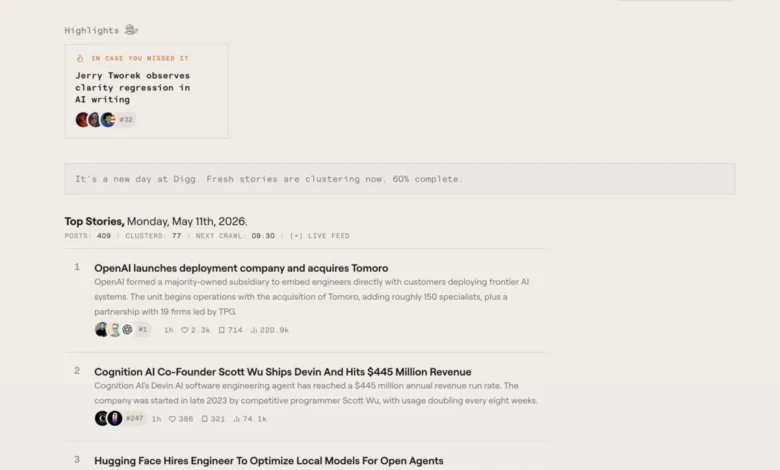
The new Digg distinguishes itself from its predecessors by its reliance on external data rather than internal user submissions. While the original Digg relied on users to "digg" or "bury" stories to determine their rank, the 2026 version functions as a sophisticated data processing engine. It ingests content from X (formerly Twitter) in real time, applying a layer of proprietary algorithms to filter out noise and identify meaningful trends.

The platform utilizes four distinct categories to organize its top-tier content:
- Most Viewed: Stories receiving the highest volume of raw traffic.
- Rising Discussion: Topics experiencing a sudden surge in mentions and replies.
- Fastest Climbing: Articles gaining momentum at a rapid velocity.
- In Case You Missed It: A selection of high-value stories that may have been overlooked by the immediate news cycle.
The "twist" in this model is that the engagement metrics displayed—views, comments, likes, and saves—are not generated on Digg itself. Instead, they are mirrored from X. The platform performs sentiment analysis, clustering, and signal detection to determine which stories are actually influencing the discourse. By tracking influential voices—such as OpenAI CEO Sam Altman or other key figures in the technology sector—Digg aims to predict which topics will go viral before they reach the broader public. Rose noted that when industry leaders engage with a specific story, it often triggers a chain reaction across the social web; Digg’s new mission is to capture and quantify that reaction for the user.
Strategic Focus on the AI Ecosystem
The decision to focus exclusively on AI news for the initial launch is a calculated move. AI is currently one of the few sectors where the professional and enthusiast communities remain deeply rooted on X, despite the platform’s broader fragmentation. This provides a rich, concentrated dataset for Digg’s algorithms to analyze.
In an email sent to beta testers, the company explained that the goal is to "track the most influential voices in a space" and surface news that is "actually worth paying attention to." If this niche-focused approach proves successful, Digg plans to expand into other verticals, such as biotechnology, finance, and climate tech. However, the company has warned that the site is currently in a "raw" and "buggy" state, intended for early feedback rather than a full-scale public debut.
The site also includes a directory of the "Top 1,000" entities in the AI space, ranking individuals, companies, and politicians based on their influence and the volume of discussion surrounding their work. This data-heavy approach caters to "data nerds" and industry professionals who require a high-level overview of the competitive landscape without spending hours scrolling through social media feeds.
Broader Implications for the Publishing Industry
The relaunch of Digg comes at a precarious time for digital publishers. For years, media outlets have relied on search engine optimization (SEO) and social media referrals for the bulk of their traffic. However, recent changes in the tech ecosystem have decimated these traditional pipelines.
Google’s introduction of "AI Overviews"—AI-generated summaries that appear at the top of search results—has significantly reduced click-through rates. These summaries often provide users with the information they need without requiring them to visit the source website. Simultaneously, Meta’s platforms (Facebook, Instagram, and Threads) have actively de-emphasized news content in their algorithms, further starving publishers of audience reach.

If Digg can successfully re-establish itself as a high-traffic gateway, it could provide a much-needed alternative source of referral traffic. Unlike Google’s AI Overviews, which aim to keep users on the search page, Digg’s model is built on surfacing links to external content. For publishers, a revived Digg could represent a return to a "curation-first" internet where quality reporting is rewarded with visibility, rather than being buried by algorithmic changes or platform-specific AI summaries.
Challenges and Market Viability
Despite the optimism surrounding Rose’s return, the new Digg faces significant hurdles. The platform currently lacks any form of internal community discussion. Without a comment section or a way for users to interact with one another on the site, Digg risks becoming a "read-only" utility that users visit briefly before leaving. This raises questions about long-term retention and whether a pure aggregator can compete with integrated platforms like X’s "For You" feed or Meta’s Threads.
Furthermore, the heavy reliance on X as a data source is a potential point of failure. Since Elon Musk’s acquisition of the platform, X has seen a shift in user demographics and a rise in competition from decentralized alternatives like Bluesky and Mastodon. If the "influential voices" that Digg tracks move to other platforms, Digg’s data source will become less relevant. While Meta’s Threads is growing, it remains a "creator-focused" environment that has been hesitant to embrace real-time news and political discourse, making it a difficult source for the kind of signal detection Digg requires.
There is also the question of the "average user." While data-driven charts and sentiment analysis are valuable for professionals, it remains to be seen if the general public has an appetite for a news site that looks more like a financial terminal than a social network.
Conclusion: A Data-Driven Return to Roots
The latest version of Digg is an admission that the era of the "Reddit clone" is over. By pivoting to a specialized, AI-powered aggregator, Kevin Rose is attempting to solve a modern problem: the "signal-to-noise" crisis. In an age where information is infinite but attention is scarce, a tool that can objectively identify what is "worth paying attention to" has inherent value.
As the site moves out of its beta phase, its success will likely depend on its ability to expand beyond the AI niche and prove that its algorithmic curation can outperform the human-curated feeds of its competitors. For now, Digg is back—not as a community forum, but as a lens through which to view the chaotic real-time evolution of the technology industry. Whether it can reclaim its status as a cornerstone of the internet remains to be seen, but its latest pivot reflects the broader shift in the digital economy away from social interaction and toward AI-driven utility.