The saga of Digg, once the undisputed titan of the early social web, has taken another unexpected turn. After a short-lived and ultimately unsuccessful attempt to challenge the dominance of community-driven forums like Reddit, the platform has abandoned its social-community ambitions to return to its roots as a curated news aggregator. This latest iteration, spearheaded by founder Kevin Rose, pivots away from user-generated threads and instead utilizes sophisticated data-processing algorithms to distill the chaotic, high-velocity stream of information emanating from social media—specifically X—into a streamlined feed of high-signal news.
The decision to shutter the previous version of the site in March 2026 followed a period of intense struggle. Despite the promise of a revitalized platform, the "Reddit-rival" iteration of Digg faced insurmountable hurdles, including a deluge of automated bot traffic that overwhelmed its community moderation tools and a lack of clear market differentiation. With the digital landscape already saturated by established giants, the startup found itself unable to gain the necessary traction to sustain its operations. By mid-March, the company had laid off staff and ceased app operations, forcing a return to the drawing board for Rose and his team at True Ventures.
A Chronology of the Digg Reboot
The history of Digg is marked by several distinct eras, each reflecting the shifting nature of how information is consumed online. Founded in 2004, the original site was a pioneer of the "social news" model, allowing users to vote on links to surface the most popular stories of the day. Its influence was so profound that it became the template for the modern internet’s content discovery ecosystem. However, as the platform faced internal management challenges and evolving competition, it underwent numerous ownership changes and strategic pivots.
The most recent chapter began in early 2026 with an ambitious launch intended to reclaim the site’s former glory. The goal was to build a modern community forum that could compete directly with Reddit. By January 2026, the company opened its new platform to the public, aiming to provide a cleaner, more focused discussion space. This effort was short-lived. By March 2026, the company admitted defeat, citing an inability to maintain quality discourse in the face of bot activity and a stagnant user growth trajectory.
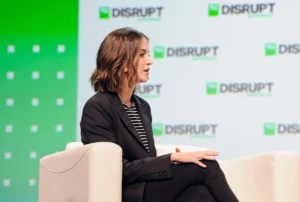
In April 2026, Kevin Rose transitioned back to full-time leadership of the project, signaling a departure from the "community-first" approach. By mid-May 2026, a new vision for the site was unveiled in a private beta, focusing on the burgeoning field of Artificial Intelligence as its initial test case.

Leveraging Data over Discussion
The new Digg distinguishes itself by removing the human-centric forum elements that defined its previous failure. Instead of relying on user voting—which is susceptible to manipulation—the platform now acts as a high-fidelity filter for the most influential developments in the AI sector.
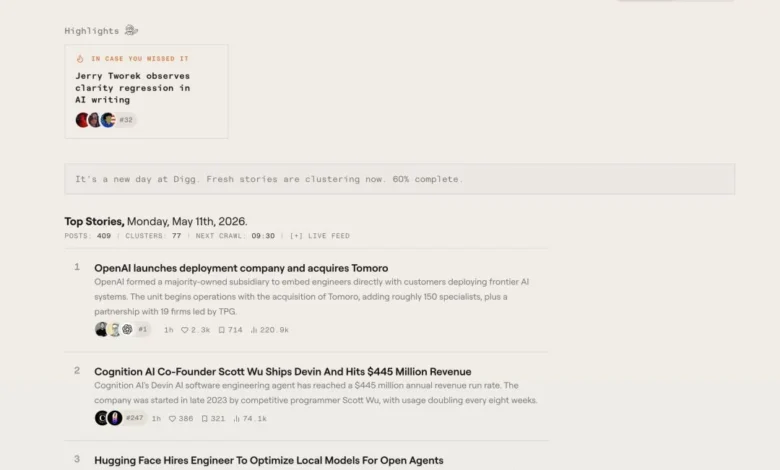
The site’s architecture is built on real-time ingestion of data from X. By monitoring engagement metrics, sentiment, and the velocity of information, Digg’s backend performs complex clustering and signal detection. The goal is to separate the "signal" from the "noise." For example, the platform is designed to detect when a prominent figure in the AI industry, such as OpenAI CEO Sam Altman, interacts with a story. In the current digital ecosystem, such interactions often serve as catalysts for massive information cascades. Digg aims to quantify these reactions, providing users with a dashboard that shows exactly which stories are gaining momentum among industry leaders.
The interface is minimalist by design. At the top of the homepage, users find four primary categories: the most viewed story, a rising topic, the fastest-climbing headline, and an "In case you missed it" section. Below these, the site displays a ranked list of top AI news, supplemented by metrics such as view counts, comment volume, and save frequencies derived from external sources rather than internal activity.
The Challenge of Scalability and Relevance
While the platform’s focus on AI is a strategic starting point, it raises questions about the site’s long-term sustainability. The primary challenge is whether this utility model can successfully translate to broader, less niche topics.
AI news is currently characterized by a highly centralized and tech-savvy audience that congregates on platforms like X. However, the broader media landscape is increasingly fragmented. Since the acquisition of Twitter (now X) by Elon Musk, the ecosystem has fractured. Many creators and news consumers have migrated to competing platforms like Threads, Bluesky, or private Discord servers. Consequently, the "signal" that Digg aims to capture is no longer unified under a single platform’s roof.
Furthermore, there is a fundamental psychological hurdle for the everyday user. The modern reader is accustomed to personalized feeds curated by algorithmic giants like TikTok, Google Discover, or Apple News. For a user to switch their habitual news intake to a secondary aggregator, the value proposition must be significantly higher than simply seeing what is trending on X. As of its current beta phase, the site lacks an internal discussion layer, meaning it functions more as a dashboard than a community. Without the ability for users to engage with one another, the site risks becoming a static repository rather than a dynamic, interactive destination.

Implications for the Digital Publishing Industry
Despite these uncertainties, the pivot to an aggregator model comes at a critical juncture for digital publishers. The industry has been severely impacted by the decline of traditional search traffic, exacerbated by Google’s "AI Overviews." These summaries, which provide answers directly within search results, have led to a marked decrease in click-through rates, depriving websites of the revenue necessary to sustain investigative journalism and high-quality reporting.
If Digg can establish itself as a trusted filter for high-value information, it could potentially emerge as a meaningful, if unconventional, traffic driver for publishers. By highlighting the most influential stories and providing a direct path to the source, the platform could help funnel engaged, niche-focused audiences back to the original websites. This would be a welcome shift for publishers currently struggling to maintain visibility in an environment where AI-generated content is increasingly crowding out human-authored journalism.
Future Outlook and Strategic Direction
In its communication to beta testers, the company has been transparent about the current state of the platform, characterizing it as "raw" and "buggy." This humility is a departure from the high-profile, feature-heavy launches of the past. By focusing on a narrow vertical, the company is attempting to prove the efficacy of its signal-detection algorithms before attempting to scale.
The inclusion of rankings for the "top 1,000 people" and "top companies" in AI is clearly intended to appeal to power users and industry insiders who need to track the power dynamics of the sector. Whether this granular level of data analysis is enough to maintain a business model remains to be seen.
The re-emergence of Digg serves as a case study in the cyclical nature of web design and the difficulty of finding a "product-market fit" in an era where the gatekeepers of information are constantly shifting. By abandoning the "community forum" experiment, Kevin Rose is betting that the future of news isn’t in more discussion, but in better curation. If the site can successfully navigate the technical challenges of real-time data analysis and prove that it offers a clearer view of the world than the chaotic feeds of major social networks, it may finally find a permanent home in the modern digital landscape. However, the path forward is narrow, and the competition for user attention has never been more intense. For now, the "dead" site lives again—but whether it can find a pulse in the competitive, AI-dominated market is a question that only time and user adoption will answer.