CSIRO Researchers Unveil Serverless Beacon to Revolutionize Secure Genomic Data Sharing on AWS

Australia’s national science agency, the Commonwealth Scientific and Industrial Research Organisation (CSIRO), has introduced Serverless Beacon (sBeacon), a highly scalable, serverless framework designed to securely query genomic variant data. Developed in close collaboration with the Amazon Web Services (AWS) ASP Prototyping and Scaling Team, sBeacon addresses long-standing challenges in clinical and research bioinformatics by providing a production-ready implementation of the global standard for genomic data exchange.
The launch marks a critical milestone for international genomic research networks. By leveraging a fully serverless architecture built on foundational AWS infrastructure, sBeacon bridges the gap between stringent data privacy requirements and the growing necessity for cross-institutional data discovery. As biobanks scale to hold tens of thousands—or even millions—of whole genomes, traditional data-sharing mechanisms have often proven too slow, expensive, or vulnerable to security risks. sBeacon provides a decentralized alternative that ensures sensitive genomic records never leave their originating secure storage environments.
Background and the Global Alliance for Genomics and Health Standard
At the core of sBeacon is the Beacon protocol, a widely adopted standard developed by the Global Alliance for Genomics and Health (GA4GH). Established to harmonize how genetic and phenotypic data are shared across international research communities, the GA4GH Beacon API defines standardized queries that allow researchers to ask simple yet vital questions, such as whether a specific genetic mutation exists within a given cohort.
Historically, implementing the Beacon protocol at scale required maintaining dedicated, always-on server fleets, which introduced significant operational overhead and idle costs. Furthermore, centralizing large datasets into a single repository often creates data silos, escalates storage costs, and heightens security vulnerabilities. To overcome these hurdles, CSIRO’s Australian e-Health Research Centre (AEHRC) team—comprising Denis Bauer, Yatish Jain, Anuradha Wickramarachchi, Brendan Hosking, and Nick Edwards—set out to design a cloud-native solution. By utilizing a serverless paradigm, the team eliminated the need for server provisioning, allowing computing power to scale elastically from zero to thousands of parallel executions instantaneously.
Architecture and Technical Implementation
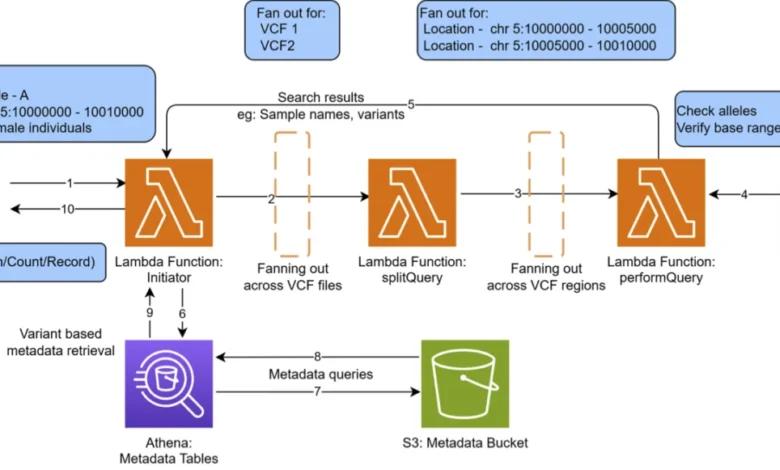
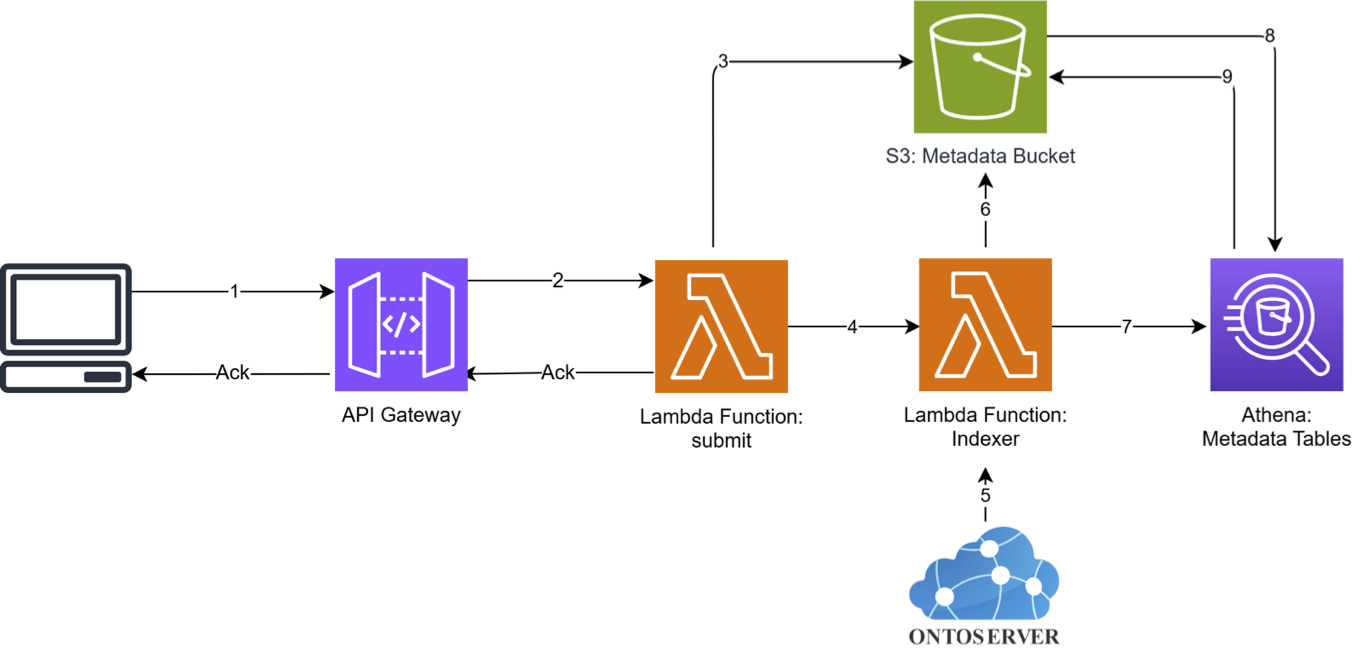
sBeacon is deployed as an open-source containerized environment managed via Terraform, enabling institutions to establish their own isolated deployments within their respective AWS accounts. The technical architecture relies on core AWS services, including Amazon Simple Storage Service (Amazon S3), AWS Lambda, Amazon DynamoDB, and Amazon Athena.
The system operates through two primary operational phases: data onboarding and data querying. During the onboarding phase, genomic data files—typically stored as Variant Call Format (VCF) files—are not duplicated or moved from their native locations. Instead, sBeacon registers the storage locations and builds lightweight index files that allow random access. Metadata concerning the samples, such as disease status, geographic location, and demographic details, is indexed and loaded into Amazon S3 in optimized Apache ORC format, while ontology terms are managed using specialized tools like CSIRO’s Ontoserver to align with the Ensembl OLS V4 specification.
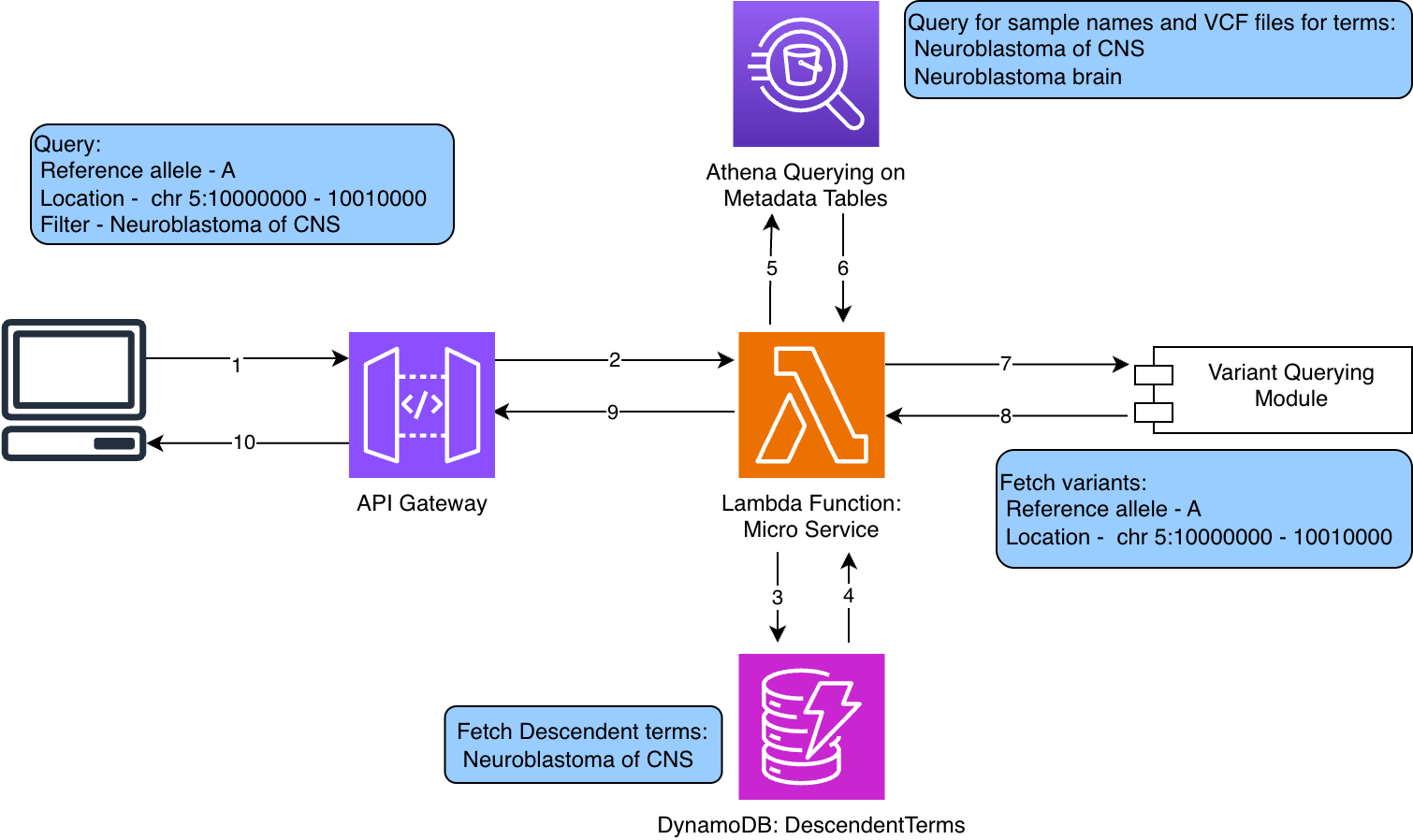
Data querying is handled through a modular architecture. When a user submits a query via the Amazon API Gateway, a microservice AWS Lambda function evaluates the request against user permissions stored in Amazon Cognito. For genomic variant queries, the system engages a specialized Variant Querying Module. An initiator Lambda function fans out parallel tasks across multiple VCF files stored in Amazon S3. Utilizing bcftools and htslib libraries, the system executes HTTP byte-range requests to read precisely the indexed genomic regions of interest—typically processing only about 1 kilobyte of data per query—without pulling raw sequence bytes into Lambda memory.
Performance and Empirical Case Study
To validate the scalability and cost-efficiency of sBeacon, the CSIRO team conducted a comprehensive case study using chromosome 1 of the 1000 Genomes Project. Representing roughly 8% of the human genome across 2,500 individuals, the multi-sample compressed VCF file totaled approximately 1.1 gigabytes.
The results demonstrated unprecedented performance metrics. Ingestion of the chromosome 1 dataset for 2,504 individuals was completed in just 18 seconds at a negligible cost of approximately $0.00052 USD. Because the framework relies on indexing rather than data duplication, ongoing storage costs for maintaining the metadata and index files amounted to roughly $0.000025 per month for the dataset’s metadata.
Query latency remained consistently low, achieving near real-time responses. Querying across a region of 10,000 base pairs to identify genotypes across all 2,504 individuals took an average of 1.52 seconds, incurring a compute cost of roughly $0.00013 USD per query. Crucially, query execution times remained stable even when the number of returned variants scaled significantly, proving the architecture’s resilience under load.
Zero-Trust Security and Privacy Framework
In clinical and human genetics, data privacy and regulatory compliance are paramount. sBeacon incorporates a robust zero-trust security model that enforces authorization granularly within the application layer rather than relying solely on perimeter defenses.
User authentication and authorization are managed through Amazon Cognito, issuing JSON Web Tokens (JWT) that carry explicit group memberships as claims. The system divides users into distinct tiers, ranging from basic boolean access—returning only binary existence checks—to aggregate counts and full variant-level record access for authorized administrators. The query processing engine strictly computes and returns only the level of granularity permitted by the user’s token, ensuring that sample-level data is never inadvertently calculated or exposed.
Furthermore, sBeacon preserves institutional data ownership through architectural decentralization. Because VCF files remain in the deploying institution’s Amazon S3 buckets, the framework supports cross-organizational federation without requiring centralized data pooling or cross-account trust relationships. External collaborators can query decentralized datasets securely, as raw genomic sequences never traverse public networks or unauthorized memory spaces.
Analysis of Implications and Future Considerations
The introduction of sBeacon represents a major leap forward for global bioinformatics, lowering the barrier to entry for institutions wishing to participate in international genomic discovery networks. By utilizing serverless architectures, organizations can drastically reduce the financial and administrative burdens associated with hosting biobank-scale data.
However, experts note that adopting such high-throughput serverless systems requires careful operational monitoring. Because fan-out queries can spawn hundreds of simultaneous Lambda invocations, institutions must monitor account concurrency limits to prevent throttling and maintain query reliability. Additionally, managing cold-start latency through provisioned concurrency may be necessary for applications demanding ultra-low response times during burst traffic periods.
Conclusion and Availability
As clinical genomics increasingly relies on large-scale population cohorts for precision medicine, frameworks like sBeacon provide a viable path toward secure, scalable, and cost-effective data interoperability. By successfully aligning modern cloud computing with international open standards like GA4GH Beacon, CSIRO has delivered a powerful tool for the global research community.
The complete source code and deployment guides for sBeacon are publicly available via the GitHub repository managed by CSIRO’s Australian e-Health Research Centre, enabling research institutions worldwide to deploy, test, and contribute to the evolution of secure genomic data exchange.