Critical Security Vulnerabilities Identified in GoAhead Embedded Web Server Affect Millions of IoT and Industrial Devices

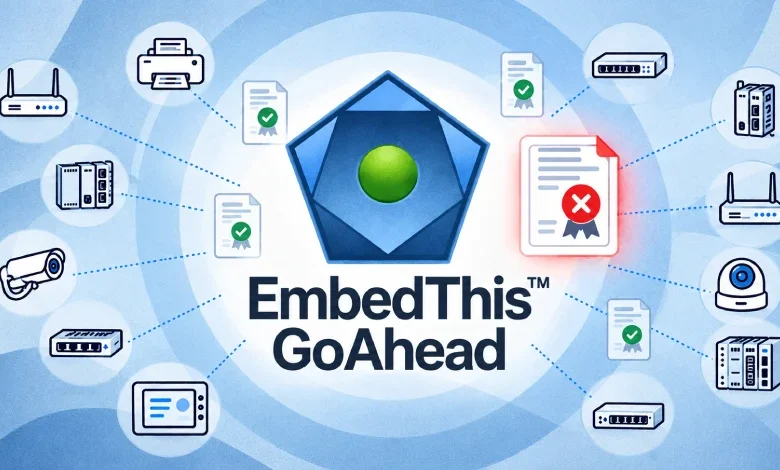
The GoAhead embedded web server, a ubiquitous software component found in hundreds of millions of routers, printers, gateways, and industrial control systems, is currently the subject of a major security disclosure following the discovery of three significant Transport Layer Security (TLS) vulnerabilities. These flaws, which primarily impact configurations using specific TLS backends, could allow attackers to bypass authentication mechanisms, decrypt secure sessions, or circumvent critical certificate validation protocols. The most severe of these, tracked as CVE-2026-115881, involves a failure in the server’s certificate revocation logic, effectively rendering the revocation process useless in affected deployments.
Understanding the GoAhead Ecosystem and the Discovery
GoAhead, developed by EmbedThis, is designed for the constraints of embedded systems. Because it is highly modular, developers can choose between various TLS backends—such as OpenSSL, LibreSSL, or Mbed TLS—depending on the hardware requirements and the security needs of the specific device. This modularity, while efficient, has become a point of failure.
The vulnerabilities were brought to light by Sébastien Féry of the security firm FoxIO, who conducted a deep-dive analysis into how GoAhead handles TLS handshakes across its various supported backends. The findings, published in late October 2026, detail how certain implementation choices in the server’s code result in security logic that is either misconfigured by default or entirely bypassed.
The Core Vulnerability: CVE-2026-115881 and Revocation Failure
The primary concern for security operators is the failure of the server to enforce certificate revocation when using the OpenSSL backend with mutual-TLS (mTLS). In an mTLS setup, both the server and the client must present valid, trusted certificates to establish a connection. When a client certificate is stolen or a device is decommissioned, an administrator typically adds the certificate’s serial number to a Certificate Revocation List (CRL) to deny it further access.
However, researchers discovered that in GoAhead versions 3.4.5 through 6.1.0, while the server successfully loads the CRL file at startup without error, it fails to actually perform the check during the TLS handshake. Consequently, an attacker presenting a revoked certificate is granted full access as if the certificate were still valid. Because the server reports no error during the loading process, administrators remain unaware that their security policy is being silently ignored. This vulnerability has been assigned a severity rating of 9.1, reflecting the high risk to sensitive infrastructure that relies on client-side certificate authentication.

Chronology of the Disclosure and Patching
The coordination of this disclosure highlights the standard industry procedure for handling zero-day vulnerabilities in critical infrastructure software. The timeline of the event is as follows:
- August 2, 2026: EmbedThis releases GoAhead version 6.1.1 to device manufacturers, providing them with the necessary patches to integrate into their firmware update cycles.
- October 12, 2026: EmbedThis publicly releases the 6.1.1 update, officially announcing the security improvements to the wider community.
- October 26, 2026: FoxIO publishes its research findings, providing technical detail on the three identified TLS bugs and the specific conditions under which they manifest.
- October 27, 2026: The cybersecurity community begins assessing the broader impact as the CVE identifiers are processed for inclusion in the National Vulnerability Database (NVD).
Additional TLS Flaws and Backend Discrepancies
Beyond the revocation failure, the research identified two other distinct vulnerabilities tied to specific library backends, illustrating the complexity of maintaining secure cross-platform software.
The LibreSSL Legacy Verifier Issue (CVE-2026-115884):
For builds utilizing older versions of LibreSSL (specifically versions 3.2.x through 3.3.6), GoAhead exhibits a weakness in handling certificate chains. When client certificates are required but issuer checking is disabled, the server fails to properly enforce a limit on the length of the certificate chain. An attacker can present an excessively long chain, allowing them to bypass authentication. This vulnerability is rated 7.4.
The Mbed TLS Cryptographic Flaw:
In versions 4.0.2 through 6.1.0 using the Mbed TLS backend, a coding error results in the server sending a 1-byte Diffie-Hellman (DH) value instead of the expected 2048-bit value. This significantly weakens the key exchange, allowing a passive observer to intercept and decrypt the session traffic. Rated at 5.9, this vulnerability is particularly dangerous because it facilitates eavesdropping without requiring an active intrusion into the device itself.
The Challenge of Firmware Remediation
The nature of the GoAhead architecture poses a unique challenge for remediation. Because the software is embedded into firmware at the point of manufacture, it cannot be "patched" by the end-user in the traditional sense. Instead, the burden of security falls upon the original equipment manufacturers (OEMs).
If a router or printer manufacturer does not release a firmware update that includes the GoAhead 6.1.1 update, the end-user is left without a direct path to secure their device. Given that GoAhead is used by industry giants such as HP, Siemens, Oracle, and D-Link, the potential attack surface is immense. However, as of late October 2026, there is no evidence that these specific vulnerabilities have been exploited in the wild. EmbedThis maintains that their early notification to partners, combined with a coordinated release, was intended to mitigate this risk.

Broader Implications for Industrial IoT Security
The discovery of these flaws underscores a persistent issue in the Internet of Things (IoT) and Industrial Control Systems (ICS) sectors: the "black box" nature of embedded firmware. Device owners often have no visibility into which TLS backend their hardware uses or how that library is configured.
The security implications are twofold. First, there is the immediate risk of credential theft or unauthorized access. Second, the existence of these bugs highlights a systemic reliance on legacy TLS configurations that may not be receiving adequate security auditing. The fact that the Mbed TLS flaw, for instance, involved a simple "length typo" suggests that even mature, widely used libraries are susceptible to human error during integration.
Recommendations for Network Administrators
For organizations relying on devices that may utilize GoAhead, the following steps are recommended:
- Inventory and Monitoring: Use tools such as JA4Scan or network traffic analysis to identify devices that appear to be running GoAhead. While identifying the exact backend version is difficult from the outside, monitoring for unusual TLS handshake patterns can provide early warning of potential exploitation.
- Firmware Updates: Regularly check the support portals of hardware vendors for firmware updates released after August 2, 2026. Prioritize updates for devices that handle critical authentication or manage sensitive network traffic.
- Defense-in-Depth: Given the possibility that many devices may never receive a patch, network administrators should isolate IoT and industrial management interfaces on segmented, restricted VLANs. Access to these interfaces should be limited via firewalls, ensuring that management pages are not exposed to the public internet.
- Credential Hygiene: Following the disclosure of a separate, critical login bypass vulnerability in GoAhead 6.1.0—where users with passwords stored in the newer Blowfish format could be authenticated with any password—all users should rotate their administrative credentials and ensure active sessions are terminated after a patch is applied.
Conclusion
The vulnerabilities discovered in GoAhead 6.1.0 and earlier serve as a sobering reminder of the interconnected nature of modern digital infrastructure. While the software itself is small and optimized for efficiency, the security of hundreds of millions of devices rests on the integrity of its TLS implementation. As the industry moves toward the adoption of newer protocols and more robust verification processes, the responsibility remains with both developers and manufacturers to ensure that security is not just an optional module, but a fundamental, verified component of every device deployment. The shift toward version 6.1.1 is a necessary step, but the long-term challenge lies in the rapid and widespread distribution of these fixes across a fragmented global hardware ecosystem.