Critical OpenSSH Vulnerability Allows Unauthorized Authentication Bypass on Alpine Linux Servers

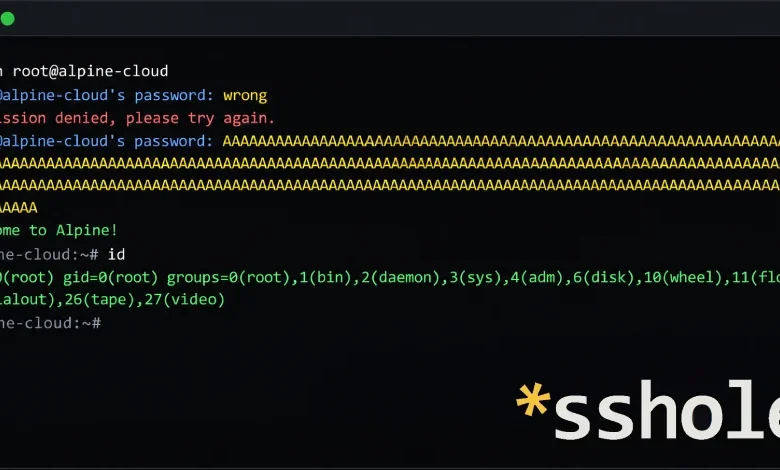
A significant security vulnerability has been identified within the standard OpenSSH server implementation on Alpine Linux, allowing remote attackers to bypass password authentication on accounts that lack a defined password. The flaw, which has been rated as critical by the OpenSSH project, stems from an incompatibility between the OpenSSH daemon (sshd) and the musl C library, which serves as the foundation for the Alpine Linux distribution. By leveraging this mechanism, unauthorized actors can gain access to systems—including accounts intended to be restricted to SSH key-only authentication—provided they possess network access to the target server, a valid account username, and a crafted password string between 257 and 1,024 bytes in length.
Technical Anatomy of the Vulnerability
The vulnerability manifests primarily on systems where the sshd process operates without the Pluggable Authentication Module (PAM) interface. Because Alpine Linux distributes its openssh-server package without PAM support and maintains password-based authentication as a default configuration, it is uniquely susceptible to this exploit.
The underlying technical failure involves the way the crypt() function within the musl library handles password verification. When a user attempts to log in, sshd hashes the input password and compares it against the stored hash in the system’s shadow file. In the case of accounts without a password, the stored field contains only an asterisk (*), which is insufficient to hold the necessary salt for verification. To compensate, sshd historically borrows the salt from another account on the same machine that possesses a legitimate password hash.
Under normal circumstances, the crypt() function returns a hash value that is then validated by sshd. However, following a 2012 update to the musl library, a failed crypt() call—specifically when a password exceeds the library’s internal 256-byte limit—returns an unmatchable hash rather than a null value. Because this unmatchable value coincides with the behavior expected by the system for certain account configurations, it creates a logic error. When an attacker provides an excessively long password, the library returns a result that the OpenSSH daemon incorrectly interprets as a successful authentication match. This interaction between the musl error-handling protocol and the OpenSSH salt-borrowing mechanism effectively grants the attacker access to the account without a valid password.
Chronology and Disclosure
The discovery of this flaw has prompted a rapid response from both the OpenSSH development team and the Alpine Linux security maintainers. The vulnerability was brought to light by security researcher Özgün Kültekin, whose technical investigation highlighted the risk posed to various musl-based operating systems.

While the exact nature of the flaw has existed in the codebase since the implementation of a fix for CVE-2016-6210, it remained dormant and undiscovered for years. Upon verification of the threat, the OpenSSH project moved to release version 10.6p2, which implements a workaround by explicitly refusing to authenticate when the stored password field is shorter than four characters.
The Alpine Linux team acted with similar urgency, releasing patched versions across all active and legacy distributions back to version 3.16. The timeline for these releases was compressed significantly, reflecting a shift in industry philosophy regarding security disclosure. Damien Miller, a lead developer at OpenSSH, noted that the team intentionally bypassed lengthy embargo periods, citing the increasing prevalence of automated AI agents capable of reverse-engineering patches and discovering vulnerabilities within hours of a release. By prioritizing transparency and immediate remediation, the maintainers aimed to mitigate the window of opportunity for malicious actors to weaponize the vulnerability before administrators could deploy updates.
Scope of Impact and Exposed Environments
The risk posed by this vulnerability is contingent upon four specific environmental conditions, all of which must be met for a successful exploit: the system must be running a version of OpenSSH compiled without PAM, password authentication must be enabled, the target account must lack a password, and at least one other account on the system must have a valid password to provide the necessary salt for the exploit.
While Alpine Linux is the primary focus of the advisory, the vulnerability is a systemic issue for environments utilizing the musl C library. Other platforms, such as Buildroot and Yocto, have been identified as potential targets for investigation, though their specific configurations—such as the default use of the Dropbear SSH implementation—may render them immune to this specific attack vector. Notably, OpenWrt, which relies on Dropbear by default, is not inherently vulnerable unless an administrator has manually installed and configured the OpenSSH server package.
The impact is particularly concerning for cloud infrastructure and containerized deployments. For instance, specific iterations of the "tiny-cloud" image (versions 3.18.11 through 3.24.3) provide the alpine user with passwordless doas privileges. While these systems are secure upon initial deployment, they become vulnerable the moment an administrator sets a console password, as the creation of a password hash provides the necessary salt for an attacker to exploit the alpine user account and subsequently escalate privileges to root.
Remediation and Best Practices
For organizations and administrators operating affected Alpine Linux servers, immediate action is required. The most direct resolution is the installation of the provided security updates. Point releases 3.21.10, 3.22.8, 3.23.8, and 3.24.4 incorporate the necessary patches, as do the legacy branches. It is critical to note that simply upgrading the package is insufficient; the sshd service must be restarted to clear the memory space of the previous, vulnerable process.

For systems where an immediate reboot or update is not feasible, the OpenSSH project and Alpine security maintainers recommend the immediate disabling of password authentication. By setting PasswordAuthentication no in the SSH configuration files, administrators can effectively neutralize the attack vector while maintaining access via SSH keys. It is advised that administrators verify their configuration using the sshd -t command before applying changes to prevent accidental lockout.
Furthermore, administrators are encouraged to perform a forensic review of their system logs. The presence of entries indicating Accepted password for regarding accounts that should only be accessible via key-based authentication—or accounts that should not have passwords at all—is a primary indicator of compromise. In such scenarios, the recommendation is to assume that the host has been fully compromised, necessitating a complete audit of user accounts, authorized_keys files, and any suspicious file modifications or unauthorized process executions.
Broader Implications for System Security
This incident serves as a poignant case study in the complexities of dependency management in modern software stacks. The vulnerability did not arise from a flaw within OpenSSH itself, nor from an inherent insecurity in musl, but rather from the unexpected, cross-layer interaction between the two. The "borrowed" salt logic, while intended as a minor functional convenience, became a security liability when the underlying C library changed its behavior regarding error reporting.
The incident also highlights the evolving nature of vulnerability disclosure. In an era where AI-driven security analysis can rapidly identify weaknesses in source code, the traditional "responsible disclosure" model—which often involves months of secret testing—is increasingly being viewed as a security risk. By opting for a rapid release cycle, the OpenSSH project has signaled that, in the current threat landscape, speed of defense is the most effective tool against automated exploitation.
Furthermore, the vulnerability underscores the importance of the "principle of least privilege" and the necessity of hardening configurations. Systems configured with default password-based authentication are inherently more brittle than those utilizing public-key infrastructure (PKI) or hardware-backed security modules. As infrastructure continues to shift toward containerized and ephemeral environments, the reliance on secure-by-default configurations becomes the most significant line of defense against both novel exploits and long-standing logic errors.
As the industry moves forward, the lack of a formal CVE (Common Vulnerabilities and Exposures) identifier at the time of the announcement serves as a reminder that the most dangerous vulnerabilities are often those that defy easy categorization. Security teams must continue to monitor not just the software they deploy, but the underlying libraries and standard C functions upon which their entire stack is built. The rapid resolution of this issue stands as a testament to the efficacy of open-source collaboration, demonstrating that when researchers and maintainers act in concert, the window for exploitation can be closed before it is even widely opened.