How Mux Transformed Its Sales Strategy by Automating Hyper-Personalized Product Demonstrations


The modern software-as-a-service (SaaS) sales landscape faces a perennial hurdle: bridging the chasm between generic feature lists and a prospect’s unique operational reality. When video infrastructure provider Mux introduced its automated video processing suite, Mux Robots, the company encountered a familiar friction point during customer acquisition efforts. While prospective clients consistently expressed appreciation for the technology’s technical capabilities during standard dashboard walkthroughs, they struggled to map those features directly onto their proprietary video workflows and immediate business needs. Recognizing that forcing potential buyers to mentally translate a generic demonstration into their own ecosystem introduces unnecessary sales friction, Mux engineering and sales teams engineered an automated, context-aware demonstration platform designed to eliminate guesswork entirely.
The genesis of this strategic pivot lay in a fundamental critique of traditional software demonstrations. Historically, tech companies rely on canned environments, static placeholder data, and generalized use-case presentations. For a platform like Mux Robots—which handles complex, automated video workflows such as intelligent clipping, translation, content summarization, and metadata extraction—a generalized interface failed to capture the imagination of decision-makers. Executives evaluating enterprise video solutions do not want to imagine what a tool might accomplish with hypothetical data; they require empirical proof of utility utilizing their own digital assets.
To solve this challenge, Mux developed an infrastructure that constructs fully branded, contextually relevant sandbox environments for prospective clients in minutes. Rather than scheduling discovery calls anchored by generic slide decks, the sales team now enters preliminary discussions equipped with a fully realized, customized demonstration page tailored precisely to the target company’s branding, lexicon, and operational focus.
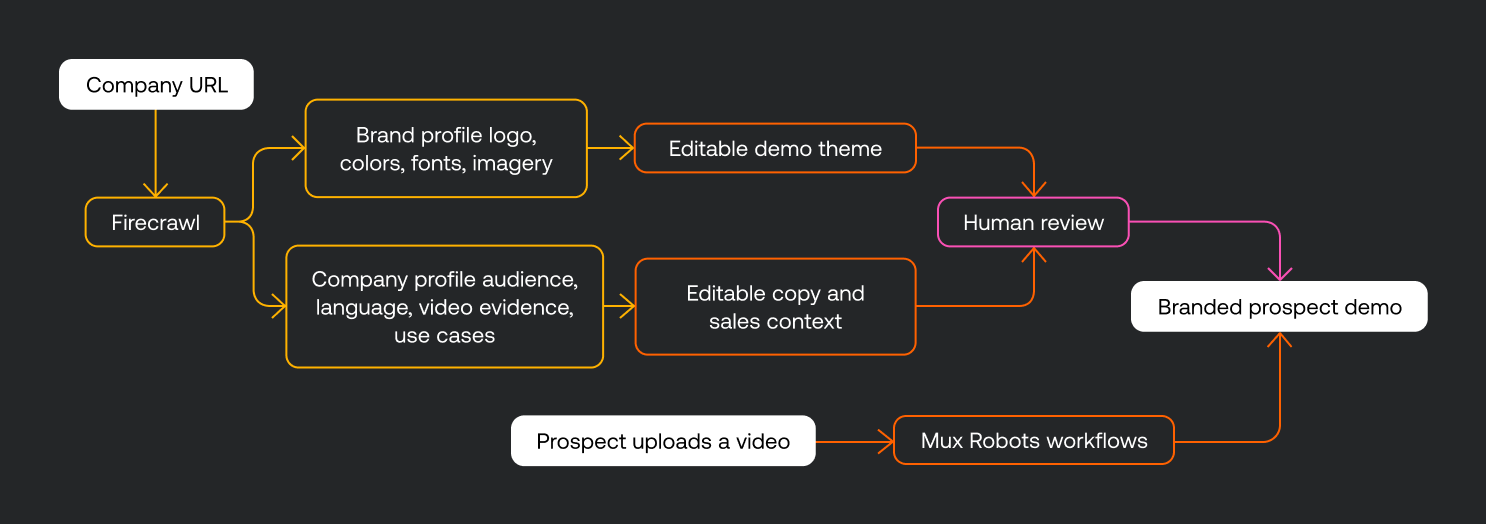
At the core of this automated personalization pipeline is Firecrawl, an advanced web-scraping and data-extraction application programming interface (API). When a member of the Mux sales team inputs a prospective company’s domain URL into the internal system, Firecrawl initiates a deep sweep of the target organization’s digital footprint. Within moments, the API extracts and structures data across three critical categories: visual brand identity, corporate messaging patterns, and technical video context.
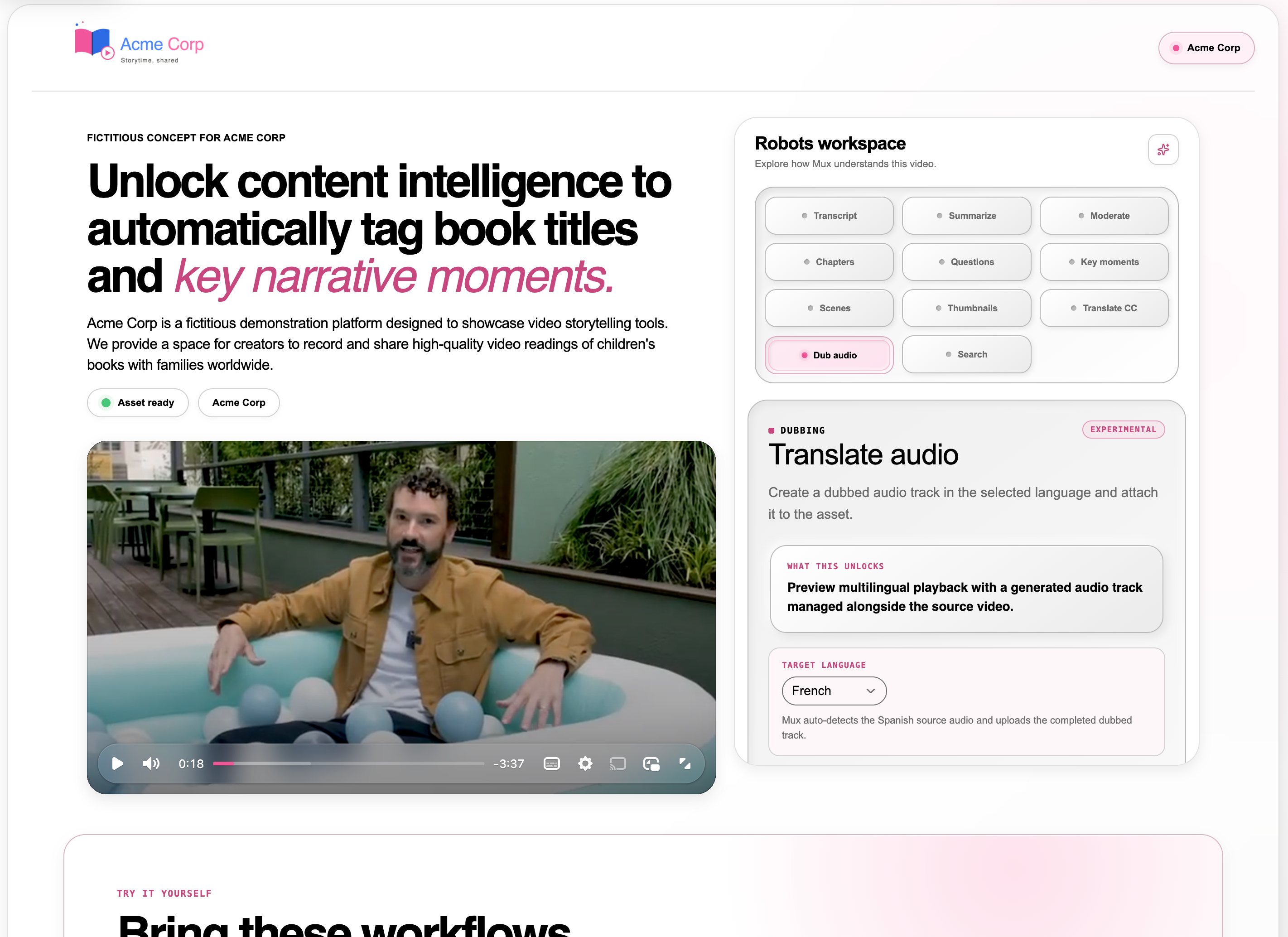
The brand profile harvest captures logos, precise color palettes, typography guidelines, and prominent imagery associated with the target enterprise. Concurrently, the corporate profile analysis evaluates the target audience, industry-specific terminology, existing video implementations visible on their website, and documented business use cases. This wealth of information is automatically ingested into a proprietary Mux staging architecture, which instantly populates a dedicated, secure staging webpage styled identically to the prospect’s existing digital properties.
However, recognizing the inherent limitations of fully automated machine processing, Mux deliberately instituted a human-in-the-loop review mechanism. Once the scraping and preliminary generation phase concludes, an assigned account executive or sales engineer reviews the generated narrative framework, refines the copy to ensure accurate tone alignment, and optimizes the highlighted sales angles before any external stakeholder accesses the environment. This ensures that the technology respects the nuances of the target business while demonstrating that the vendor has invested the necessary time to understand the prospect’s market position.
Beyond aesthetic personalization, the efficacy of the new demonstration framework hinges on frictionless content ingestion. A video infrastructure product’s true value proposition is inextricably linked to the quality and nature of the customer’s proprietary media assets. To bridge the gap between theoretical utility and practical application, Mux streamlined the mechanism through which prospects introduce their own video files into the evaluation environment.
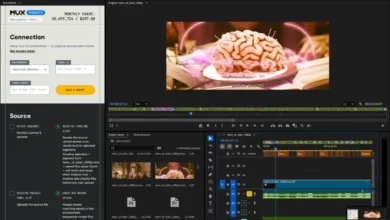
During or prior to a scheduled sales presentation, the account executive generates a private, secure, and branded upload link unique to that specific prospect. The potential client simply drags and drops a raw video file—whether it is a marketing webinar, a user-generated clip, or a long-form corporate archive—into the designated interface. Upon upload, the file instantly populates the customized demonstration player and programmatically triggers the Mux Robots backend workflows.
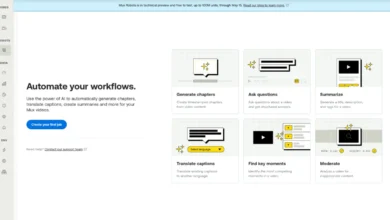
By the time the sales call reaches its midpoint, the platform has typically completed processing the client’s proprietary video. Instead of walking through simulated scenarios, the sales representative opens the prospect’s personalized page to reveal real-time automated outputs derived directly from the uploaded file: AI-generated transcriptions, precise timestamped scene detections, localized audio dubbing, automated summaries, and structured search indexing results. This immediate loop of input and output fundamentally alters the psychological dynamic of the sales conversation. Prospects cease asking whether the software can handle their specific operational requirements and instead pivot immediately toward discussions concerning API integration, scale, and enterprise deployment.
To maximize the effectiveness of these hyper-personalized demonstrations, Mux realized that the software interface alone was insufficient; the sales team required structured guidance to interpret and present the automated outputs effectively. The system therefore generates a comprehensive "Conversation Brief" alongside the branded landing page.
This internal sales enablement document translates the data harvested by Firecrawl into concrete talking points structured around a proprietary framework focused on discovery, focus, and outcome. For example, if a prospective media company’s website emphasizes rapid indexing of short-form video assets for social media distribution, the brief provides the sales representative with precise, numbered talking points detailing how Mux Robots automatically ranks thumbnails, generates timestamped scene markers, and formats short-form catalogs.
Crucially, these briefs are fully editable. Account executives retain the editorial autonomy to modify talking points, adjust framing based on real-time conversational cues during the sales call, and leverage Mux’s instant clipping API to generate shareable, bite-sized clip links on the fly. This synthesis of automated intelligence and human sales expertise ensures that technology acts as an enabler of high-value strategic dialogue rather than a rigid script provider.
The introduction of this automated, context-driven demonstration methodology represents a broader evolutionary trend across the enterprise software sector. As enterprise software buyers experience fatigue from traditional, high-friction sales cycles dominated by lengthy slide presentations and delayed proof-of-concept deployments, companies are increasingly shifting toward product-led growth (PLG) strategies and instantaneous, zero-friction personalization.
By removing the administrative and technical barriers that traditionally separated a prospect from experiencing software using their own data, Mux has compressed the enterprise sales timeline. The overarching metric of success for this initiative is not merely aesthetic sophistication or positive qualitative feedback during sales calls, but tangible acceleration in conversion rates, shortened sales cycles, and increased velocity from initial prospect engagement to closed-won contract execution.
Furthermore, because Mux maintains end-to-end ownership of the demonstration infrastructure—from the initial web scrape via Firecrawl to the final API-driven video processing pipeline—the organization possesses granular analytics regarding where and how prospects engage with the evaluation environment. This data loop allows engineering and product teams to continuously refine the underlying Mux Robots architecture based on real-world usage patterns observed across diverse industry verticals.
As software markets become increasingly saturated, the ability to eliminate the cognitive translation gap for prospective buyers will likely separate market leaders from legacy competitors. Mux’s strategy demonstrates that the future of enterprise software sales lies not in explaining what a product can do in theory, but in proving its value instantly, automatically, and within the exact operational context of the customer’s own business.