Beverage industry giants turn to fuel hedging strategies to navigate volatile transportation markets and surging operational costs

Major players in the global beverage industry, including Molson Coors and Primo Brands, are increasingly turning to complex financial hedging instruments to mitigate the impact of historically high fuel prices and a volatile freight environment. As geopolitical instability—specifically the ongoing conflict in Iran—disrupts energy markets and sends transportation costs soaring, these corporations are seeking to establish price predictability for their supply chains. The move reflects a broader trend among major consumer goods companies, which are finding that traditional cost-management strategies are no longer sufficient to combat the compounding effects of inflationary pressure, labor shortages, and regulatory hurdles.
The Convergence of Geopolitical Volatility and Operational Costs
The current economic landscape for beverage distributors is characterized by a "perfect storm" of logistical challenges. According to recent Q3 earnings disclosures, companies are grappling with an 8.1% increase in the cost of goods sold per hectoliter, a figure driven largely by the convergence of rising aluminum prices, elevated natural gas requirements for brewing processes, and a tightening freight market.
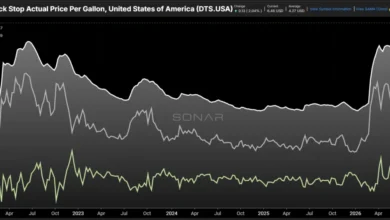
The primary catalyst for this instability remains the conflict in Iran, which has reverberated through global energy markets, pushing on-highway diesel prices to a staggering $5.70 per gallon. This represents a significant year-over-year increase of $1.86, according to November 2026 data from the Energy Information Administration. For firms that rely on heavy, energy-intensive transportation networks, these price spikes are not merely a line-item concern but a fundamental threat to profit margins.
Molson Coors CFO Tracey Joubert highlighted the multi-faceted nature of these pressures, noting that the company’s transportation network is experiencing the dual impact of rising fuel costs and restricted carrier capacity. Despite maintaining long-term transportation contracts, the company has been forced to increasingly utilize the spot market, where capacity constraints have led to significantly higher, often prohibitive, shipping rates.
Strategic Hedging: A Tool for Stability
In response, firms like Molson Coors and Primo Brands are doubling down on hedging programs. Hedging, in this context, involves entering into financial contracts that lock in fuel prices at a set rate, effectively shielding the company from further market spikes.
Will Dusek, a partner at AlixPartners, explains that while hedging is often misconstrued as a tool solely for cost-cutting, it is fundamentally a risk management strategy. "A hedging program is about managing price exposure, not just protecting yourself from rising prices," Dusek noted. By establishing price certainty, companies can better forecast their quarterly earnings and allocate capital with greater confidence, despite the chaos in the broader energy sector.
Primo Brands, the parent company of household names such as Pure Life, Arrowhead, and Saratoga, has opted to increase its diesel hedging for 2027 to levels consistent with its 2026 strategy. CEO Eric Foss emphasized that while these measures do not provide a total shield against inflation, they serve as a critical lever for internal cost control. CFO David Hass added that while the rates locked in for 2027 exceed 2026 averages, they remain significantly lower than current spot market prices, providing a vital cushion against potential future volatility.
The Broader Context of Freight and Regulatory Pressure
The reliance on fuel hedging is compounded by a structural shift in the trucking industry. The market is currently experiencing a "tightening" effect caused by a confluence of regulatory and demographic factors. New federal mandates regarding non-domiciled commercial driver’s licenses (CDL), coupled with stringent efforts to codify English-language proficiency requirements for drivers operating in border regions, have limited the pool of available labor.
These regulatory pressures, combined with a persistent shortage of drayage drivers, have pushed the freight market into a state of chronic undersupply. When carriers face labor shortages and rising fuel costs, they pass these expenses back to the shipper. This has left companies like Molson Coors in a difficult position: their internal $450 million savings program has been highly effective in offsetting standard inflationary pressures, yet it remains insufficient to combat the explosive growth in transportation-specific input costs.
Expert Analysis: Is Hedging the New Normal?
Despite the clear benefits of price stability, fuel hedging remains a niche strategy among logistics professionals. According to Eddison Lee, a partner at AlixPartners, the implementation of such programs is both difficult to justify and operationally complex. "The business case is hard to justify day to day," Lee stated. "Hedging solutions can be costly, and effective application requires either a sophisticated procurement desk or outside specialist."
Most firms still prefer to use fuel surcharges and delivery fees to pass costs directly to the consumer. Primo Brands has signaled that it maintains this flexibility, with management noting that they will utilize surcharges should cost pressures remain elevated. However, as the volatility of the global fuel market shows no sign of abating, the appetite for sophisticated risk management tools like hedging is growing.
Sagar Shah, SVP of supply and marketplace at Uber Freight, suggests that the predictability offered by hedging is becoming an essential competitive advantage. "While we are in such a volatile fuel environment, this is a way for the shipper to lock in fuel prices," Shah noted. The ability to guarantee a transport cost enables companies to maintain stable retail pricing, which is crucial for maintaining brand loyalty in the competitive beverage sector.
Looking Ahead: 2027 and Beyond
As companies prepare for the fiscal year 2027, the focus remains on resilience. The use of financial derivatives to stabilize fuel costs is expected to remain a central component of the corporate strategy for large-scale manufacturers, especially as they look to decouple their operational stability from the unpredictability of global geopolitical events.
However, industry analysts warn that hedging is not a panacea. The cost of maintaining these financial instruments can itself be significant, and if the market were to suddenly correct downward, companies locked into high-price hedging contracts could find themselves at a disadvantage. Consequently, most firms are adopting a "blended" approach: maintaining moderate hedging positions to ensure a baseline of price stability while preserving the flexibility of fuel surcharges to address extreme, unexpected spikes.
The situation remains fluid. With energy markets closely tied to the outcome of the conflict in Iran, supply chain leaders are maintaining a high state of vigilance. For the beverage sector, which relies on the seamless movement of heavy products from production plants to distribution centers, the ability to successfully navigate the fuel market will likely be a defining factor in operational success for the coming years.
Summary of Key Impacts
- Financial Risk: The primary driver for hedging is the avoidance of "price shock," which can erode margins in an industry where volume is high but per-unit profit is often thin.
- Operational Strain: Tightening freight capacity, exacerbated by a driver shortage and new CDL regulations, has increased the reliance on spot markets, where companies are exposed to the full brunt of volatile fuel pricing.
- Strategic Flexibility: While companies like Molson Coors and Primo Brands are hedging, they are also maintaining traditional tools, such as delivery surcharges, to ensure they have the agility to respond if hedging contracts prove insufficient.
- Industry Precedent: The actions taken by these firms are being watched closely by others in the food and beverage space, with entities like United Natural Foods, Inc. also signaling interest in similar, structured approaches to cost management.
As the industry moves forward, the integration of financial procurement desks with supply chain logistics operations will likely become more common. In an era defined by global instability, the companies that thrive will be those that can successfully integrate financial rigor with operational excellence. For now, the "lock-in" strategy remains the primary defense against a fuel market that continues to defy conventional stability models.