AWS Weekly Roundup: November 2026 Developer Tooling and Cloud Infrastructure Updates

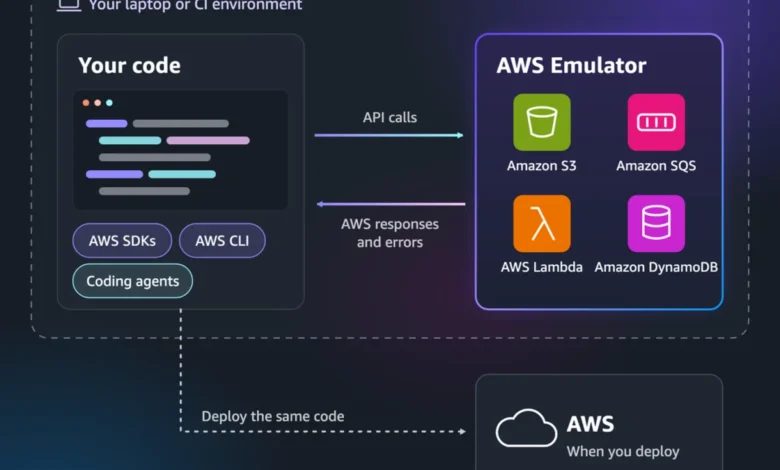
The recent launch of AWS Emulator marks a significant shift in how developers interact with cloud-native services, allowing for local execution of API interactions that previously required live cloud provisioning. This development, which headlined the week’s announcements, provides a sandbox environment where developers and automated coding agents can test, inspect, and refine code without incurring costs or managing cloud resources during the iterative development phase. By pointing existing AWS CLI tools or SDKs toward an HTTPS endpoint, engineers can simulate interactions with services like Amazon DynamoDB, significantly reducing the "feedback loop" time that is often a bottleneck in cloud development.
The Mechanics of Local Development with AWS Emulator
The introduction of the AWS Emulator addresses a longstanding friction point in software engineering: the necessity of deploying code to a live cloud environment to verify basic functionality. Historically, even minor code changes required a full deployment cycle. With this emulator, developers can run local tests on Linux, macOS, or Windows using Docker, mirroring the behavior of AWS services without needing an active AWS account for the emulation itself.
While the tool provides a high degree of fidelity, AWS has cautioned that it is not a complete replacement for cloud-based testing. Specifically, the emulator does not replicate complex AWS Identity and Access Management (IAM) configurations, resource-policy enforcement, or cross-Region behavioral nuances. As such, developers are advised to utilize the emulator for rapid, initial validation and rely on standard cloud environments for final security and compliance verification. The source code, now available on GitHub, invites community contributions to expand the library of supported API calls beyond the current baseline.
Advancing Hardware Isolation with Nitro Sandboxes
Complementing the local development push, Amazon has introduced Nitro Sandboxes for Amazon EKS, ECS, and EC2, aimed at enhancing security for multi-tenant environments. This feature allows individual pods or tasks to reside within their own virtual machine boundary while continuing to share the underlying physical EC2 hardware.
This evolution is particularly significant for enterprises handling sensitive data, as it allows for "confidential mode"—a configuration that protects workloads not only from other tenants but also from the node operators themselves. By leveraging hardware-level isolation, organizations can execute generated code from agents or manage third-party workloads with a higher degree of confidence. This capability is integrated into the existing AWS Nitro System, which has served as the backbone for AWS’s compute infrastructure for years, ensuring that these security gains do not come at the expense of performance or scalability.
Evolution of Agentic Workflows and Security
The recent update to the Amazon Bedrock AgentCore runtime underscores the industry’s rapid move toward more efficient AI-driven automation. By making the next-generation runtime the default, AWS has reduced agent session startup times to under two seconds. These runtimes now scale dynamically, supporting up to 8 vCPU and 32 GB of memory, while offering a cost-reduction profile of up to 68% in memory utilization. Each agent session is encapsulated within its own isolated microVM, maintaining security standards while increasing the throughput of agentic tasks.
Parallel to this, Amazon Cognito has implemented OAuth 2.0 token exchange, a feature that allows developers to exchange user tokens for downstream service tokens with narrower scopes. This is a critical development for developers building AI agents that operate on a user’s behalf. By limiting the scope and audience of the derived token, developers can ensure that agents follow the principle of least privilege, preventing the accidental exposure of sensitive user credentials across multiple backend services.
Data Management and Disaster Recovery Enhancements
Infrastructure reliability received significant attention this week with the addition of managed cross-Region disaster recovery for Amazon OpenSearch Service. Designed for high-availability requirements, this feature allows users to pair domains in different regions within the same account. AWS specifies a recovery objective of under one minute for data loss and under 20 minutes for recovery time in the event of an unplanned failover.
This is complemented by updates to Amazon ElastiCache Serverless for Valkey, which now supports vector, full-text, and hybrid search alongside server-side aggregations. These features are targeted at product discovery and recommendation engines, where the ability to query frequently changing data in real-time is paramount. By enabling these operations at the cache layer, developers can reduce the latency involved in retrieving agent memory or user-specific context.
Operational Governance and Cost Optimization
For administrative teams, the introduction of account-level retention policies in Amazon CloudWatch Logs simplifies the management of massive log volumes. Administrators can now enforce retention periods across all log groups or filter by specific name prefixes, ensuring that compliance requirements—such as long-term security log storage—are met without the need for manual, per-group configuration. This change, which allows for overlapping policies with the longest duration taking precedence, reduces the administrative burden of maintaining consistent logging standards across large-scale, multi-account AWS organizations.
Industry Context and Strategic Implications
The cumulative effect of these announcements points toward a strategic pivot at AWS: making the cloud more "agent-aware" and developer-friendly. The focus on rapid feedback loops, as highlighted in internal perspectives from AWS leadership regarding coding agents, suggests that the next generation of cloud development will be defined by the efficiency with which AI tools can interact with cloud APIs.

Data from the field confirms this trend. Companies like Zillow have demonstrated the efficacy of configuration-driven workflows using AWS Step Functions to manage over 100 million daily notifications. By adopting patterns like idempotent modules and campaign isolation, organizations can build systems that are not only resilient but also testable at scale. The emphasis on "testing before deployment" using tools like the TestState API is becoming the gold standard for large-scale engineering teams.
Looking Ahead: The Road to re:Invent
As the calendar turns toward late November, the industry is preparing for AWS re:Invent in Las Vegas, scheduled for November 30 to December 4. The event is expected to feature over 2,200 sessions, focusing on the latest advancements in generative AI, serverless architecture, and cloud-native security. The announcements made this week serve as a preview of the architectural priorities that will dominate the conference.
For organizations currently auditing their cloud spend and operational overhead, the guidance provided by AWS on optimizing cost-per-task for Bedrock agents offers a framework for measuring Return on Investment (ROI). By documenting baselines and reconciling estimated costs with actual billing data, businesses can move from experimental AI deployments to sustainable, production-grade agentic systems.
In summary, the developments from the past week demonstrate a comprehensive effort to lower the barrier to entry for complex cloud tasks while simultaneously providing the high-level security and governance controls required by enterprise customers. Whether through local emulation, hardware-isolated sandboxes, or improved disaster recovery for search services, the underlying theme remains the same: accelerating the development cycle while maintaining rigorous operational integrity. Developers and architects are encouraged to review these updates against their current infrastructure to identify opportunities for efficiency gains and improved security postures.