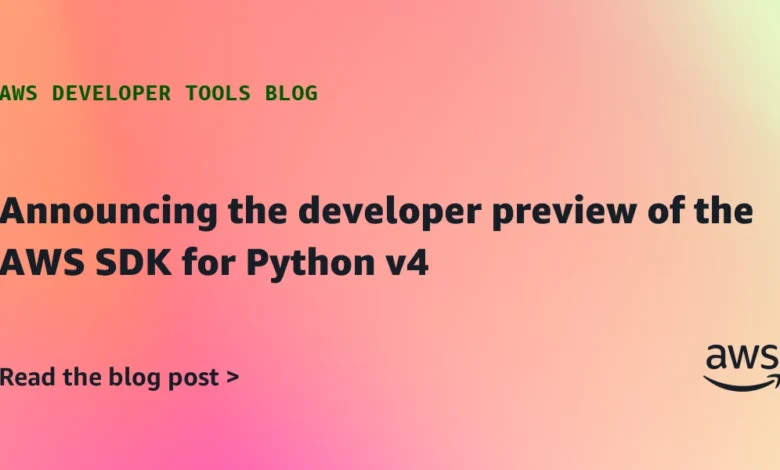
Announcing the developer preview of the AWS SDK for Python v4 | Amazon Web Services

The Evolution of the AWS Python Ecosystem
For over a decade, Boto3 has served as the de facto standard for Python developers interacting with AWS. While highly functional, Boto3 was built during an era when Python’s asynchronous capabilities were less mature. As modern application architecture moved toward microservices, serverless functions, and high-throughput data processing, the limitations of a synchronous, monolithic library became more apparent. The introduction of the v4 SDK is not merely an update but a complete re-engineering of the underlying framework.
The chronology of this development reflects AWS’s broader strategy to modernize its developer tooling. Following the release of newer SDKs for languages like Rust and Go, which prioritized performance and type safety, AWS engineers began drafting the architecture for a Python successor that would align with modern Python 3 standards. The developer preview, launched in late 2024, marks the first time the public can interact with this redesigned stack, allowing the community to provide feedback before the eventual General Availability (GA) release.
Core Architectural Advancements
The most significant departure from previous versions is the transition to a modular architecture. In Boto3, developers were often required to install the entire library, which included support for every AWS service, regardless of whether those services were utilized in the application. The v4 SDK shifts to a package-per-service model. If a project only requires interaction with Amazon S3 or Amazon Bedrock, the developer installs only those specific packages. This reduction in dependency bloat is expected to improve container startup times and streamline CI/CD pipelines, a critical factor for organizations optimizing for cost and cold-start latency in serverless environments.
Furthermore, native asynchronous support is now a first-class citizen. By leveraging Python’s asyncio library, the new SDK allows for concurrent execution of multiple API calls without the overhead of thread management. This is particularly transformative for tasks such as bulk data ingestion, multi-model AI inference via Amazon Bedrock, or managing large fleets of EC2 instances. The inclusion of AsyncClient classes alongside synchronous ones provides a bridge for developers to modernize legacy codebases incrementally.
Type Safety and Developer Experience
A recurring challenge in the Python ecosystem is the lack of strict type checking, which can lead to runtime errors that are costly to debug in production. The v4 SDK integrates comprehensive type hints across all service clients. This allows Integrated Development Environments (IDEs) like VS Code or PyCharm to provide real-time autocompletion and static analysis. By utilizing typed model objects—such as ListBucketsInput—developers can catch configuration errors during the coding phase rather than discovering them after a deployment. This shift toward "type-first" development is expected to reduce the incidence of malformed requests, which currently account for a significant portion of debugging cycles in large-scale cloud projects.
Implementation and Usage Patterns
For developers transitioning to the developer preview, the process begins with environment configuration. The SDK is designed to be compatible with standard AWS credential providers, reading from environment variables or local configuration files (~/.aws/config).
When implementing the new SDK, the shift in syntax is subtle but impactful. The transition from the traditional client instantiation to a context-manager approach ensures that HTTP connections are managed and closed efficiently. For instance, creating an Amazon S3 client now involves:
from aws_sdk_s3 import S3Client

with S3Client() as s3:
    response = s3.list_buckets(max_buckets=10, prefix="logs")
This pattern guarantees resource cleanup. For asynchronous workflows, the usage of async with ensures that network sockets are handled appropriately within the event loop, preventing potential leaks during high-load scenarios. The support for event streaming—particularly in the context of LLM responses via Bedrock—enables developers to handle data as it arrives, rather than waiting for an entire payload to be buffered, which significantly lowers perceived latency for end-users.
Broader Industry Implications
The implications of this transition extend beyond simple syntax improvements. As enterprises increase their reliance on generative AI, the ability to stream responses from models like Claude via Amazon Bedrock has become a competitive requirement. The v4 SDK’s native handling of streaming events directly addresses this need, providing a standardized interface that is both predictable and performant.
Data from recent developer surveys suggests that Python remains the dominant language for data science and AI/ML, two fields where AWS is heavily invested. By aligning its primary interface with the best practices of the Python community—such as modularity and modern async patterns—AWS is effectively lowering the barrier to entry for developers who prioritize performance.
However, AWS officials have maintained a cautious stance regarding the current state of the SDK. By designating the release as a "Developer Preview," the company is signaling that the API surface area is subject to change. They have explicitly advised against migrating production-grade systems to the v4 SDK at this time. The strategy is to utilize the community as a testing ground to identify edge cases, performance bottlenecks, and usability hurdles that might not have appeared in internal testing environments.
Roadmap to General Availability
The timeline for the transition to GA remains flexible, contingent upon the volume and quality of feedback received via GitHub. Currently, the AWS engineering team is prioritizing several key areas:
- Feature Parity: Ensuring that the full spectrum of features available in Boto3 is replicated in the new modular architecture.
- Performance Benchmarking: Optimizing the overhead of the new client layer to ensure that it matches or exceeds the performance of the older, monolithic SDK.
- Documentation Expansion: Creating comprehensive guides that assist developers in migrating complex Boto3 codebases to the v4 framework.
While no firm date has been set for the transition to stable release, the frequency of updates in the developer preview suggests an accelerated development cycle. The community has been encouraged to open issues on the official GitHub repository, particularly regarding the handling of specific AWS service protocols and the ergonomics of the new client methods.
Conclusion and Outlook
The AWS SDK for Python v4 represents a strategic alignment between AWS and the modern Python ecosystem. By prioritizing modularity, asynchronous throughput, and strict typing, Amazon is positioning its cloud infrastructure to be more accessible to the next generation of software architects. While the current developer preview serves as a sandbox for experimentation, the architectural foundations being laid now will likely define the interaction layer between Python and AWS for the coming decade.
For organizations currently building on AWS, the recommendation is clear: begin evaluating the v4 SDK in non-critical environments. By testing the new modular patterns against existing workflows, developers can prepare their infrastructure for the inevitable shift. The future of AWS cloud development in Python is clearly leaning toward a more efficient, type-safe, and high-concurrency model, and the v4 SDK is the primary vehicle for that transformation. As the project nears its eventual GA release, the feedback provided by the community today will be the ultimate determinant of the SDK’s success in real-world, large-scale cloud operations.