Canada and France Forge Deep Strategic Alliance in Defense, Energy, and Space Amid Shifting North Atlantic Geopolitics

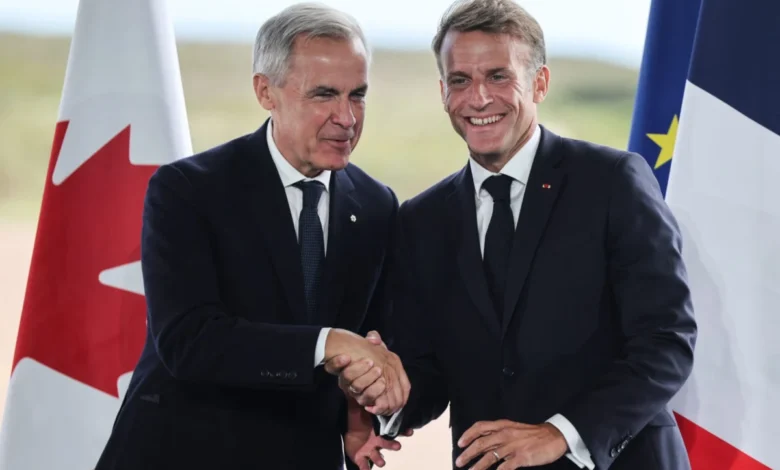
Canadian Prime Minister Mark Carney and French President Emmanuel Macron met on Sunday to seal a sweeping bilateral pact designed to enhance cooperation across defense, space exploration, energy security, and advanced technology. The high-stakes meeting, hosted at the airport in the French territorial archipelago of Saint-Pierre and Miquelon located just off the coast of Newfoundland, underscores a rapid and profound realignment in Canadian foreign policy. As Ottawa seeks to insulate its economy and national security from mounting pressures originating south of the border, its strategic pivot toward Europe represents one of the most significant shifts in North Atlantic diplomacy in decades.
The newly minted agreement commits the space agencies and defense ministries of both nations to joint infrastructure development. This includes collaborative efforts on launch systems and ground-based reception facilities, signaling a shared intent to bolster sovereign capabilities in an increasingly contested aerospace domain. Beyond defense and space, the leaders cemented frameworks for cooperation in telecommunications, climate resilience, advanced computing—such as quantum computing and supercomputing—and the critical minerals supply chain.
A Strategic Pivot Toward Europe
Sunday’s discussions build directly upon Carney’s historic parliamentary announcement just days prior, during which he expressed open support for Canada becoming the European Union’s first associate member. That proposal, which has sent ripples through international trade and diplomatic circles, is framed by Ottawa as an essential defensive maneuver against economic coercion.
“Canada and Europe will build an alliance for the future that will strengthen our collective resilience so we can live our lives as we choose based on the values that we share,” Carney declared following the talks with Macron.
The catalyst for this sudden transatlantic embrace is a cooling of relations between Ottawa and Washington. Under the administration of U.S. President Donald Trump, the Canadian government has faced a barrage of aggressive trade measures, including steep tariffs, persistent demands for unilateral economic concessions, and repeated rhetorical suggestions that Canada should be annexed as the 51st U.S. state. These unprecedented pressures have forced Canadian policymakers to aggressively diversify their economic and security partnerships, moving away from a historically heavy reliance on the United States and anchoring themselves more firmly within European multilateral structures.
The Energy Crisis and the Search for Alternative Supplies
For France, the meeting offered a timely opportunity to secure vital energy inputs amid severe global market disruptions. The ongoing war involving Iran has constricted petroleum supplies, sending shockwaves through international energy markets and heightening European anxieties over surging fuel prices and home heating costs.
During the joint press engagement, President Macron highlighted Canada’s vast natural endowments as a critical asset for European energy security.
“Canada is a country with significant resources of critical minerals and rare earths. It is also a major oil and natural gas producer,” Macron noted. “What we want to do is conclude agreements to secure more liquefied natural gas that can be shipped to Europe’s Atlantic coast.”
The push for liquefied natural gas (LNG) and critical minerals—such as lithium, cobalt, and nickel, which are essential for electric vehicle batteries and defense technologies—creates a symbiotic economic relationship. While France and the broader EU desperately require diversified supply chains insulated from Middle Eastern volatility and Russian pipeline politics, Canada finds a massive, stable market eager to purchase its natural resources without the political leverage or protectionist threats currently emanating from Washington.
Geopolitical Realignments in the Arctic and North Atlantic
The summit in Saint-Pierre and Miquelon—an overseas collectivity of France with a population of approximately 5,800—also provided a backdrop for broader discussions regarding Arctic sovereignty and international law. The meeting followed closely on the heels of a heavily scrutinized agreement regarding Greenland, announced by President Trump. The deal successfully expanded the U.S. military footprint on the island while maintaining nominal Danish sovereignty, averting what could have been a severe breach of international norms following months of rhetoric from Washington regarding the acquisition of the semiautonomous Arctic territory.
Macron offered public praise for the resolution of the Greenland standoff, framing it as a triumph for international stability.
“Danish sovereignty is being respected, international law is being respected,” Macron stated on Saturday prior to Carney’s arrival. “Anything that helps ease tensions is a good thing.”
The Arctic has emerged as a premier theater of geopolitical competition, drawing the focus of Russia, China, and the United States. By knitting their defense, aerospace, and intelligence capabilities closer together, Canada and France are signaling that middle powers can and will coordinate to protect northern sovereignty and maritime routes, independent of unilateral declarations by superpowers.
Timeline of Recent Escalations and Diplomatic Shifts
The speed at which Canada has recalibrated its foreign and economic policy is historic. A chronological examination of recent events highlights the compression of diplomatic timelines:
- Early Months: The U.S. administration institutes a series of sweeping protectionist tariffs on Canadian goods, accompanied by public speculation from Washington regarding Canadian statehood, straining bilateral ties to a historic low.
- Mid-Week: Canadian Prime Minister Mark Carney addresses parliament, stunning international observers by endorsing the concept of Canada pursuing associate membership within the European Union.
- Saturday: French President Emmanuel Macron arrives in the French territorial enclave of Saint-Pierre and Miquelon, emphasizing the necessity of bilateral cooperation in the face of global instability.
- Sunday: Carney and Macron formally meet, establishing joint directives for space infrastructure, defense sharing, critical mineral extraction, and European-bound LNG exports.
Broader Economic and Political Implications
The implications of the Carney-Macron pact extend far beyond the immediate geography of North America and Western Europe. By institutionalizing cooperation in cutting-edge technological sectors—including quantum computing, satellite networks, and supercomputing—Canada and France are positioning themselves at the forefront of the global knowledge economy. These sectors are increasingly viewed through a national security lens, where technological sovereignty is as vital as military defense.
Furthermore, the alignment offers a blueprint for how middle powers can navigate a fractured, multipolar global order characterized by great power competition. For Canada, the transition from a nearly singular economic orbit around the United States to a diversified portfolio featuring deep European integration represents a structural transformation of its national identity.
Critics may point to the logistical and regulatory hurdles of integrating Canadian infrastructure with European standards—particularly regarding energy transport and data governance—as significant challenges. However, the political will demonstrated by Ottawa and Paris suggests that both capitals view these hurdles as secondary to the urgent necessity of strategic autonomy.
As the implementation phases of the space, defense, and energy agreements begin, the partnership between Canada and France will likely serve as a cornerstone for a revitalized transatlantic security architecture. In an era defined by trade wars, resource nationalism, and shifting geopolitical boundaries, the meeting off the coast of Newfoundland has firmly established a new axis of cooperation designed to weather the storms of the twenty-first century.
Related posts: