ReadyOn Deploys Four Walls Architecture to Secure Multi-Tenant Enterprise Workloads on Amazon EKS

The modern enterprise software landscape increasingly relies on multi-tenant cloud architectures to balance operational efficiency with cost reduction. However, when handling deeply sensitive corporate assets—such as payroll records, complex organizational hierarchies, and large-scale workforce intelligence data for Fortune 100 clients—efficiency can never compromise data isolation. ReadyOn, a prominent Amazon Web Services (AWS) Partner specializing in intelligent labor orchestration platforms, has addressed this fundamental security challenge through the rollout of its innovative "Four Walls" security model on Amazon Elastic Kubernetes Service (Amazon EKS).
Kubernetes has established itself as the de facto standard for orchestrating containerized applications, powering mission-critical workloads across the globe. Yet, security experts have long noted that upstream Kubernetes installations are not inherently secure out of the box. Historically, default configurations permit anonymous requests to reach the API server where they are only blocked by Role-Based Access Control (RBAC), containers routinely execute with root privileges unless explicitly restricted, and network policies are entirely absent until manually authored by systems engineers.
While securing single-tenant clusters is already a recognized engineering hurdle, introducing a multi-tenant paradigm fundamentally alters the threat model. In a multi-tenant environment, the primary security objective shifts from preventing external intrusions to mitigating lateral movement—specifically, ensuring that Tenant A can under no circumstances access the data, resources, or compute infrastructure belonging to Tenant B. Traditionally, many platform developers have relied exclusively on Kubernetes namespaces to enforce this boundary. However, Kubernetes designers never intended namespaces to serve as an impervious security boundary on their own. Recognizing that a single layer of defense is insufficient for enterprise compliance, ReadyOn engineered an overlapping, compound defense framework that operates across multiple independent layers of the technology stack.
Background Context and the Stakes of Enterprise Multi-Tenancy
ReadyOn’s Harmony platform processes vast quantities of sensitive enterprise information, including payroll processing metrics, personnel evaluations, and real-time operational analytics for hundreds of thousands of corporate employees worldwide. The exposure of such data would not only inflict severe reputational damage on the technology provider but would also trigger immediate, cascading regulatory liabilities across multiple international jurisdictions.
Faced with these high stakes, ReadyOn engineers determined that relying solely on namespace isolation—the equivalent of trusting a single wall—was fundamentally unacceptable. Instead, the organization developed a defense-in-depth paradigm known as the Four Walls model. This architecture establishes four distinct, independent barriers spanning different layers of the IT stack: Kubernetes namespaces, dedicated Karpenter-managed node pools, Amazon Virtual Private Cloud (Amazon VPC) security groups, and per-tenant Amazon Aurora databases. To successfully breach a tenant boundary under this model, an unauthorized user or compromised process would need to simultaneously bypass the Kubernetes API, the node scheduler, the underlying AWS software-defined network, and the isolated data layer.
Wall 1: Namespace Isolation and GitOps-Enforced Consistency
The foundation of ReadyOn’s security architecture begins at the Kubernetes API layer with namespace isolation. Although namespaces are recognized as soft multi-tenancy boundaries, they provide the logical structure required to anchor the remaining security layers.
To eliminate configuration drift and human error, ReadyOn operationalizes its infrastructure through a GitOps workflow powered by Argo CD. When onboarding a new enterprise tenant, engineers introduce a single declarative entry into a centralized configuration repository. Automation pipelines instantly generate all requisite cluster resources, including the tenant namespace, tailored network policies, specific RBAC bindings, strict resource quotas, and secret management configurations. Consequently, "legacy" tenants with outdated or weaker security postures cannot exist within the ecosystem; every tenant receives an identical, hardened security baseline by construction.
Furthermore, dynamic admission control frameworks validate all submitted resources against a rigorous set of security policies. These controls actively block privileged container configurations, prevent the creation of unauthorized cluster-wide resource types, and enforce strict RBAC role bindings. Each tenant group is programmatically restricted to its own namespace, ensuring that no tenant principal can inspect, modify, or list resources outside of its authorized domain. To maintain state integrity, the GitOps controller continuously reconciles the live cluster state against the declared state in Git, automatically reverting any unauthorized manual modifications—such as changes made via kubectl commands—within seconds.
Wall 2: Compute Isolation via Karpenter
Moving beyond the Kubernetes API layer, Wall 2 addresses compute isolation, ensuring that tenant code never executes on shared worker nodes. ReadyOn utilizes Karpenter, an automated node provisioning project for Kubernetes, to establish dedicated compute infrastructure for individual tenants.
The architecture enforces compute separation through a dual-taint strategy. Karpenter provisioners dynamically spin up nodes characterized by two distinct taints: a unique tenant-identifier taint (such as tenant=acme-corp) and a specific workload-type taint (such as workload=frontend). Consequently, a containerized workload must successfully tolerate both taints to be scheduled. Tenant A’s frontend nodes are physically and logically segregated from Tenant A’s background batch processing nodes, and both are entirely isolated from Tenant B’s underlying infrastructure.
In addition, admission controllers rigorously validate that pod toleration claims precisely match the namespace’s established tenant identity, preventing the scheduler from executing cross-tenant placements. At the node operating system level, all application nodes enforce Instance Metadata Service Version 2 (IMDSv2) with a reduced hop limit, mitigating potential container escape risks. IAM roles attached to individual nodes are strictly scoped to a single tenant’s cloud resources, ensuring that even in the unlikely event of a container breakout, the blast radius remains tightly contained.
Wall 3: Network Isolation at the Amazon VPC Layer
While the first two walls operate within the software abstractions of Kubernetes, Wall 3 drops entirely below the container orchestration layer to enforce rigid network segmentation at the Amazon VPC and security group level. This infrastructure is managed directly by AWS and remains entirely outside the direct control of the Kubernetes control plane or application pods.
Each tenant’s dedicated Amazon Aurora database cluster is protected by an AWS security group that permits inbound connections exclusively from the security group attached to that specific tenant’s application nodes. As a result, Tenant A’s application workers are physically incapable of opening a TCP connection to Tenant B’s database. This network-level isolation is enforced by the underlying AWS software-defined network. Bypassing it would require circumventing the VPC routing architecture itself.
The overarching VPC topology is meticulously structured into four distinct tiers:
- Public Perimeter Tier: Reserved exclusively for enterprise-grade load balancers.
- Application Tier: Housed within private subnets running EKS worker nodes.
- Database Tier: Encompassing Aurora clusters completely isolated from direct internet access.
- Control Plane Tier: Restricting access to private EKS API endpoints via VPN connections integrated with OpenID Connect (OIDC) and Multi-Factor Authentication (MFA).
Additionally, Kubernetes network policies enforce a strict default-deny posture for all inter-namespace traffic, while Amazon VPC Flow Logs continuously capture network telemetry to feed automated anomaly detection systems.
Wall 4: Data Isolation and Storage Encryption
The final barrier in ReadyOn’s architecture targets the ultimate repository of corporate value: the underlying data stores. While shared database architectures rely heavily on application-level query logic—where a single omitted "WHERE tenant_id = ?" clause can result in catastrophic data leakage—ReadyOn deliberately provisions dedicated Amazon Aurora clusters for every individual tenant.
Because each tenant maintains an isolated database instance, there are no shared database tables or row-level filters that can be misconfigured. Tenant A’s application code simply lacks the database endpoint, authentication credentials, and network routing path required to communicate with Tenant B’s data store. Furthermore, dedicated Aurora clusters facilitate the implementation of unique AWS Key Management Service (AWS KMS) encryption keys per tenant. Data-at-rest is encrypted using distinct cryptographic keys, ensuring that even if raw storage media were somehow compromised, one tenant’s key cannot decrypt another tenant’s information.
Complementing database segregation, workloads authenticate with AWS services using short-lived credentials issued via IAM Roles for Service Accounts (IRSA). By leveraging OIDC federation between the EKS cluster and AWS Security Token Service (AWS STS), tenant workloads assume transient IAM roles scoped exclusively to their individual resource boundaries. These temporary credentials expire within minutes, eliminating the operational risks associated with long-lived static access keys. Per-tenant observability backends further guarantee that telemetry data, logs, and performance metrics remain strictly partitioned.
Threat Modeling and Adversarial Validation
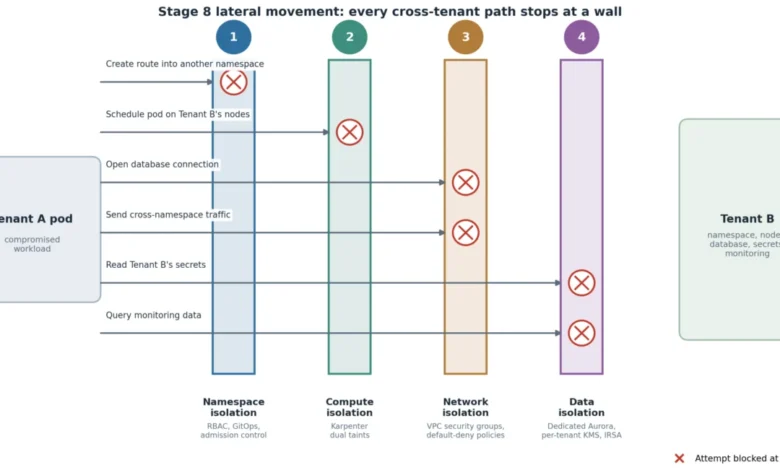
To verify the resilience of this multi-layered approach, ReadyOn maps its defensive controls against comprehensive multi-tenant threat models, directly aligning potential attack vectors with standard MITRE ATT&CK techniques. The most critical inflection point within this framework occurs during simulated lateral movement phases (such as Stage 8 of internal threat models), where an adversary who has compromised a low-privilege container within a Tenant A pod attempts to pivot toward Tenant B resources.
Under empirical adversarial testing, cross-tenant attack paths are systematically neutralized: attempts to route traffic into another namespace are halted at Wall 1; efforts to schedule malicious pods onto foreign worker nodes are blocked at Wall 2; attempts to establish unauthorized database connections or initiate cross-namespace communication are dropped at Wall 3; and attempts to exfiltrate secrets or query foreign monitoring telemetry are terminated at Wall 4. Regular adversarial penetration testing exercises simulating fully compromised tenant workloads have consistently failed to discover or execute a viable cross-tenant breach path.
Broader Industry Implications and Future Outlook
The deployment of the Four Walls model by ReadyOn offers a valuable architectural blueprint for engineering teams operating mission-critical, multi-tenant software-as-a-service (SaaS) platforms on Amazon EKS. By demonstrating that robust zero-trust isolation can be achieved without sacrificing the economic advantages and operational agility of multi-tenancy, the architecture underscores the vital importance of defense-in-depth methodologies.
As cloud-native environments continue to grow in complexity, relying on single-layer security controls is increasingly recognized as an unviable strategy for enterprise IT governance. ReadyOn’s integration of GitOps consistency, automated compute provisioning, software-defined network controls, and dedicated data layers establishes a rigorous standard for enterprise security compliance. For organizations managing sensitive corporate data within containerized ecosystems, adopting multi-layered, interdependent defensive frameworks will remain an essential mandate in maintaining client trust and regulatory compliance in an evolving threat landscape.