Upgrade Amazon EKS clusters with confidence using Kubernetes version rollbacks | Amazon Web Services

The Historical Challenge of Kubernetes Upgrades
The inability to roll back a Kubernetes control plane has necessitated the creation of elaborate "compensating mechanisms" within IT departments. To manage the inherent risk, organizations have historically relied on rigorous multi-stage strategies. These include extensive "bake periods"—where new versions are tested in isolated environments for weeks—staggered deployment groups to minimize the blast radius of a potential failure, and months-long upgrade cycles that involve intensive manual sign-offs.
These defensive strategies, while intended to protect production workloads, have created a significant secondary problem: technical debt. Kubernetes releases three minor versions per year. When teams lack confidence in their ability to recover from a failed upgrade, they often delay the process entirely. Consequently, thousands of enterprise clusters remain tethered to aging versions, exposing organizations to security vulnerabilities and, eventually, the forced migration mandates of extended support timelines. The industry has sought a solution to this for years; while initiatives like KEP-4330 have attempted to address the issue through emulated versions, those methods kept clusters in a transitional, non-production state rather than returning them to a fully validated environment.
The Mechanics of EKS Version Rollback
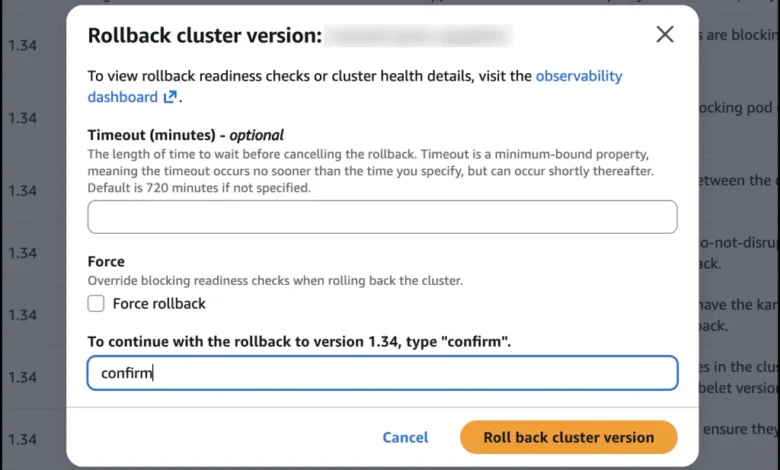
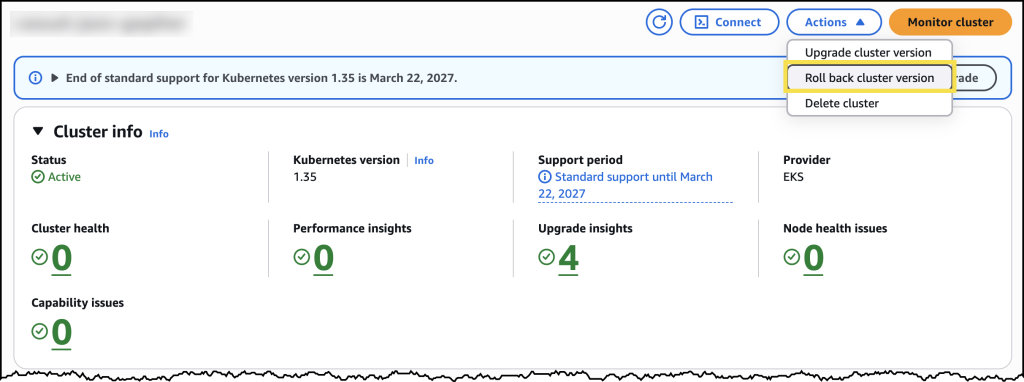
The new functionality introduced by AWS allows administrators to reverse a Kubernetes version upgrade within a seven-day window. Unlike theoretical or emulated rollback strategies, this feature returns a cluster to its exact, previously functional state. If a team upgrades from, for instance, Kubernetes 1.34 to 1.35 and discovers a critical compatibility issue with an internal microservice or a third-party add-on, the EKS console now provides an "undo" button.
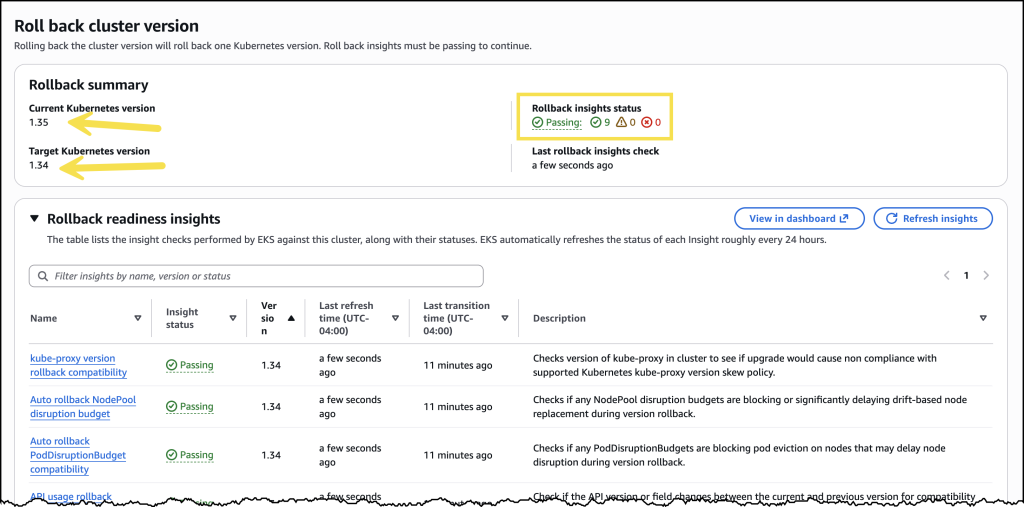
This process is governed by a strict, incremental logic. The system supports rolling back one minor version at a time, ensuring that the cluster configuration remains stable throughout the transition. Furthermore, AWS has integrated "cluster insights" directly into the rollback workflow. Before a revert is initiated, the system automatically assesses the cluster’s readiness. It flags potential conflicts, such as node version incompatibilities or dependencies on deprecated APIs, allowing administrators to address these risks before the rollback commences. For urgent scenarios where an administrator has already conducted a manual impact analysis, the system provides a --force flag to bypass these automated safety checks.
Expanding Capabilities: EKS Auto Mode
The rollback feature is particularly significant for users of EKS Auto Mode, a fully managed infrastructure service that abstracts away the complexities of compute, networking, and storage management. In an Auto Mode environment, the rollback process is more intricate because it must synchronize the state of both the control plane and the managed nodes.

Because EKS prioritizes workload stability, the system is designed to respect existing Pod Disruption Budgets (PDBs) during a rollback. This ensures that even during a reversion, the cluster maintains the minimum required capacity to serve traffic. AWS has acknowledged that this adherence to PDBs may extend the time required for a full cluster revert. To provide operators with granular control, a new cancel API has been introduced. This allows administrators to stop a node rollback at any point if they determine that the process is impacting latency or if they wish to adjust their PDB settings to accelerate the transition. By default, EKS will never override these budgets, ensuring that the rollback process remains as non-disruptive as possible.
Implications for Regulated Industries
For sectors such as finance, healthcare, and government—where uptime and compliance are non-negotiable—this announcement carries profound implications. In regulated environments, the "upgrade or expire" cycle of Kubernetes has historically been a major point of friction for auditors and site reliability engineers (SREs).
By providing a guaranteed path back to a known, stable configuration, EKS removes the primary deterrent to keeping clusters patched and current. This capability effectively lowers the risk threshold for continuous integration and deployment (CI/CD) pipelines. Analysts suggest that this will likely lead to an acceleration of version adoption across the EKS ecosystem, as the cost of "being wrong" during an upgrade has been drastically reduced. Furthermore, by standardizing the rollback experience, AWS is effectively commoditizing what was previously a high-skill, high-stress manual intervention.
Operational Workflow and Availability
The implementation of this feature is designed to be seamless for existing EKS users. Within the AWS Management Console, a cluster administrator can navigate to the configuration page of an upgraded cluster to view the remaining rollback window. The interface provides a clear status dashboard, detailing the progress of the control plane revert and the health of the underlying node infrastructure.
Data from early implementations indicate that a control plane rollback typically requires approximately 20 minutes, a timeframe that aligns with the duration of a standard, forward-moving upgrade. The integration of node-level monitoring ensures that the revert is not just a software change, but a holistic return to a validated operational baseline.
Economic and Strategic Context
AWS has confirmed that these version rollback capabilities are available at no additional cost across all commercial AWS regions. Users will continue to pay only for their standard EKS control plane fees and the compute resources provisioned within their clusters. By incorporating this feature as a native component of the EKS service rather than a premium add-on, AWS is positioning the reliability of its managed Kubernetes offering as a key competitive differentiator.
This development serves as a milestone in the broader evolution of cloud-native infrastructure. As Kubernetes matures, the focus of the community and major cloud providers is shifting from basic functionality to operational resilience. By tackling the "one-way door" problem, AWS is addressing one of the final remaining structural obstacles to large-scale, enterprise-wide Kubernetes adoption.
The feature is immediately available for all EKS clusters, regardless of whether the user manages their own worker nodes or utilizes the fully managed EKS Auto Mode. With this, the burden of managing complex, long-term version lifecycles is significantly lessened, allowing engineering teams to shift their focus from infrastructure maintenance to application-level innovation. As the industry moves toward a model of continuous, low-risk infrastructure updates, the ability to safely revert will likely become the standard requirement for any enterprise-grade container orchestration platform. For now, the introduction of this feature signals that the era of "upgrade anxiety" for Kubernetes administrators may finally be drawing to a close.