AWS Weekly Roundup: OpenAI GPT-6 Astra on Amazon Bedrock, Amazon Quick desktop GA, Kiro for students, and more (September 14, 2026) | Amazon Web Services

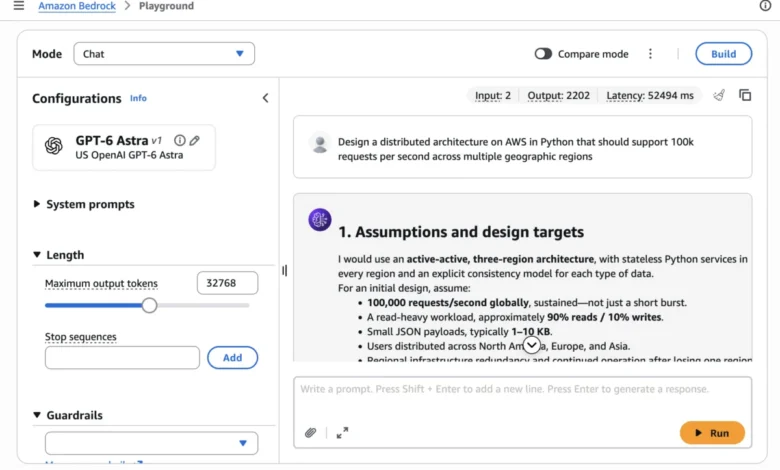
The Evolution of the Generative AI Landscape
The arrival of GPT-6 Astra on Bedrock follows a rigorous development cycle in the generative AI sector. Since the public emergence of Large Language Models (LLMs) in late 2022, the industry has transitioned from simple text generation and basic chatbot functionality to the era of "AI agents." These agents are defined by their ability to act as intermediaries between software systems, capable of interpreting intent and executing sequences of commands across various applications.
GPT-6 Astra represents a generational leap in this category. Unlike its predecessors, which were largely confined to text-based interaction, Astra is engineered for "computer use"—the ability to operate interfaces, manipulate digital tools, and reconcile competing inputs from disparate sources. The model’s 1-million-token context window is a critical technical achievement, allowing it to process entire software repositories, multi-year legal contracts, or thousands of pages of internal documentation in a single prompt. This capacity addresses one of the primary friction points for businesses: the inability of previous models to maintain a coherent, deep understanding of massive, multi-faceted business workflows.
Chronology of Integration
The collaboration between AWS and OpenAI reflects a long-term roadmap to standardize AI infrastructure.
- Late 2023: AWS announced the expansion of Amazon Bedrock to include a wider array of third-party models, emphasizing a "model-agnostic" strategy.
- Early 2024: Industry demand for "agentic" AI workflows reached an inflection point, prompting AWS to prioritize infrastructure that supports long-context window models.
- Q3 2025: OpenAI finalized the development of GPT-6 Astra, focusing on multi-modal reasoning and browser-based automation.
- September 2026: The official launch of GPT-6 Astra on Amazon Bedrock, providing enterprise access through existing API frameworks and enabling integration with tools like ChatGPT Work and Codex.
Technical Specifications and Operational Utility
The technical architecture of GPT-6 Astra on Amazon Bedrock is designed to satisfy the rigorous security and compliance requirements of enterprise IT departments. A central feature of this deployment is the isolation of inference data. AWS has explicitly stated that data processed through the Bedrock API is not utilized for the training of OpenAI’s foundation models. This "zero-training" policy is a cornerstone of the partnership, intended to mitigate corporate anxieties regarding proprietary data leakage.
The model’s performance is bolstered by its capability for deep reasoning. In practical terms, this allows a business to input a complex code repository and request a vulnerability audit, or feed a series of conflicting regulatory documents into the model to identify compliance gaps. The browser-use capabilities further extend this utility; the model can be instructed to log into specific business applications, retrieve data, and format reports—tasks that previously required manual human intervention or fragile Robotic Process Automation (RPA) scripts.
Strategic Implications for the Enterprise
The move to integrate Astra with Amazon Bedrock suggests a broader shift in how organizations prioritize their AI investments. Historically, companies struggled with the "last mile" problem—building an AI that works in a research environment but fails to integrate into production software. By leveraging AWS’s existing governance, identity, and access management (IAM) controls, businesses can deploy Astra-based agents with the same level of oversight applied to traditional database or cloud storage solutions.
Industry analysts suggest that this integration will significantly reduce the "time-to-value" for generative AI projects. With the availability of enterprise plugins for ChatGPT Work, employees can access these advanced reasoning capabilities within their existing browser-based workflows. This creates a bridge between the model’s raw intelligence and the daily, mundane tasks that consume significant professional time.
Market Context and Competitive Positioning
The AI market is currently undergoing a period of consolidation. While numerous smaller, open-source models exist, the enterprise sector is increasingly favoring models that are backed by robust infrastructure providers. The partnership between AWS and OpenAI positions them as the primary solution for large-scale corporate AI adoption. By providing a unified interface (Bedrock) where enterprises can experiment with various models while maintaining strict data sovereignty, AWS is effectively positioning itself as the "operating system" for the AI-driven enterprise.
The 1-million-token context window is a key competitive differentiator. In data-intensive industries such as finance, healthcare, and software development, the ability to maintain context over long durations is essential for accurate output. While competitors have offered varying levels of context, the integration of such a large window within the AWS ecosystem provides a level of speed and reliability that is difficult to replicate in self-managed environments.

Official Stance and Governance
AWS has reiterated that the security of customer data remains the top priority. By utilizing established AWS controls, organizations can audit every model invocation. This level of transparency is vital for companies operating in highly regulated sectors such as banking and law. The ability to monitor exactly when a model was called, what data it accessed, and what action it performed allows for a level of accountability that was previously difficult to achieve with black-box AI services.
Furthermore, the introduction of enterprise plugins for ChatGPT Work demonstrates a clear commitment to interoperability. Instead of forcing users to migrate to a new, isolated environment, the system is designed to meet users where they work. This reduces the learning curve for staff and increases the likelihood of high-adoption rates within large organizations.
Looking Toward the Future
As we move into the final quarter of the year, the impact of GPT-6 Astra on organizational productivity will be closely monitored. The focus for many developers will shift from building "chatbots" to building "agents"—software entities that don’t just talk, but act. This shift is expected to fundamentally change the nature of software development, where natural language instructions become as vital as compiled code.
The integration of GPT-6 Astra on Amazon Bedrock is not merely a feature update; it is an infrastructure milestone. It signifies that the tools required to automate high-level cognitive work are now mature enough to be deployed at scale. For the enterprise, the question is no longer whether generative AI can handle complex tasks, but rather how quickly they can integrate these models into their existing workflows to maintain a competitive edge.
The upcoming months will likely see an influx of documentation, white papers, and technical tutorials from AWS and its partners detailing how to best leverage the Astra model for specific industry use cases. As organizations continue to move their workloads to the cloud, the integration of agentic, high-reasoning models into the foundational stack of global business operations appears to be the next logical step in the ongoing digital transformation of the global economy. The partnership between AWS and OpenAI serves as a blueprint for this transition, offering a secure path toward a future where human expertise is augmented by autonomous, high-reasoning digital assistants.
Related posts: