The landscape of digital visibility is undergoing a tectonic shift. As Generative AI-powered search engines—such as Perplexity, ChatGPT, and Google’s AI Overviews—transform how users interact with information, businesses are rapidly pivoting from traditional Search Engine Optimization (SEO) to Answer Engine Optimization (AEO). This transition has introduced a new, complex line item to marketing budgets: the cost of securing a brand’s presence in the era of artificial intelligence.
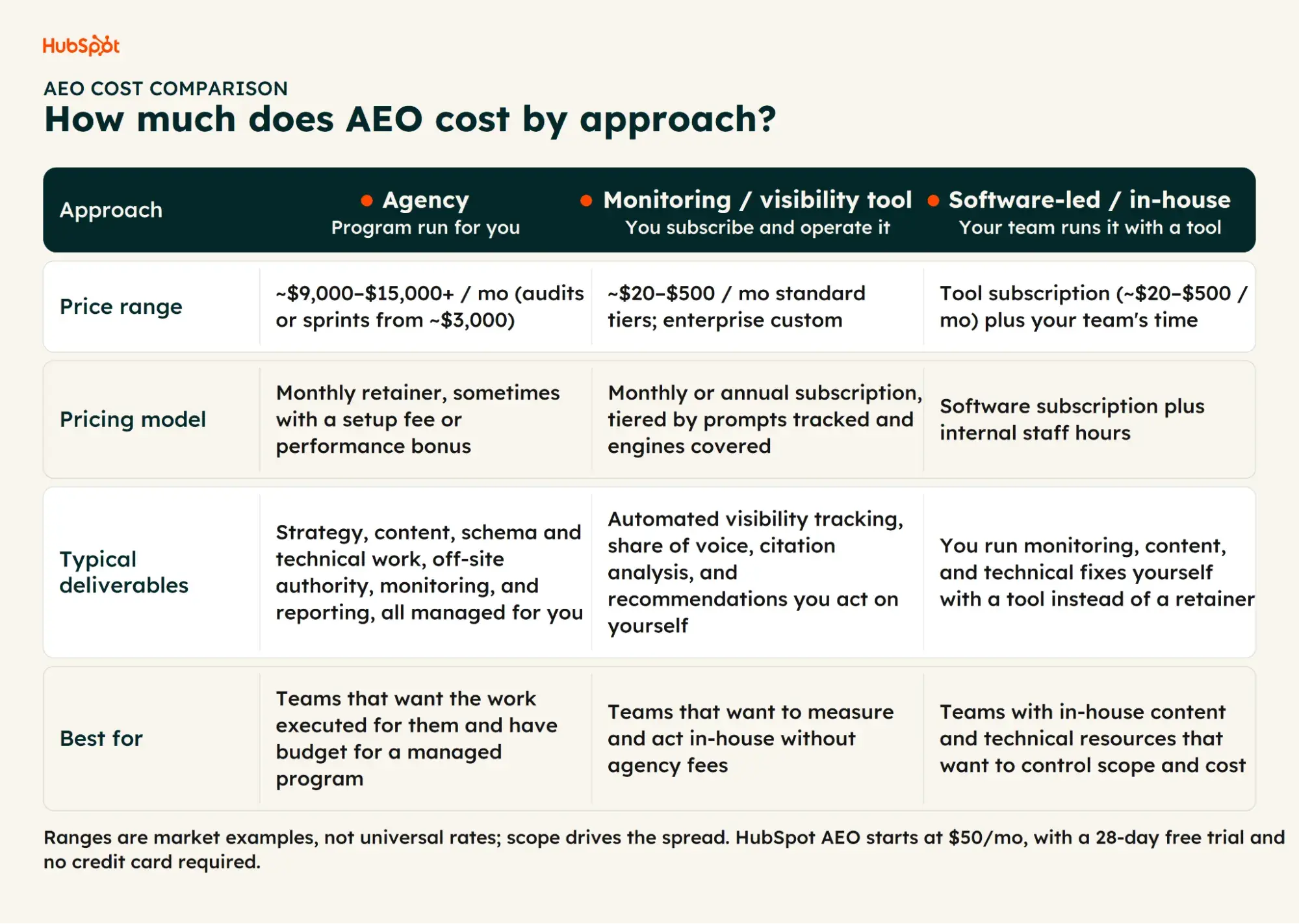
For modern enterprises, the financial commitment to AEO is as varied as the strategies employed to achieve it. On the entry level, businesses can access automated monitoring tools for as little as $30 to $50 per month. At the opposite end of the spectrum, full-service agency retainers—which encompass comprehensive strategy, content engineering, and off-site authority building—can escalate to upwards of $15,000 monthly. Understanding the nuances of these costs is essential for stakeholders attempting to balance the need for AI visibility with the realities of fiscal constraints.
The fundamental driver of this price disparity is scope. A subscription to a monitoring tool provides data—the "what" of your AI presence—but leaves the "how" of remediation and content creation to your internal teams. Conversely, managed agency services offer a turnkey solution, absorbing the technical and creative labor required to align a brand’s digital footprint with the requirements of Large Language Model (LLM) training sets.
The Evolution of the Search Landscape: A Chronology
The urgency surrounding AEO is a direct consequence of the rapid integration of AI into search behavior. Between early 2025 and late 2025, industry data from sources such as Search Engine Land indicated that AI-driven referral traffic nearly tripled. While this still constitutes a relatively small slice of the total search ecosystem—often less than 2% of total referral traffic—the trend line is vertical, signaling that consumer behavior is shifting away from traditional blue-link lists toward synthesized, conversational answers.

Historically, SEO focused on ranking a domain in a list of results. AEO, by contrast, focuses on becoming the authoritative source of truth for an AI engine. In the first half of 2025, early adopters began testing the efficacy of schema markup and entity-based SEO, realizing that LLMs prioritize factual density and logical structure over keyword stuffing. By the third quarter of 2025, the market saw the emergence of dedicated AEO monitoring platforms, such as those provided by HubSpot and other specialized SaaS providers, which allowed companies to track specific prompts across multiple engines.
Comparative Analysis of Cost Structures
To effectively navigate this market, organizations generally fall into one of three operational categories. Each approach carries distinct financial and resource implications.
1. The Agency Model
This is the "white glove" approach. Agencies typically command a premium because they provide a holistic service. A one-time audit or a short-term sprint can cost approximately $3,000, while ongoing, high-intensity monthly programs range from $9,000 to $15,000 and beyond. These fees cover strategy, schema implementation, content production, and off-site authority building. This model is most suitable for mid-to-large enterprises that lack the internal bandwidth to manage the complexities of AEO.
2. The Software-Led Model
Teams with strong in-house content and technical resources often opt for a software-led approach. By utilizing platforms such as HubSpot AEO (starting at $50/month) or other niche tools, these teams can monitor their share of voice, citation frequency, and competitor performance for a fraction of the cost of a retainer. The investment here is primarily in the subscription cost and the allocation of internal staff hours. This model grants the company total control over its brand narrative and technical implementation.
3. The Hybrid Model
Many firms are adopting a "pilot-first" strategy. This involves a moderate investment in software to identify gaps in AI visibility, followed by targeted, project-based outsourcing for specific technical or content needs. This allows for a more agile deployment of capital, ensuring that the budget is spent on high-impact areas rather than broad-spectrum retainers.

Drivers of Price Variance
When evaluating quotes for AEO, it is critical to recognize that price differences are rarely the result of "vendor markup" alone. Five key factors typically dictate the invoice total:
- Prompt Volume: The number of unique queries or search prompts a brand wishes to monitor across various AI engines.
- Engine Coverage: Tracking visibility on one engine (e.g., ChatGPT) is cheaper than monitoring a complex ecosystem including Google AI Overviews, Perplexity, and Gemini.
- Content Volume: The frequency at which the provider is tasked with producing or updating content to meet the specific requirements of AI synthesis.
- Technical Complexity: Whether the work requires deep-level entity management, schema implementation, or complex site architecture audits.
- Authority Building: Off-site efforts, such as digital PR or strategic backlink acquisition, which are often the most labor-intensive and expensive components of an AEO campaign.
The Relationship Between AEO and Traditional SEO
A point of contention among industry experts is whether AEO is a replacement for SEO. The current consensus suggests that they are symbiotic. AEO relies on the same foundation as SEO: a technically sound, credible, and authoritative website. Pages that rank highly in traditional search results often serve as the source material for AI citations.
Consequently, cutting an SEO budget to fund AEO can be counterproductive. If the primary source of a brand’s authority—its organic search ranking—declines, the likelihood of being cited by an AI engine also diminishes. AEO should be viewed as an evolution or extension of a brand’s search strategy, not a separate, disconnected entity. Budgeting for AEO should ideally be integrated into an existing SEO allocation, with a shift in focus toward "answerability" rather than just "rankability."
Red Flags in AEO Pricing
As with any nascent market, there is a risk of predatory or misguided pricing. Organizations should be wary of agencies that promise "guaranteed top-tier rankings" in AI answers. Because generative AI is non-deterministic, results can vary significantly from one query to the next based on user intent and context.
Furthermore, be cautious of vendors who simply repackage standard SEO services as "AEO" without providing any specific insights into citation tracking or LLM-optimized content strategy. An honest engagement will always start with a clear, measurable pilot phase, a transparent reporting cadence, and a focus on specific metrics such as brand mentions, citation frequency, and competitive share of voice.
Budgeting for a 60-to-90 Day Pilot
For organizations unsure of the potential ROI, a 60-to-90-day pilot is the industry standard for gathering data. This timeframe is long enough to establish a baseline and measure incremental progress without committing to a long-term, high-cost contract.
The pilot should prioritize:
- Benchmarking: Establishing a baseline for brand mentions and citation frequency.
- Identification: Pinpointing the most critical "missing" citations where competitors are currently winning.
- Low-Hanging Fruit: Implementing minor schema fixes or updating high-value content to better match the format required for AI-generated summaries.
During this period, teams should avoid heavy investment in off-site authority building, as the results are rarely visible in such a short window. Instead, lean on monitoring tools to provide data-driven insights. Many platforms offer free trials, allowing teams to conduct this initial assessment for a nominal cost.
Future Implications
The integration of AI into the user journey is not a temporary trend; it is the next iteration of the internet. Companies that ignore the shift toward answer engines risk being "de-indexed" from the public consciousness in the same way businesses without websites were marginalized in the early 2000s.
While the costs of AEO may seem daunting, they are a necessary investment in brand preservation. By starting with a lean, software-led pilot, businesses can demystify the process, align their content strategies with the realities of AI synthesis, and scale their investments as they observe measurable improvements in their brand’s visibility. As the technology matures, the ability to effectively manage one’s presence in the AI-generated answer will likely become the single most important indicator of a brand’s digital health. Organizations that act now to establish their authority within these engines will secure a significant, long-term competitive advantage in an increasingly automated marketplace.