Two Decades of Cloud Transformation: Reflecting on the 20th Anniversary of Amazon EC2

Twenty years ago, a pivotal shift occurred in the global technology landscape when Amazon Web Services (AWS) launched the beta version of Amazon Elastic Compute Cloud (EC2). Announced via a blog post by Jeff Barr, the service introduced the then-radical concept of resizable Linux virtual servers, billed by the hour, and localized within a single region—US East. What began as a singular instance type, the m1.small, has since evolved into the bedrock of modern digital infrastructure, effectively democratizing access to high-performance computing and catalyzing the transition from on-premises hardware to the cloud.
The Genesis of Cloud Infrastructure
In 2006, the prevailing paradigm for enterprise computing required significant capital expenditure, long-term capacity planning, and the physical management of server racks. The introduction of EC2 fundamentally altered this trajectory. By providing a virtualized compute environment, AWS allowed developers to spin up servers in minutes rather than weeks. This shift removed the "barrier to entry" for startups and provided enterprises with an unprecedented level of agility.
The original offering was intentionally minimal. By focusing on a "minimal-yet-useful" design, AWS established a philosophy of iterative development that has defined the company’s trajectory for the last two decades. As the service matured, it moved beyond simple virtual machines, incorporating persistent storage, networking, and security architectures that would eventually become standard across the industry.
A Chronology of Critical Milestones
The evolution of EC2 is marked by a series of strategic innovations that expanded the utility of the service while addressing the complex requirements of global businesses:
- 2006 (The Beta Launch): Amazon EC2 debuts, offering virtualized computing power on demand.
- 2008 (Storage Persistence): The introduction of Amazon Elastic Block Store (EBS) solved the challenge of data persistence, allowing data to exist independently of the life cycle of a single instance.
- 2009 (Scalability and Connectivity): The deployment of Elastic Load Balancing, Auto Scaling, and Amazon CloudWatch enabled applications to handle variable traffic patterns autonomously. That same year, Amazon Virtual Private Cloud (VPC) provided the security of isolated networks, a prerequisite for enterprise cloud adoption.
- 2017 (Performance and Security): The AWS Nitro System was unveiled, representing a significant architectural change that offloaded virtualization, networking, and storage management to dedicated hardware, thereby improving security and performance.
- 2018 (Custom Silicon): The launch of AWS Graviton processors signaled a shift toward ARM-based computing, designed to offer better price-performance ratios for scale-out workloads.
- 2018–2019 (Global Reach): AWS extended the EC2 footprint beyond centralized regions with the launch of AWS Outposts, Local Zones, and Wavelength, pushing compute capacity to the network edge and telecommunications carrier networks.
Scaling to Unprecedented Levels
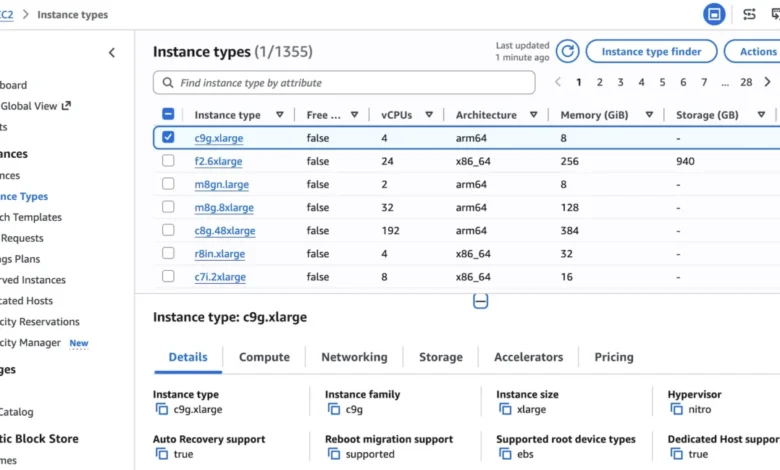
Today, the scale of the EC2 ecosystem is staggering. From its humble origins as a single instance type, the service now supports over 1,200 distinct instance types. These variations are meticulously engineered to satisfy diverse workload requirements, ranging from memory-optimized instances for big data analytics to accelerated computing instances equipped with GPUs for artificial intelligence and machine learning model training.
Geographically, the service has expanded from one initial region to a global footprint of 39 AWS Regions. This expansion has been critical for multinational corporations that must comply with data residency regulations while maintaining low-latency access for users worldwide. The integration of EC2 into the broader AWS ecosystem—serving as the underlying infrastructure for services like Amazon ECS, EKS, Lambda, SageMaker, and Bedrock—cements its position as the foundational layer of the internet economy.
Economic and Operational Implications
The economic impact of EC2 cannot be overstated. By shifting from a Capital Expenditure (CapEx) model to an Operating Expenditure (OpEx) model, organizations have been able to reallocate resources toward innovation rather than routine hardware maintenance. This shift has enabled the rise of the "as-a-service" economy, where software-defined infrastructure allows for rapid experimentation.

From a technical standpoint, the evolution of EC2 has been characterized by a transition toward heterogeneous computing. Modern cloud workloads are increasingly specialized; whereas a general-purpose server was once sufficient for most tasks, contemporary applications now demand specialized hardware accelerators for generative AI, high-performance computing (HPC), and real-time data processing. AWS has responded to this by designing its own custom silicon, such as the Graviton and Trainium chips, ensuring that EC2 remains competitive in a market defined by the compute-intensive demands of modern AI.
Industry Perspectives and Future Outlook
Analysts often point to the "AWS effect" as the primary driver behind the rapid maturation of the cloud sector. Competitors, including Microsoft Azure and Google Cloud, followed the EC2 blueprint, leading to a competitive landscape that has benefited the end-user through constant price drops and feature enhancements.
The longevity of EC2 is attributed to its "foundational" design. By creating a flexible abstraction layer over physical hardware, AWS ensured that as new technologies—such as 5G, edge computing, or quantum processing—emerge, they can be integrated into the EC2 framework without requiring a complete overhaul of the customer’s architectural patterns.
According to observers within the cloud computing industry, the next twenty years will likely be defined by the integration of artificial intelligence directly into the management layer of the infrastructure. As the complexity of managing thousands of instances grows, AI-driven automation will become essential for maintaining security, optimizing costs, and managing global deployments.

Conclusion: The Foundation of the Next Era
As AWS commemorates the 20th anniversary of EC2, the focus remains on the service’s reliability and its role as the backbone of the digital world. While the hardware has transitioned from simple virtualized servers to sophisticated, custom-built silicon clusters, the core value proposition remains intact: providing secure, resizable compute capacity that allows developers to focus on building rather than provisioning.
The legacy of EC2 is not merely one of technical achievement, but one of organizational philosophy. By proving that a service could be launched in a "minimal-yet-useful" state and then iteratively improved based on real-world feedback, AWS established a blueprint for modern software development. As the industry moves toward a future where compute is increasingly ubiquitous, distributed, and AI-centric, Amazon EC2 is positioned to remain the essential infrastructure upon which the next generation of technological innovation will be built. Whether for a small web application or a massive, trillion-parameter foundation model, the decision to launch an instance remains the starting point for digital transformation worldwide.