Amazon Web Services (AWS) today announced the launch of AWS Lambda MicroVMs, a groundbreaking new serverless compute primitive designed to enable developers to run user-generated or AI-generated code within isolated, stateful execution environments. This innovation promises to bridge a critical gap in the existing serverless landscape, offering virtual machine-level isolation, near-instant launch and resume capabilities, and direct control over environment lifecycle and state, all while abstracting away the complexities of infrastructure management and virtualization technologies. Powering this new offering is Firecracker, the same lightweight virtualization technology that has demonstrably scaled to support over 15 trillion monthly Lambda function invocations, underscoring its robust and battle-tested foundation.
The Genesis of Lambda MicroVMs: Addressing a Critical Gap in Multi-Tenant Applications
The evolution of cloud computing has seen a continuous drive towards greater abstraction and efficiency, culminating in the widespread adoption of serverless architectures. AWS Lambda, since its introduction in 2014, has revolutionized how developers deploy and scale event-driven, stateless functions. However, the rapidly evolving application landscape, particularly over the last few years, has brought forth a new class of multi-tenant applications with unique and demanding requirements that existing compute primitives struggled to meet without significant trade-offs.
These emerging applications, such as sophisticated AI coding assistants, interactive online code environments, advanced data analytics platforms, comprehensive vulnerability scanners, and dynamic game servers executing user-supplied scripts, all share a fundamental need: to provide each end-user or session with a dedicated and securely isolated execution environment for code that the application developer did not author. Running untrusted code safely and efficiently has historically presented a formidable challenge.
Prior to the advent of Lambda MicroVMs, developers faced a difficult dilemma. Traditional virtual machines (VMs) offered robust isolation, making them a secure choice for untrusted workloads. However, their startup times, often measured in minutes, rendered them unsuitable for interactive, low-latency user experiences. Containers, while offering launch times in seconds, operate on a shared-kernel architecture. This necessitates extensive custom hardening and sophisticated security measures to safely contain untrusted code, a burden that adds significant complexity and potential vulnerabilities.
Functions-as-a-Service (FaaS) platforms, exemplified by AWS Lambda, excel at event-driven, request-response workloads, providing unparalleled scalability and cost efficiency for stateless operations. Yet, they were not inherently designed for long-running interactive sessions that demand the retention of environment state across multiple user interactions. Each invocation of a traditional Lambda function typically starts from a clean slate, making state management for persistent sessions a cumbersome task often requiring external data stores.

This landscape forced developers into a difficult compromise: either accept sub-optimal trade-offs between performance and isolation, or commit substantial engineering resources to design, build, and operate bespoke virtualization infrastructure. The latter path demanded deep expertise in low-level systems and security, diverting valuable engineering time and talent away from core product development. AWS Lambda MicroVMs enters this arena as a purpose-built solution, precisely engineered to fill this void and empower developers to innovate without these constraints.
Under the Hood: Firecracker’s Role and Core Capabilities
At its core, AWS Lambda MicroVMs leverages Firecracker, an open-source virtualization technology developed by AWS. Firecracker was specifically designed for creating lightweight micro-virtual machines that are ideal for serverless workloads. Its minimalist design means it consumes minimal memory and provides rapid startup times, while still offering the strong security isolation of a virtual machine. The fact that Firecracker has powered the immense scale of AWS Lambda functions – handling trillions of invocations monthly – is a testament to its reliability, performance, and security pedigree. This proven operational maturity is directly inherited by Lambda MicroVMs, giving developers confidence in its foundational robustness.
Lambda MicroVMs delivers three distinct capabilities that, until now, no single AWS compute service could offer in combination:
-
Virtual Machine Level Isolation: This paramount feature stems directly from Firecracker. Each user session runs within its own dedicated MicroVM, ensuring no shared kernel or shared resources between different users. This robust isolation model guarantees that untrusted code supplied by one user is strictly contained within their execution environment, preventing unauthorized access to other environments or the underlying host system. This level of security is crucial for multi-tenant applications where code integrity and data separation are non-negotiable.
-
Rapid Launch and Resume: The operational model of Lambda MicroVMs is centered around an "image-then-launch" paradigm. Developers begin by creating a MicroVM Image, supplying a Dockerfile and their application code packaged as a zip artifact in Amazon S3. Lambda then executes the Dockerfile, initializes the application, and critically, takes a Firecracker snapshot of the running environment’s memory and disk state. Subsequent MicroVMs launched from this image resume from this pre-initialized snapshot, bypassing the traditional cold boot process. This innovative approach results in near-instant startup latency for both initial launches and idle resumes. Even interactive sessions involving multi-gigabyte application states can come back online with responsiveness that feels seamless to the end-user, drastically improving user experience.
-
Stateful Execution: A core differentiator, Lambda MicroVMs ensures that a running MicroVM retains its memory, disk state, and running processes throughout the user’s session. This means that installed packages, loaded machine learning models, and working filesets remain readily available. Furthermore, during periods of user inactivity, a MicroVM can be suspended – with its complete memory and disk state preserved – and then rapidly resumed when traffic returns. This "pause-and-resume" functionality is transformative, allowing for persistent sessions without incurring continuous high running costs. MicroVMs support up to 8 hours of total runtime, and their automatic suspension after a configurable idle window makes them ideal for a wide array of applications, from quick software vulnerability scans (minutes) to complex data analytics tasks (hours) and interactive coding environments with potentially extended periods of user inactivity. It’s important to note that applications that generate unique content, establish network connections, or load ephemeral data during initialization may need to integrate with service-provided hooks to ensure compatibility and correct behavior when resuming from a snapshot.

Practical Implementation: A Step-by-Step Overview
Getting started with AWS Lambda MicroVMs is designed to be intuitive, leveraging familiar AWS interfaces and concepts. The process typically begins in the AWS Lambda console, where "Lambda MicroVMs" now appears as a dedicated section.
The first step involves creating a MicroVM Image. Developers package their application, such as a Flask web application, along with its Dockerfile, into a zip file. This artifact is then uploaded to an Amazon Simple Storage Service (Amazon S3) bucket, serving as the source for the MicroVM Image.
For instance, a simple Flask API (app.py) could define a basic "Hello, World!" endpoint, while the Dockerfile specifies the build environment. The Dockerfile, in this example, builds upon public.ecr.aws/lambda/microvms:al2023-minimal, installs necessary Python dependencies, copies the application files, and defines the entry point using Gunicorn.
The MicroVM Image is then created using the AWS CLI or the console, referencing the S3 artifact, an image name, a base image ARN (e.g., arn:aws:lambda:us-east-1:aws:microvm-image:al2023-1), and an IAM role for the build process.
aws lambda-microvms create-microvm-image
--code-artifact uri=<path/to/s3/artifact.zip> --name <VM_image_name>
--base-image-arn arn:aws:lambda:us-east-1:aws:microvm-image:al2023-1
--build-role-arn <IAM role ARN>
Upon executing this command (or completing the console steps), Lambda retrieves the zip file, executes the Dockerfile, initializes the application, and then captures a Firecracker snapshot of the running disk and memory state. Build logs are streamed in real-time to Amazon CloudWatch under a dedicated log group, providing transparency into the image creation process. Once ready, the image appears in the console with its Amazon Resource Name (ARN) and version number, signifying its readiness for deployment.
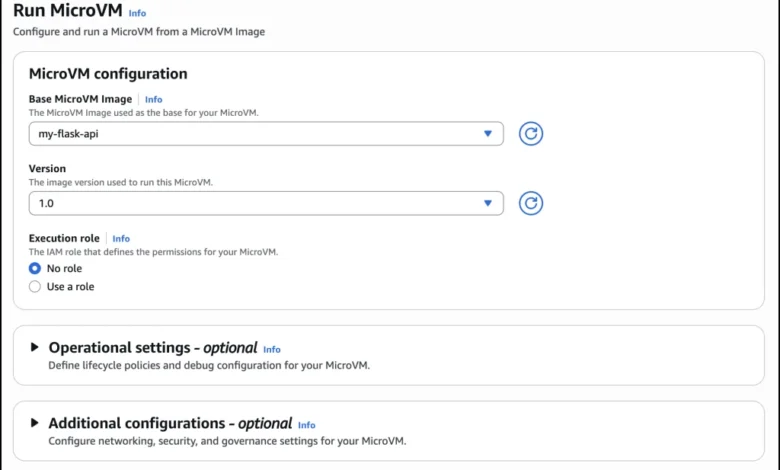
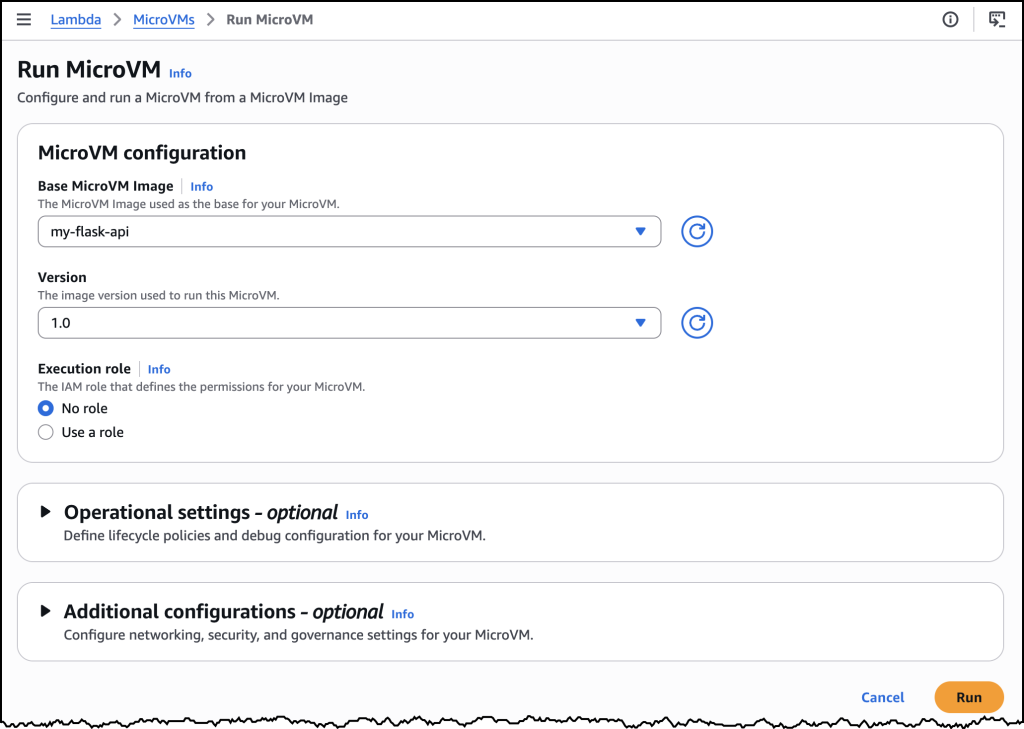
Launching a MicroVM is equally straightforward. Using either the AWS Console or the CLI, developers specify the image ARN, an execution role, and a crucial idle policy. This policy dictates how the MicroVM manages inactivity, for example, suspending after 15 minutes of idle time and automatically resuming upon the next incoming request. No complex networking setup is required; Lambda automatically assigns the MicroVM a unique ID and provides a dedicated endpoint URL.

aws lambda-microvms run-microvm
--image-identifier arn:aws:lambda:<region>:<acct>:microvm-image:my-image
--execution-role-arn arn:aws:iam::<acct>:role/MicroVMExecutionRole
--idle-policy '"maxIdleDurationSeconds":900,"suspendedDurationSeconds":300,"autoResumeEnabled":true'
Because the MicroVM launches from a pre-initialized snapshot, the Flask application in this example is already running the moment the launch completes. This "one API call to get a fully initialized, bootstrapped compute environment" represents a significant leap in developer productivity and user experience.
To interact with the running MicroVM, a short-lived authentication token is generated via the CLI and attached to a standard HTTPS request using the X-aws-proxy-auth header. The request lands immediately on the Flask application. Critically, testing the idle policy demonstrates the system’s power: allowing the MicroVM to sit idle past its suspend threshold triggers an automatic suspension, with its memory and disk state snapshotted and stored. A subsequent request then seamlessly resumes the MicroVM, with the application state fully intact. From the client’s perspective, the pause is imperceptible, offering a truly continuous and responsive experience.
Broader Implications and Market Impact
The introduction of AWS Lambda MicroVMs is poised to have a significant impact across various industries and application types, fundamentally altering how developers approach multi-tenant, interactive, and code-execution workloads.
- AI and Machine Learning: AI coding assistants and interactive machine learning notebooks can now provide each user with a dedicated, isolated environment to run code, train models, or experiment with data without performance degradation or security concerns arising from resource contention or shared kernels. This accelerates experimentation and ensures data privacy for individual sessions.
- Education and Development: Online coding academies, interactive tutorials, and developer sandboxes can offer students and professionals real-time, personalized coding environments that launch instantly and retain state, mimicking a local development setup without any local configuration overhead. This lowers the barrier to entry for learning and development.
- Gaming: Game servers that execute user-supplied scripts or mods can now provide a highly secure and performant sandbox for each player or game session. This enhances the player experience by enabling rich customization while safeguarding the integrity of the game environment and other players.
- Data Analytics and Processing: Platforms that allow users to run custom scripts or queries against datasets can leverage MicroVMs for isolated execution, preventing rogue scripts from impacting others or the underlying infrastructure. The stateful nature is particularly beneficial for iterative data exploration.
- Security and Compliance: Vulnerability scanners, code linters, and other security tools that need to execute potentially malicious or untrusted code in isolation can do so with confidence, knowing that the MicroVM provides strong containment. This is critical for maintaining robust security postures.
- Cost Efficiency: The ability to suspend MicroVMs during idle periods and resume them rapidly translates into significant cost savings. Developers pay only for the compute time when the MicroVM is active or suspended (for storage of state), rather than continuously provisioning and paying for idle VMs or containers. This aligns perfectly with the serverless promise of "pay-for-value."
- Developer Productivity: By abstracting away the complexities of virtualization and infrastructure management, Lambda MicroVMs frees developers to focus on building their core product. The "one API call" to get a fully initialized environment drastically reduces development and deployment overhead.
Strategic Positioning within the AWS Ecosystem
AWS Lambda MicroVMs represents a new and distinct resource within the broader AWS Lambda family, equipped with its own API surface. It does not replace existing AWS Lambda Functions but rather complements them, creating a more comprehensive serverless ecosystem.
Lambda Functions remain the optimal choice for event-driven, request-response workloads where statelessness or minimal state management is preferred. Their instantaneous scaling, granular billing, and deep integration with other AWS services make them ideal for microservices, APIs, and data processing pipelines.
Lambda MicroVMs, conversely, is purpose-built for multi-tenant applications that require a dedicated, isolated, and stateful environment for each end-user or session, specifically for executing user- or AI-generated code. The two services can work in tandem: an application’s event-driven backbone could be powered by traditional Lambda Functions, which then invoke or interact with Lambda MicroVMs for specific steps that necessitate running untrusted code in isolation or maintaining persistent state across interactive sessions. This synergistic relationship allows developers to select the right compute primitive for each component of their application, optimizing for performance, cost, and security. AWS, in essence, provides the execution environment; developers bring the application logic.
Availability and Future Outlook
AWS Lambda MicroVMs is available today in key AWS Regions, including US East (N. Virginia, Ohio), US West (Oregon), Europe (Ireland), and Asia Pacific (Tokyo). The service supports the ARM64 architecture, offering configurations with up to 16 vCPUs, 32 GB of memory, and 32 GB of disk space per MicroVM. This robust resource allocation ensures that even demanding interactive and stateful workloads can be efficiently managed.
Idle MicroVMs can be explicitly suspended via an API call or automatically through a configurable lifecycle policy, drastically reducing running costs while preserving the full state for rapid resumption. Detailed pricing information, reflecting the "pay-for-value" model characteristic of serverless services, is available on the AWS Lambda pricing page. This includes charges for compute duration, memory usage, and the storage of suspended states.
The launch of Lambda MicroVMs signifies a significant advancement in serverless computing, pushing the boundaries of what is possible with fully managed services. As AI, collaborative development, and interactive experiences continue to evolve, the demand for secure, scalable, and stateful execution environments for untrusted code will only grow. AWS Lambda MicroVMs is strategically positioned to meet these demands, enabling a new generation of innovative applications.
Developers interested in exploring this new capability can visit the AWS Lambda console, the dedicated Lambda MicroVMs product page, or consult the comprehensive Lambda MicroVMs Developer Guide for detailed documentation and getting started resources. This new offering reaffirms AWS’s commitment to empowering developers with cutting-edge, secure, and efficient cloud infrastructure.