Operation Hall of Fame Dismantles Multi-State Cocaine Ring, Seizes $2.1 Million in Drugs and Arrests Nine Individuals

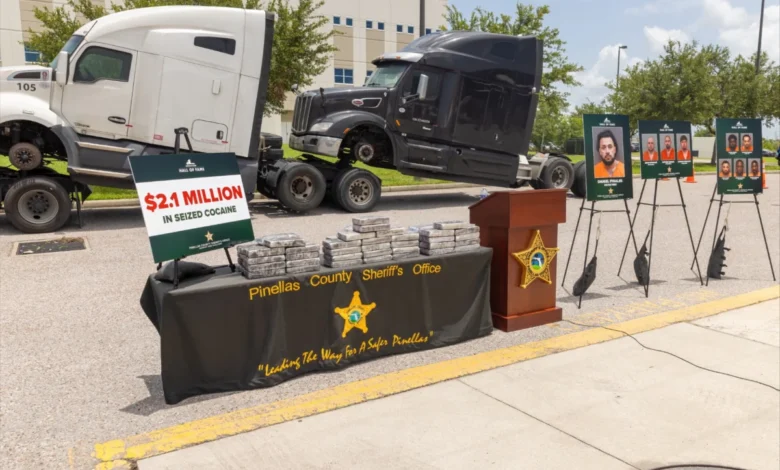
Law enforcement authorities have successfully dismantled a sophisticated multi-state cocaine trafficking operation, culminating in the arrest of nine individuals and the seizure of approximately 132 pounds (60 kilograms) of cocaine with an estimated street value of $2.1 million. The arrests, part of a three-year investigation dubbed "Operation Hall of Fame," exposed an elaborate scheme involving the clandestine transport of narcotics from El Paso, Texas, to Pinellas County, Florida, utilizing seemingly innocuous commercial truck tractors as a cover.
Unraveling a Three-Year Investigation
The culmination of Operation Hall of Fame was announced on July 14 by Pinellas County Sheriff Bob Gualtieri, alongside Florida Department of Law Enforcement (FDLE) Special Agent in Charge Mark Dubina. Their statements detailed an extensive and complex investigation that had been ongoing for approximately three years, targeting Daniel Pinales and his alleged drug trafficking organization. The initial phases of the investigation involved meticulous detective work, including three separate wiretap investigations. These wiretaps proved instrumental in identifying individuals who were obtaining cocaine directly from Pinales, gradually building a comprehensive picture of his distribution network within Florida. Crucially, these efforts also uncovered the external supply source operating far beyond Florida’s borders.
Detectives eventually traced the origin of the cocaine supply to El Paso, Texas, a strategic point along the U.S.-Mexico border known as a major transit hub for illicit drugs entering the country. By April of the current year, investigators had developed intelligence indicating that significant quantities of cocaine, typically multiple kilograms per shipment, were being transported from El Paso into Florida. The method of concealment was particularly cunning, utilizing commercial truck tractors, the powerful front sections of semi-trailer trucks.
The "Complete Facade" of Transport
Sheriff Gualtieri described the transportation arrangement as "a complete facade," designed to evade detection by both routine traffic stops and specialized drug-sniffing canine units. The traffickers employed a unique tactic: an operable truck tractor would tow two additional, seemingly disabled, truck tractors. This convoy configuration was intended to appear as a legitimate commercial hauling operation, with the trailing "disabled" units serving merely as props. However, the true purpose of this setup was far more nefarious.
Investigators believe the cocaine was primarily hidden within the sleeper compartment of one of the black-colored truck tractors. This elevated location, high above the roadway, presented a significant challenge for roadside canine units, making detection considerably more difficult during routine inspections. The sheer scale and apparent legitimacy of the convoy were designed to deter suspicion. "Somebody sees this, you’re just thinking this trucker’s going about their business," Sheriff Gualtieri remarked during the press conference, highlighting the deceptive simplicity of the scheme.
The drug trafficking organization operated with remarkable regularity, executing these elaborate transport missions on a monthly basis. Each month, three men associated with the Texas supply chain would arrive in Florida, typically near Interstate 75 in Wesley Chapel. They would check into a local hotel, accompanied by a rented SUV that traveled alongside the tractor convoy.
Under the cover of nightfall, the participants would allegedly transfer duffel bags filled with cocaine from the truck tractors to Daniel Pinales. Pinales would then transport these illicit deliveries to an empty apartment he maintained in the Rocky Point area of Tampa. From this clandestine hub, Pinales allegedly distributed kilograms of cocaine throughout Pinellas County, establishing a robust local supply chain. While Pinales managed the Florida distribution, the Texas-based couriers would await payment. The sheriff estimated that these men received approximately $1 million after each successful trip, underscoring the immense profitability and financial scale of the operation.
The July Takedown: A Meticulous Surveillance Operation
The final phase of Operation Hall of Fame commenced on July 10, when investigators successfully located the convoy traveling southbound near Lake City, Florida. This critical surveillance operation meticulously tracked the movements of the suspects. Arturo Carlos was identified as the driver of the three truck tractors, while Jesus Morales and Joaquin Enriquez traveled in the accompanying rented SUV. The group adhered to their established routine, spending Saturday at their usual Wesley Chapel hotel.
As night descended, around 8 p.m., Morales and Enriquez were observed removing three duffel bags from one of the black truck tractors. This was the moment investigators had been waiting for, confirming the presence of the narcotics. The surveillance team then tracked Pinales, who departed Brandon in a rented Honda minivan and traveled north on Interstate 75. Both vehicles converged in a dimly lit parking lot near Fletcher Avenue in Tampa. Detectives watched as Morales and Enriquez transferred the duffel bags into Pinales’s minivan.
At this critical juncture, law enforcement moved in. Pinales attempted to flee but was apprehended by officers. Inside his minivan, deputies discovered the three duffel bags, which contained the 60 kilograms of cocaine. Sheriff Gualtieri confirmed that this amount equated to approximately 132 pounds, with a street value of about $2.1 million. The sheriff emphasized the repetitive nature of this illicit trade, stating, "This was happening every single month."
Legal Ramifications and Broader Implications
Following the arrests, the suspects faced a litany of charges. Daniel Pinales, identified as the alleged leader of the Florida distribution network, faces one count of cocaine trafficking, which carries a mandatory minimum sentence of 15 years in prison. A judge set his bail at a substantial $2.25 million, reflecting the gravity of the charges and the perceived flight risk. Sheriff Gualtieri highlighted the sheer volume of drugs Pinales was allegedly responsible for, estimating that comparable monthly loads could total more than 700 kilograms annually. "The amount of cocaine that Daniel Pinales was putting on the streets of Pinellas County is just simply astronomical," Gualtieri stated, underscoring the significant impact of this bust on the local drug supply.
The other individuals arrested also face serious charges:
- Arturo Carlos, the alleged driver of the truck tractors, was charged with two counts of trafficking.
- Tyler Green faces four cocaine-related trafficking counts.
- Marice Higgins received eight cocaine-related charges, along with additional allegations of marijuana distribution and firearm possession.
- Brian Varner also faces eight cocaine-related charges.
- Jesus Morales, Joaquin Enriquez, Cody Dent, and Ryan Sturgis each face one count.
Morales and Enriquez, after their meeting with Pinales, returned to the Wesley Chapel hotel where they were subsequently arrested, along with Carlos. While these arrests represent a significant victory for law enforcement, Sheriff Gualtieri confirmed that the investigation is far from over. He indicated that investigators have identified similar illicit deliveries elsewhere across the country, suggesting a broader network that Operation Hall of Fame may only have begun to unravel. "This investigation is ongoing, and it’s not over with," Gualtieri asserted, signaling potential for further arrests and the dismantling of additional components of the trafficking ring. It is important to note that all charges remain allegations, and prosecutors must prove every count beyond a reasonable doubt in a court of law.
The Texas-Florida Corridor: A Persistent Challenge
The successful execution of Operation Hall of Fame underscores the persistent challenge of inter-state drug trafficking, particularly along the well-established Texas-Florida corridor. Texas, sharing a lengthy border with Mexico, serves as a primary entry point for illicit drugs into the United States. Mexican transnational criminal organizations (TCOs) exploit this proximity, utilizing a complex web of transportation networks, including commercial trucking, to move narcotics inland.
Florida, with its extensive coastline, numerous ports, and robust tourism industry, unfortunately, presents an attractive market and distribution hub for drug traffickers. The state’s vast network of interstates and its proximity to international waters also make it a strategic location for both receiving and further distributing narcotics across the eastern seaboard. Law enforcement agencies, including the DEA, routinely highlight this corridor as a critical pathway for cocaine, heroin, methamphetamine, and fentanyl. Traffickers constantly adapt their methods, from sophisticated concealment within commercial freight, as seen in this case, to leveraging smaller vehicles and human couriers. The profit margins involved in this illicit trade are enormous, providing a powerful incentive for criminal organizations to innovate and persist despite aggressive law enforcement efforts. A kilogram of cocaine purchased at the border for a few thousand dollars can fetch upwards of $35,000 on the streets of Florida, making the risk-reward calculation highly favorable for criminal enterprises.
Inter-Agency Cooperation and the Future of Enforcement
The success of Operation Hall of Fame is a testament to the power of sustained, collaborative law enforcement efforts. A three-year investigation involving multiple wiretaps and cross-state surveillance demands immense resources, specialized training, and seamless cooperation between agencies. The partnership between the Pinellas County Sheriff’s Office and the Florida Department of Law Enforcement (FDLE), alongside other unnamed federal and local partners, was crucial in tracking and apprehending the suspects. Such operations require a meticulous approach, blending traditional police work with advanced intelligence gathering and digital forensics.
Sheriff Gualtieri and Agent Dubina’s joint announcement underscored the importance of these multi-jurisdictional task forces in combating organized crime that transcends state lines. The dismantling of a network capable of funneling over 700 kilograms of cocaine annually into Florida not only disrupts a significant supply chain but also sends a clear message to other criminal organizations that law enforcement remains vigilant and determined.
The ongoing nature of the investigation suggests that authorities are not merely content with the immediate arrests but are actively pursuing leads to identify and dismantle higher echelons of this or related criminal enterprises. The fight against drug trafficking is a continuous battle, requiring constant adaptation from law enforcement to counter the evolving tactics of sophisticated criminal networks. However, operations like "Hall of Fame" demonstrate that through dedication, intelligence, and inter-agency collaboration, significant strides can be made in safeguarding communities from the corrosive effects of illegal drugs.