AWS Lambda Now Supports GPU-Accelerated Workloads for Lambda Managed Instances

The landscape of serverless computing underwent a significant transformation this week as Amazon Web Services (AWS) announced the general availability of GPU support for Lambda Managed Instances (LMI). This development marks a departure from traditional serverless architectures, which have historically relied exclusively on CPU-based compute, by enabling developers to execute high-performance workloads such as machine learning inference, complex media processing, and scientific simulations within the simplified, event-driven framework of AWS Lambda.
For years, the serverless paradigm has been defined by its "no-infrastructure" promise, allowing developers to upload code and rely on the cloud provider to manage the underlying environment. However, this model previously struggled to accommodate the hardware-specific requirements of graphics processing units (GPUs). Developers requiring GPU power were often forced to manage EC2 clusters, orchestrate complex container deployments, or rely on specialized third-party platforms that lacked deep integration with the broader AWS ecosystem. By extending Lambda Managed Instances to support G-series EC2 instances, AWS is effectively bridging the gap between high-performance computing (HPC) and the operational agility of serverless.
Addressing the Infrastructure Burden
The technical challenges of managing GPU infrastructure are multifaceted. Historically, deploying a GPU-accelerated application required engineers to select specific instance families, manually install and version-match NVIDIA drivers, configure CUDA libraries, and implement sophisticated autoscaling logic to manage costs. Because GPUs are expensive assets, idle time represents a direct financial loss.
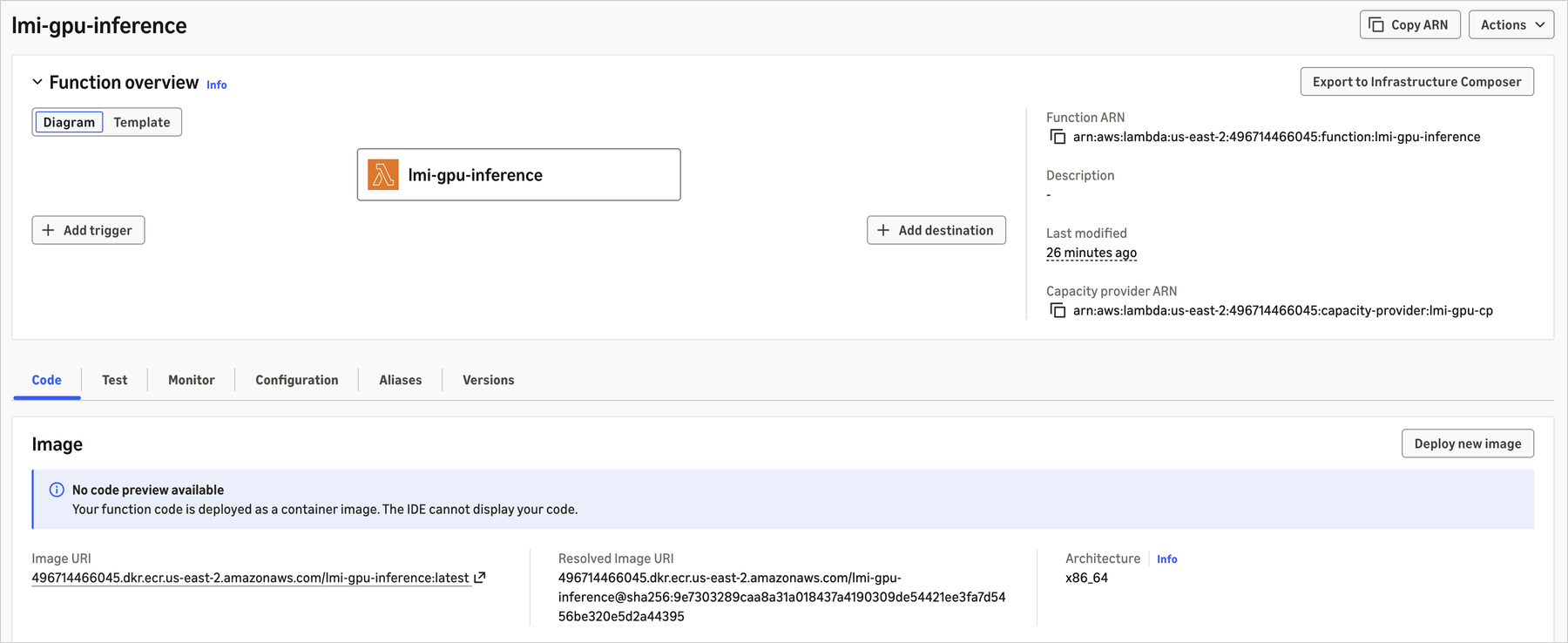
The new implementation within Lambda removes these operational barriers. Under the updated architecture, GPU-accelerated functions are deployed as standard OCI-compliant container images. AWS handles the provisioning of the underlying hardware, the management of driver stacks, and the integration with native AWS event sources. When a request hits the function, Lambda handles the lifecycle—from the initial spin-up of the environment to the eventual decommissioning of the instance—without the developer ever needing to interact with the underlying EC2 configuration.
Technical Specifications and Capabilities
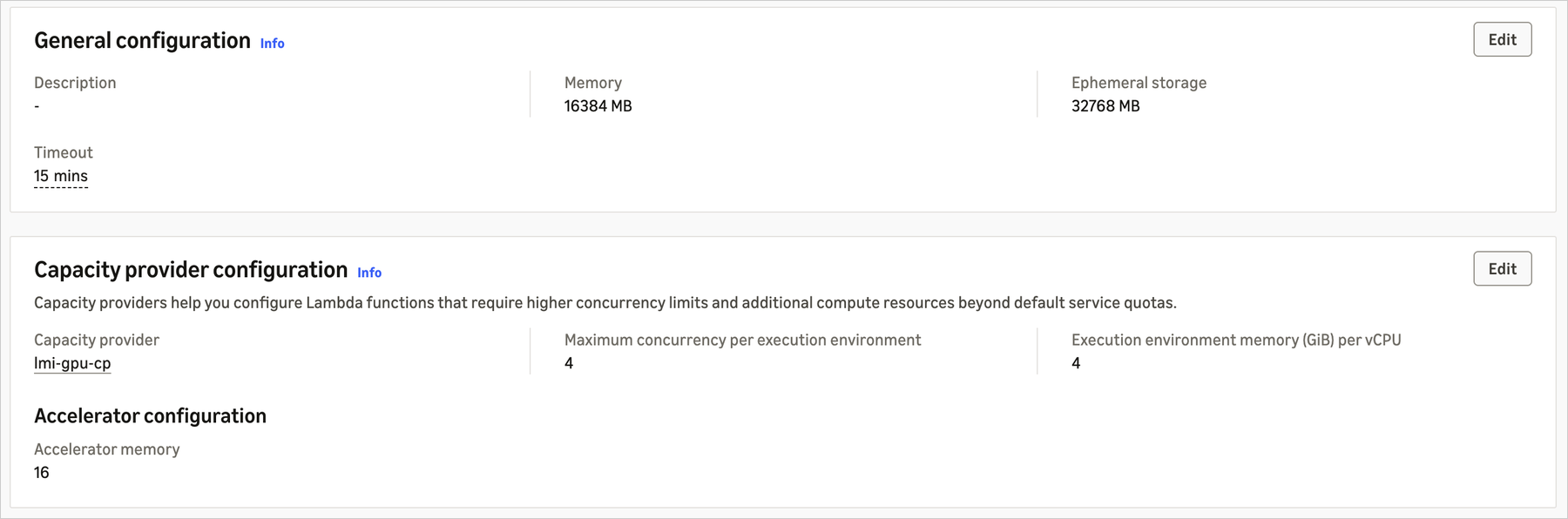
The integration provides substantial headroom for demanding workloads. Lambda Managed Instances now support container images up to 32 GB, with ephemeral storage options also capped at 32 GB, facilitating the loading of large machine learning models. Furthermore, the architecture supports up to 32,768 MB of memory and provides 3 to 48 GB of dedicated accelerator memory.

A critical component of this release is the support for extended function timeouts, which now reach up to 90 minutes for asynchronous and event-source-mapped invocations. This is a significant departure from the standard 15-minute timeout associated with traditional Lambda functions, acknowledging that GPU-intensive tasks—such as batch media transcoding or multi-step inference—frequently require longer execution windows.
The concurrency model has also been refined. By allowing up to 48 concurrent requests per execution environment, AWS has addressed the utilization issue that has long plagued serverless GPU deployments. Instead of provisioning an entire GPU for a single task, Lambda can now batch multiple concurrent requests onto a single instance, maximizing the utilization of the expensive hardware and reducing the cost-per-request for the end user.
Chronology of Development
The path to this launch reflects the evolving demands of the AI/ML community. Over the past 24 months, the surge in generative AI interest created a bottleneck: while developers wanted to use LLMs and other neural networks, the operational overhead of maintaining dedicated GPU clusters was prohibitive for smaller teams.
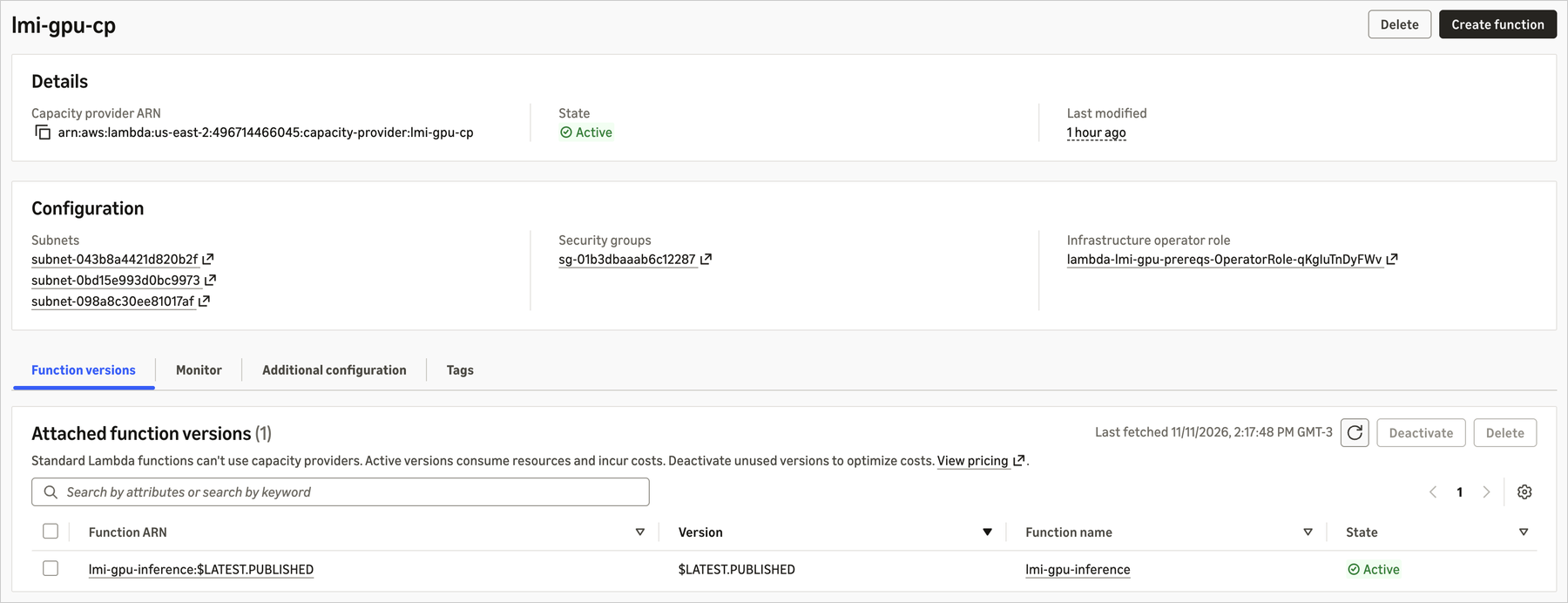
Early in 2026, AWS began integrating deeper support for OCI images in Lambda, laying the groundwork for more complex runtime environments. By mid-2026, internal testing of the "Lambda Managed Instances" framework showed that it could successfully abstract the complexity of G-series instance management. The final rollout, concluded in November 2026, saw the inclusion of curated base images—including vLLM and sglang optimized containers—which allow users to deploy inference endpoints with minimal coding, often requiring only the configuration of a model ID.
Economic and Operational Implications
From an economic standpoint, the integration of G-series instances (G4dn, G5, G6, G6e, and others) into the Lambda ecosystem offers a more flexible cost structure. Customers are charged for the underlying EC2 instance time at a premium that includes a 9.75 percent management fee, alongside the standard Lambda per-request fee of $0.20 per million requests.
This model allows for the application of existing Savings Plans and Reserved Instances, which are traditionally utilized for persistent EC2 infrastructure. By mapping these cost-saving instruments to serverless functions, organizations can potentially lower the barrier to entry for running production-grade AI.
Industry analysts note that this shift represents a "commoditization of inference." By removing the need for a dedicated DevOps team to manage CUDA versions and cluster health, AWS is enabling a broader demographic of software engineers—not just infrastructure specialists—to deploy sophisticated AI models. This democratization is expected to accelerate the adoption of agentic workflows, where a CPU-based agent can offload specific inference tasks to a serverless GPU function, only paying for the exact duration of the computation.
Monitoring and Observability
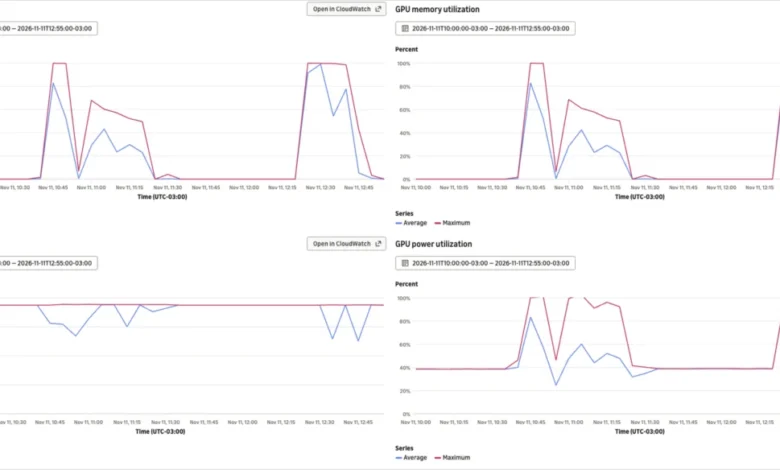
A major hurdle in serverless GPU adoption has been the "black box" nature of hardware utilization. To counter this, AWS has integrated granular GPU-specific metrics directly into the Amazon CloudWatch console. Developers can now track GPU utilization, memory bandwidth, and power consumption as first-class metrics alongside CPU and memory usage. This visibility allows for more precise tuning of concurrency settings and instance selection, ensuring that developers are not over-provisioning resources for tasks that could be handled by smaller or less expensive GPU variants.
Strategic Outlook
The launch is not limited to simple inference; it positions Lambda as a central node in modern AI architectures. By integrating with Lambda Durable Functions, developers can now build complex, long-running pipelines where a GPU-accelerated function acts as one step in a larger, stateful workflow.
Furthermore, the use of Seekable OCI (SOCI) lazy loading—which allows functions to begin executing before the entire container image is downloaded—addresses the cold-start latency that often deters the use of large models in serverless environments. Internal benchmarks from AWS suggest that this can reduce startup times by up to 70 percent, making it feasible to use high-performance models in near-real-time applications.
As the industry moves toward a future where AI models are integrated into almost every aspect of software, the ability to scale these models without the associated management overhead will be critical. By abstracting the hardware layer while maintaining the flexibility of the container ecosystem, AWS has signaled a clear intent to dominate the serverless AI infrastructure market. The move places pressure on competitors to offer similar levels of abstraction, as developers increasingly prioritize tools that minimize "undifferentiated heavy lifting" in favor of rapid deployment and iterative development.
For organizations already embedded in the AWS ecosystem, this release simplifies the roadmap for AI integration, turning what was once a multi-week infrastructure project into a configuration exercise that can be completed in minutes. As more instance families are added to the supported list in the coming months, the flexibility of this model is only expected to grow, cementing the role of serverless in the future of high-performance computation.
Related posts: