Amazon Integrates Infoblox Threat Defense into Route 53 Resolver DNS Firewall to Automate Enterprise Network Security

Securing modern cloud infrastructure requires defending complex environments at the foundational layers of network communication. Domain Name System (DNS) traffic inspection has long served as a critical line of defense, enabling organizations to intercept malware delivery, command-and-control (C2) channels, and data exfiltration before malicious payloads breach internal network perimeters. Attackers routinely leverage outbound domain name queries to establish unauthorized connections and siphon sensitive enterprise assets out of targeted environments. Recognizing the administrative burden associated with continuously maintaining up-to-date domain blocklists, Amazon Web Services (AWS) has rolled out a major enhancement to its cloud security portfolio. Infoblox Threat Defense is now officially available in preview within the Amazon Route 53 Resolver DNS Firewall, bringing robust, partner-managed DNS threat intelligence directly into native AWS rule groups.
This strategic integration bridges the gap between cloud-native network controls and advanced third-party cybersecurity threat feeds. By embedding Infoblox intelligence directly into the DNS Firewall workflow, AWS aims to drastically simplify how security operations teams protect their Amazon Virtual Private Cloud (Amazon VPC) workloads. Rather than manually sourcing, formatting, and updating domain blocklists—a process prone to lag and operational overhead—cloud administrators can now subscribe directly through the AWS Marketplace. The resulting partnership ensures that enterprise networks receive real-time, automated updates reflecting emerging global threats, all managed through existing AWS deployment channels and financial accounting frameworks.
Comprehensive Solution Architecture and Operational Mechanics
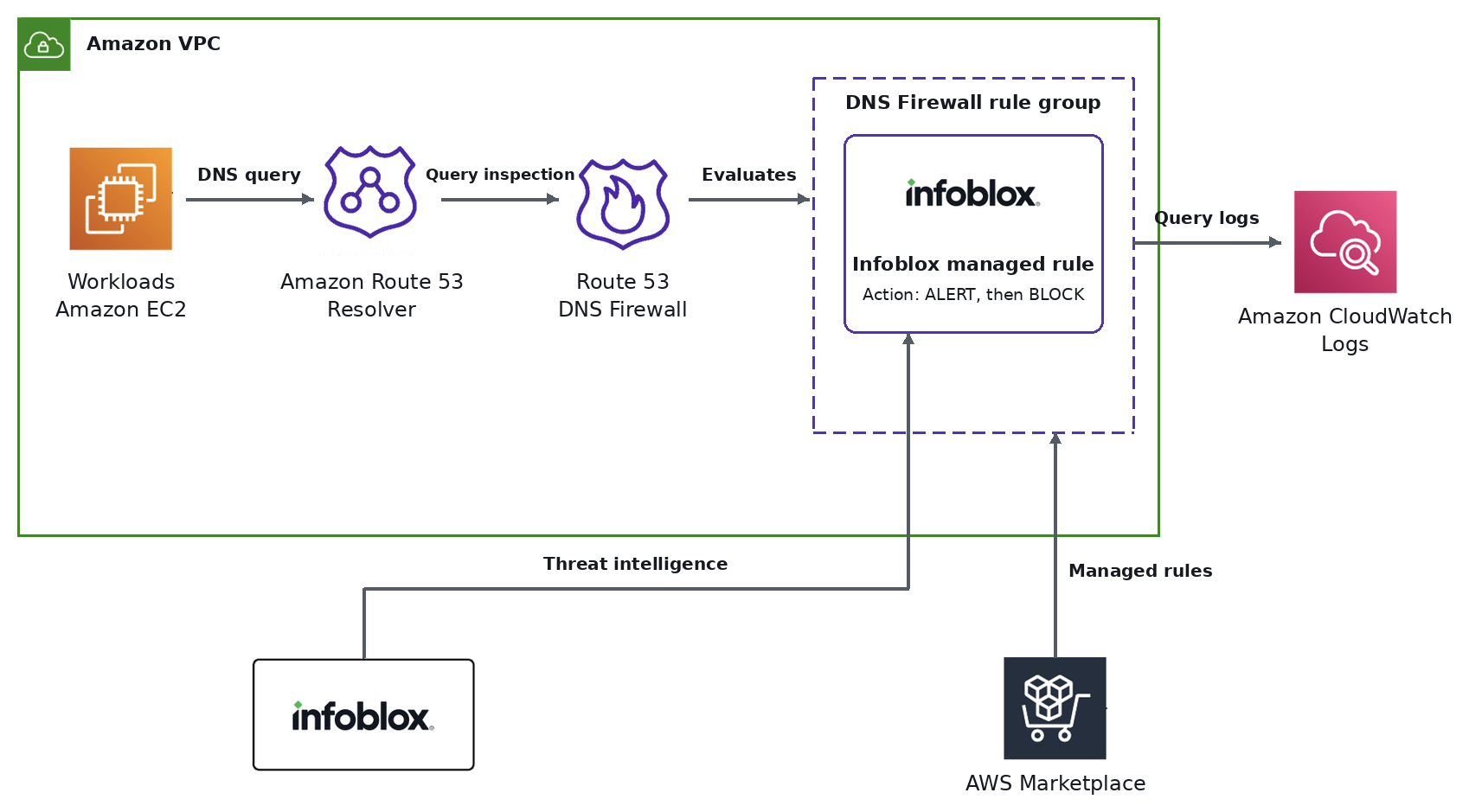
The technical implementation of the Infoblox integration within Route 53 Resolver DNS Firewall relies on a streamlined, multi-tier inspection pipeline designed to minimize latency while maximizing visibility. Workloads hosted within an Amazon VPC—such as Amazon Elastic Compute Cloud (Amazon EC2) instances—continually generate DNS queries as applications resolve external endpoints and internal service locations. When these queries are dispatched, they are intercepted by the Amazon Route 53 Resolver, which acts as the foundational recursive DNS service for the VPC.
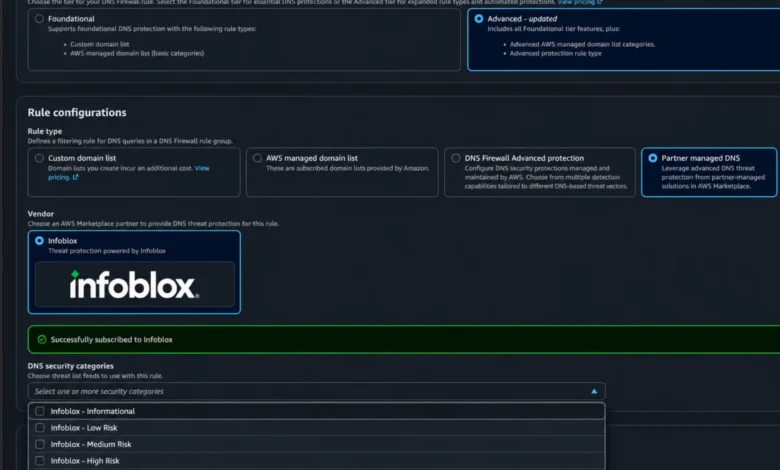
Rather than directly forwarding these requests to public or authoritative resolvers, Route 53 Resolver routes each outbound query to the DNS Firewall for deep inspection. The firewall evaluates the query against predefined rule groups, which now house the Infoblox managed rule. Depending on the configuration, the rule evaluates the destination domain against five distinct Infoblox security categories: Informational, Low Risk, Medium Risk, High Risk, and Critical Risk.
Should a query trigger a match, the event is recorded in the Resolver query logs and delivered to Amazon CloudWatch Logs for centralized auditing and security analysis. Outside the boundaries of the VPC infrastructure, Infoblox continuously supplies
real-time threat intelligence feeds to the managed rule, while the AWS Marketplace handles provisioning, metering, and licensing components. This decoupled yet synchronized architecture guarantees that security teams maintain absolute control over their local traffic policies without sacrificing the breadth of global threat visibility.
Streamlined Procurement, Subscription, and Financial Management
One of the most friction-inducing challenges in modern enterprise cybersecurity is vendor sprawl and the administrative complexity of managing disparate billing systems. Organizations frequently struggle to reconcile software-as-a-service (SaaS) security subscriptions with cloud infrastructure expenditures. AWS and Infoblox have directly addressed this friction by embedding subscription management and metering directly into the native AWS Marketplace workflow.
Administrators can discover, subscribe to, and govern Infoblox protections through the exact same DNS Firewall configuration panels they use for native rules. Because consumption metering is built directly into the AWS Marketplace billing engine, enterprises do not need to establish an extraneous billing relationship with Infoblox. Software usage charges appear seamlessly alongside existing AWS infrastructure costs on a unified monthly invoice. This integrated procurement model allows cloud architects, chief information security officers (CISOs), and finance departments to collaborate from a single, transparent purchasing and reporting framework, significantly accelerating deployment velocity and reducing procurement latency.
Step-by-Step Implementation and Deployment Walkthrough
Deploying the Infoblox managed rule within an AWS environment requires adherence to a structured configuration sequence to ensure uninterrupted application availability and robust security posture. Before initiating the deployment, organizations must ensure their AWS Identity and Access Management (IAM) principals possess the necessary granular permissions to interact with Amazon Route 53 Resolver, Amazon VPC, and AWS Marketplace services, adhering strictly to the principle of least privilege.
The implementation workflow begins within the Amazon VPC management console, where administrators navigate to the DNS Firewall section to create or modify an existing rule group. By selecting the Advanced pricing tier and choosing "Partner managed DNS" as the rule type, operators can designate Infoblox as the vendor. Upon selecting Infoblox, the console prompts the user to subscribe via the AWS Marketplace if a prior subscription is not already active. A confirmation banner verifies the successful transaction, unlocking access to the five core Infoblox DNS security risk categories.
Once the rule is established within a rule group, it must be explicitly associated with target VPCs to take effect. During this association phase, cloud engineers must carefully consider fail-open versus fail-closed architectural configurations. By default, VPC firewall configurations fail closed; if the DNS Firewall service experiences an interruption, Route 53 Resolver blocks queries and returns a SERVFAIL response, potentially disrupting critical application name resolution. To prioritize operational availability over strict security enforcement, administrators can enable FirewallFailOpen for the VPC, balancing resilience against potential downtime.
Proactive Testing, Alert Monitoring, and Iterative Enforcement
Industry best practices dictate that security teams should never enforce blocking rules on production environments without prior observation and tuning. The Infoblox integration supports a phased deployment methodology that begins in alert mode to establish baseline traffic patterns and identify potential false positives.
Administrators must first enable Route 53 Resolver query logging, directing logs to a destination such as an Amazon CloudWatch Logs log group, an Amazon Simple Storage Service (Amazon S3) bucket, or an Amazon Data Firehose delivery stream. These logs can subsequently be ingested into enterprise Security Information and Event Management (SIEM) or Security Orchestration, Automation, and Response (SOAR) platforms for comprehensive threat analysis.
During the initial alert phase, security engineers monitor query logs for matches against the Infoblox rule set without interrupting legitimate business traffic. Because DNS Firewall does not support direct ALLOW actions on Advanced tier rules, organizations must handle false positives or approved business domains by creating custom domain allowlists. By configuring a custom rule with an ALLOW action and assigning it a lower priority number than the Infoblox rule, administrators ensure that authorized domain queries are evaluated and permitted before the firewall checks against the Infoblox threat intelligence feeds.
Once the environment has been thoroughly monitored, and necessary exceptions have been successfully mapped, administrators can transition the Infoblox rule action from ALERT to BLOCK. This final step operationalizes the threat intelligence feed, proactively neutralizing malware communication channels and data exfiltration attempts at the network edge.
Cost Considerations and Resource Lifecycle Management
Evaluating cloud-native security controls requires a clear understanding of financial implications. Operating the Infoblox managed rule within Route 53 Resolver DNS Firewall encompasses three primary cost dimensions. First, users incur standard charges for Route 53 Resolver DNS Firewall rule groups and associated rules. Second, costs accrue based on the volume of DNS queries processed and inspected by the firewall. Finally, the Infoblox partner-managed rule introduces a service fee governed through the AWS Marketplace subscription based on usage metrics.
Organizations conducting temporary proofs-of-concept or short-term evaluations must execute a disciplined resource cleanup protocol to prevent ongoing billing accruals. To decommission the evaluation environment safely, administrators should first disassociate the DNS Firewall rule group from all target VPCs. Next, they should delete the rule containing the Infoblox managed rule, remove the rule group itself, and terminate the AWS Marketplace subscription via the console subscription management interface. Finally, disabling query logging configurations and purging associated log groups or S3 buckets ensures that no residual storage or processing costs persist after testing concludes.
Broader Industry Implications and Future Outlook
The integration of Infoblox Threat Defense into Amazon Route 53 Resolver DNS Firewall marks a significant milestone in the evolution of cloud network security. As sophisticated cyber threats increasingly rely on domain-based infrastructure to execute multi-stage attacks, organizations can no longer rely solely on perimeter firewalls or endpoint detection tools. Securing the DNS layer provides an indispensable vantage point for early threat detection and automated mitigation.
By combining Infoblox’s extensive threat intelligence repository with AWS’s scalable cloud infrastructure, enterprises gain an enterprise-grade defense mechanism that operates at the speed and scale of modern cloud environments. This development underscores a broader industry trend toward ecosystem integration, where specialized cybersecurity vendors partner closely with hyperscale cloud providers to deliver unified, frictionless security solutions. For enterprise security leaders, this capability removes historical barriers to advanced DNS protection, enabling tighter governance, streamlined compliance, and resilient defense-in-depth strategies across distributed cloud architectures.
Related posts: