Testing AI Agent Resilience: How AWS Fault Injection Service Exposes Hidden Vulnerabilities in Production

Artificial intelligence agents are rapidly moving from experimental sandboxes into core enterprise workflows, taking on autonomous tasks that require interactions with databases, application programming interfaces (APIs), and external search engines. However, as these digital assistants scale, software engineers and enterprise architects face a critical operational dilemma: what happens when an agent’s foundational tools fail silently?
When a database query times out, an API returns malformed data, or a search utility drops vital parameters, a poorly configured agent rarely halts its operations gracefully. Instead, many modern agents rely on underlying training data to fabricate plausible-sounding answers, present raw error codes directly to end users, or suffer silent failures that leave internal operations teams entirely in the dark.
These scenarios are not hypothetical edge cases. In modern production environments, networks experience partitions, upstream cloud services degrade, and tool-generated queries frequently return incomplete or corrupted results. Organizations that fail to test their AI workloads against these adversarial conditions are relying entirely on optimistic assumptions rather than empirical evidence.
To bridge this operational visibility gap, developers can now leverage Amazon Web Services (AWS) Fault Injection Service (FIS) integrated with the Strands framework and Amazon Bedrock AgentCore. By actively introducing controlled chaos into live environments, engineering teams can evaluate whether their agents correctly identify tool failures, handle corrupted data safely, and trigger appropriate alarms before real-world disruptions impact business-critical functions.
The Evolution of Chaos Engineering for Autonomous AI Agents
Historically, chaos engineering was developed to test distributed cloud infrastructure by intentionally terminating compute instances, breaking network connections, and overloading storage volumes. The core philosophy dictates that resilient systems are built by proactively identifying weaknesses through controlled, real-world failure injection rather than waiting for catastrophic system outages to occur organically.
As architectures shift from traditional microservices to autonomous generative AI agents, the scope of chaos engineering must evolve accordingly. An AI agent is not merely a static web server processing deterministic HTTP requests; it is a complex, probabilistic decision-making engine that interprets unstructured data, executes tool calls iteratively, and generates natural language responses based on both external tool outputs and parametric memory.
When an infrastructure component fails in a traditional application, the error handling is deterministic—a 504 Gateway Timeout or a 500 Internal Server Error is explicitly caught and handled by application logic. In contrast, when a tool fails or returns partial JSON data to an AI agent, the foundation model receives corrupted context. Without strict guardrails, guard mechanics, and robust system prompting, the model may attempt to hallucinate missing information, weaving corrupted tool outputs into a coherent yet entirely false narrative.
To address this challenge, AWS and the open-source community have introduced specialized tooling to test deployed agent runtimes under duress. By utilizing the AWS Fault Injection Service alongside the Strands Evals SDK and Amazon Bedrock AgentCore, engineering organizations can systematically evaluate agent behavior during active traffic serving without requiring risky code redeployments or architecture changes.
Architectural Overview: Injecting Faults Without Disrupting Production Traffic
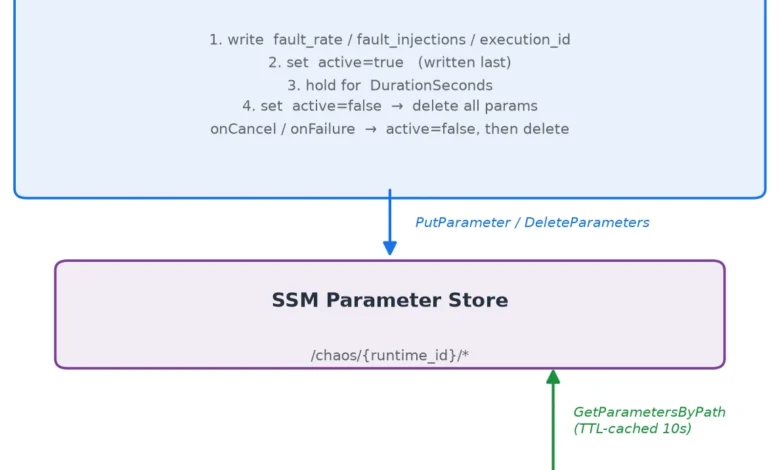
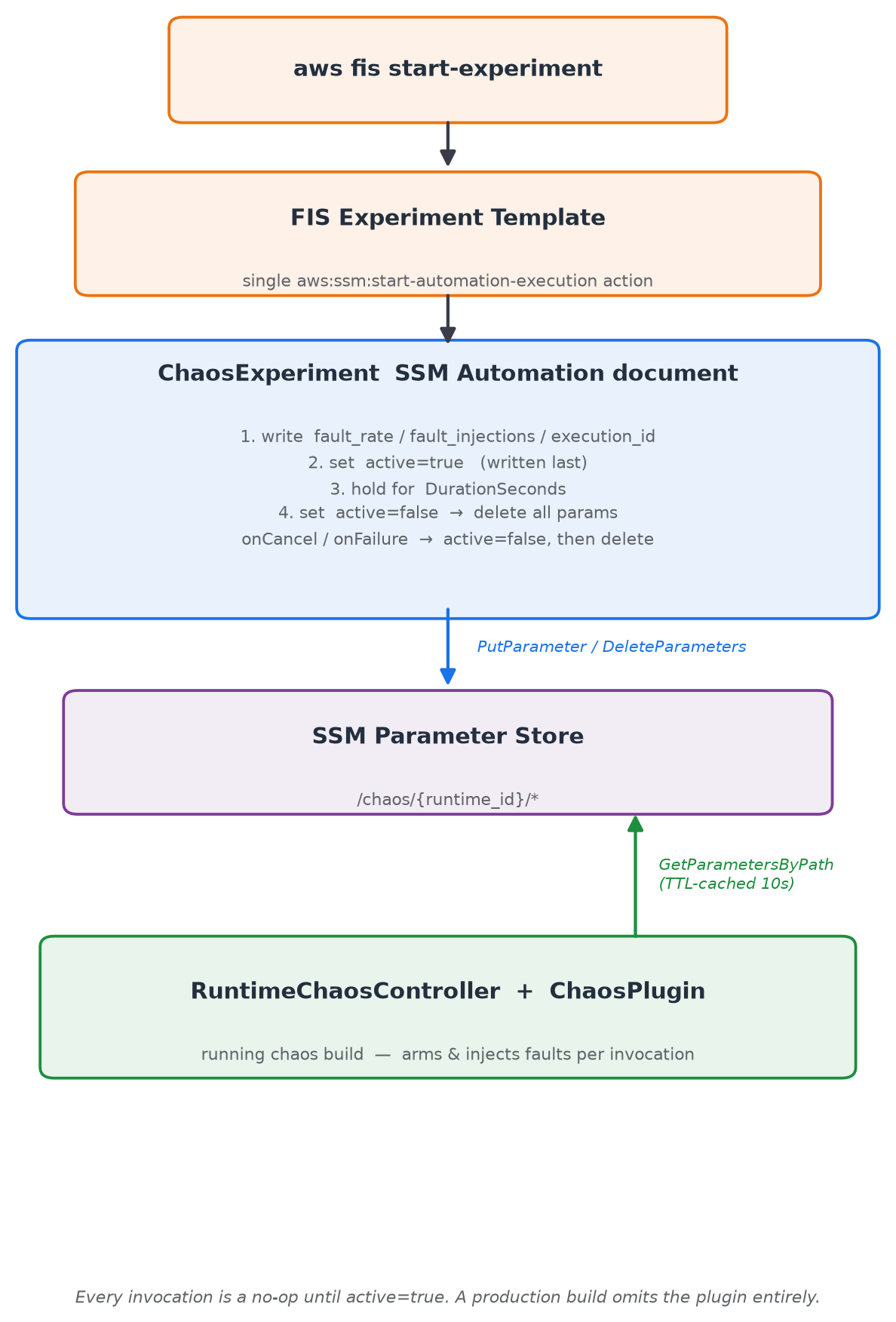
Implementing chaos testing within an enterprise-grade agent architecture requires a precise separation of concerns between runtime execution and fault activation controls. The integration methodology relies on dynamic configuration states stored within AWS Systems Manager (SSM) Parameter Store, governed by automated FIS workflows.
In a typical experimental setup, AWS FIS executes a single SSM Automation action that modifies specific fault parameters stored under a designated namespace, such as /chaos/runtime_id/. The agent’s runtime controller reads these SSM parameters upon each incoming invocation, evaluating whether faults should be injected dynamically.
This design ensures that the agent continues serving live traffic uninterrupted throughout the experiment. No redeployments are necessary to initiate or terminate a chaos run. Two primary controls separate the deployment of fault-injection code from its active execution:
- Deployment Control: The chaos plugin code is packaged directly into the agent’s container image and deployed securely within an Amazon Bedrock AgentCore runtime container.
-
Activation Control: The actual triggering of faults is controlled externally via AWS FIS and SSM Parameter Store, allowing developers to switch faults on and off dynamically
in staging or production environments.
This architecture supports two distinct families of faults designed to test different vulnerabilities in the agent lifecycle:
- Pre-Hook Faults: These occur immediately before a tool is invoked, effectively intercepting and canceling the call. Supported pre-hook effects include network timeouts, simulated network execution errors, and structural validation failures.
- Post-Hook Faults: These occur immediately after a tool returns data, intercepting and corrupting the payload before the foundation model processes it. Supported post-hook effects include field truncation, data removal ratios, and value corruption ratios.
Defining Test Hypotheses and Empirical Measurement
Before initiating any chaos experiment, engineering teams must establish a clear, falsifiable hypothesis regarding expected agent behavior. A well-constructed hypothesis defines observable signals and failure thresholds, such as:
"When tool calls for the inventory-management agent are canceled or corrupted, we expect the agent to report the failure transparently and fail safe rather than fabricate data. Following three consecutive failed tool calls within a two-minute window, an automated CloudWatch alarm must be raised, notifying the DevOps team within five minutes. Upon service recovery, the agent must return to normal operating parameters within thirty seconds."
Following the completion of the experiment, teams compare empirical observations against this baseline hypothesis. Gaps between expected and actual behavior highlight critical areas requiring prompt engineering refinements, tool-level validation logic, or updated observability metrics.
For advanced evaluation beyond manual log reviews, developers utilize the Strands Evals SDK, which includes specialized LLM-judge evaluators—such as the FailureCommunicationEvaluator, RecoveryStrategyEvaluator, and PartialCompletionEvaluator—to score agent outcomes on a standardized zero-to-one scale.
Empirical Insights: The Hidden Danger of Unprompted Foundation Models
Recent experimental data comparing agent configurations under identical fault conditions reveals profound vulnerabilities in standard agent designs. When researchers subjected a Pokémon team-advisor agent to continuous tool timeouts (get_move set to 100% failure rate), the results varied dramatically based solely on the agent’s system prompt instructions.
- Configuration A (Standard Prompting): Lacking explicit instructions on how to handle tool failures, the agent attempted repeated retries, consuming approximately 1.35 times more tool calls on average—and scaling up to 2.5 times the unfaulted baseline during peak failure runs. Crucially, when exhausted retries failed to yield data, the unprompted agent fell back entirely on its parametric training knowledge, presenting outdated historical data as absolute fact to the user while falsely claiming technical difficulties were minor.
- Configuration B (Failure-Handling Prompting): Configured with an explicit system prompt directing it to halt immediately upon tool failure, name the missing data explicitly, and decline to guess, the agent terminated execution efficiently after significantly fewer attempts. It refrained entirely from hallucinating missing statistics, accurately communicating its operational limitations to the end user.
When post-hook corruption faults—such as field truncation or value corruption—were introduced, fourteen out of fifteen unprompted runs produced confident, erroneous answers without acknowledging that the underlying data had been degraded. The agent only recognized corruption when encountering values completely outside logical parameters (such as an impossible numerical power rating). Conversely, prompted agents consistently identified anomalies and declined to process the corrupted payload.
The Observability Gap: Why Traditional Infrastructure Monitoring Fails
One of the most significant findings from agent chaos engineering is that graceful failure handling is entirely invisible to traditional infrastructure monitoring tools.
During experimental runs where 100% of tool calls were either canceled or intentionally corrupted, standard Amazon CloudWatch error metrics registered a flat 0.0. Every incoming client invocation returned an HTTP 200 OK status code because, from the perspective of the serverless runtime and container infrastructure, no application crash or unhandled exception occurred.
If an organization’s observability strategy relies solely on traditional availability metrics, HTTP status codes, and infrastructure CPU utilization, these silent AI failures will go completely unnoticed. To solve this visibility gap, developers must implement application-level telemetry.
Mitigating Silent Failures with Tool Contracts and Guardrails
Mitigating agent hallucination and silent data corruption requires a multi-layered defense strategy combining application code validations, schema validation contracts, and enterprise security guardrails.
- Tool-Level Schema Validation: Using frameworks like Pydantic, developers can define strict output models for every tool invocation. For instance, validating a retrieved data structure against minimum length constraints and required data types ensures that truncated or corrupted payloads trigger an immediate
ValidationErrorbefore the foundation model can process them. - Embedded Metric Format (EMF) Logging: By capturing tool validation errors via event hooks (such as the Strands
AfterToolCallEvent), agents can emit structured EMF log lines directly to Amazon CloudWatch. CloudWatch automatically transforms these log entries into actionable custom metrics, enabling reliable operational alarms for silent tool degradation. - Amazon Bedrock Guardrails: Enterprise deployments should complement application-level logic with native cloud security features, such as Amazon Bedrock Guardrails, which provide advanced content filtering, semantic validation, and contextual grounding checks to prevent unverified data from reaching end users.
It is vital to recognize that modern foundation model features—such as strict tool use and structured JSON outputs—guarantee only that the model’s response adheres to a defined schema. They do not verify whether the underlying data returned by an API or database was accurate, complete, or fresh. A schema-valid answer can still be built upon a timed-out, truncated, or completely corrupted foundation.
Best Practices for Enterprise Implementation
Engineering organizations seeking to adopt AI agent chaos engineering should adhere to established industry best practices to ensure safe experimentation:
- Start in Non-Production Environments: Always initiate chaos experiments in isolated staging or development runtimes before deploying fault templates to production workloads.
- Begin with Low Fault Rates: Start with fractional fault injection rates (e.g., 5% to 10% failure rates) to observe subtle degradation patterns before testing catastrophic failure scenarios (100% failure rates).
- Automate Experimentation: Integrate FIS experiment templates into continuous integration and continuous deployment (CI/CD) pipelines to test agent resilience regularly as system tools and models evolve.
- Define Strict Stop Conditions: Always configure automated alarm-based stop conditions within AWS FIS to immediately halt experiments if broader system stability is compromised.
Conclusion
The primary value of running chaos experiments on AI agents does not lie in confirming that your infrastructure remains online during an outage. Rather, it exposes the subtle, probabilistic ways an agent manipulates bad data, and whether your operations team has the visibility to detect it.
A single tool timeout can produce a transparent, safe refusal from a well-prompted agent or a confident, fabricated falsehood from an unprompted one. Every instance where an agent presents corrupted data as objective truth represents a tangible vulnerability that must be addressed through rigorous testing, strict payload validation, and proactive chaos engineering.
By systematically applying AWS Fault Injection Service to modern agentic workloads, enterprises can move beyond hopeful assumptions, uncover hidden failure modes, and build genuinely resilient AI systems capable of operating reliably in unpredictable production environments.
Related posts: