Cognizant and AWS Professional Services Overhaul OrderServ to Solve Multi-Tenant Scaling and Cost Overruns

When digital food-ordering platforms experience rapid brand acquisition and expansion, their underlying cloud infrastructure often hits a bottleneck. Dedicated compute clusters, which were initially deployed to maintain strict isolation between different quick-service restaurant (QSR) brands, quickly become a major financial liability. Furthermore, when promotional traffic surges occur during lunch rushes or national holidays, every failed application request translates directly to a lost sale and a frustrated customer who may immediately pivot to a competitor.
To combat these challenges, global technology services company Cognizant partnered with AWS Professional Services to radically modernize its omnichannel food ordering platform, OrderServ. By redesigning the architecture into a multi-tenant software-as-a-service (SaaS) model, the engineering teams successfully slashed compute costs by up to 64 percent, reduced horizontal scaling time from several minutes to under a minute, and drastically trimmed customer authentication expenses.
The Evolution of Digital Food Ordering: From Monolith to Multi-Tenancy
Cognizant’s OrderServ is an enterprise-grade omnichannel ordering solution designed to handle high-volume digital transactions across multiple devices. It natively integrates with point-of-sale (POS) hardware, kitchen display systems, payment gateways, and customer loyalty programs. In its initial iterations, the platform operated as a traditional monolith. However, as the digital food-service market accelerated—especially following shifts in consumer behavior toward online ordering—Cognizant recognized that traditional hosting architectures could not keep pace with market demands.
In 2022, Cognizant published a landmark engineering case study detailing the deployment of OrderServ 2.0. That milestone release migrated the platform from a monolithic structure to a collection of microservices hosted on AWS Fargate, instantly netting a 30 percent cost reduction over legacy hosting environments.
Despite this early success, the platform’s continued growth exposed structural limitations. As OrderServ expanded from supporting a single quick-service restaurant brand to powering multiple distinct brands across various international markets, the engineering team maintained a rigid isolation model. Each brand operated on a dedicated Amazon Elastic Container Service (Amazon ECS) cluster comprising 21 individual microservices. While this configuration guaranteed hard tenant isolation and simplified security boundaries, it created severe operational inefficiencies.
The primary drawback was financial: infrastructure costs scaled in direct, linear proportion to every new brand onboarded. Moreover, provisioning separate clusters meant that scaling speeds lagged behind sudden, unpredictable traffic spikes, which frequently surged by five to ten times baseline volumes within a matter of minutes.
The Problem with Dedicated Clusters
In the fiercely competitive quick-service restaurant sector, application availability directly impacts revenue. When promotional campaigns or holiday rushes trigger massive traffic inflows, infrastructure must adapt instantaneously. Under the legacy model, running 21 microservices per brand across dedicated AWS Fargate clusters meant that supporting five distinct brands required maintaining 105 separate services and 315 resource-heavy sidecar containers.
This model precluded any meaningful economies of scale. Unused capacity sat idle within individual clusters, unable to absorb traffic spikes occurring in other brand environments. Furthermore, onboarding a new brand required a manual, multi-day infrastructure provisioning exercise rather than a simple configuration update. Cognizant needed an architecture capable of supporting more than ten distinct brands cost-effectively while preserving strict data security and handling volatile demand patterns.
Architectural Overhaul: Implementing a Shared Cluster Model with Tenant Isolation
To resolve these unsustainable economics, AWS Professional Services and Cognizant formulated a comprehensive multi-tenant SaaS transformation. The core of this strategy involved moving away from dedicated per-brand clusters toward a single, shared Amazon ECS cluster model, while retaining an opt-out pathway for extremely high-volume brands that required dedicated infrastructure.
Transitioning to a shared compute model introduced the risk of "noisy neighbors," where a traffic surge from one brand could degrade performance for others. To mitigate this, the engineering teams developed a specialized .NET Core tenancy library that serves as the primary enforcement mechanism for tenant isolation. Rather than relying solely on infrastructure boundaries, every incoming request carries an X-Tenant-Id header injected by an Amazon API Gateway authorizer.
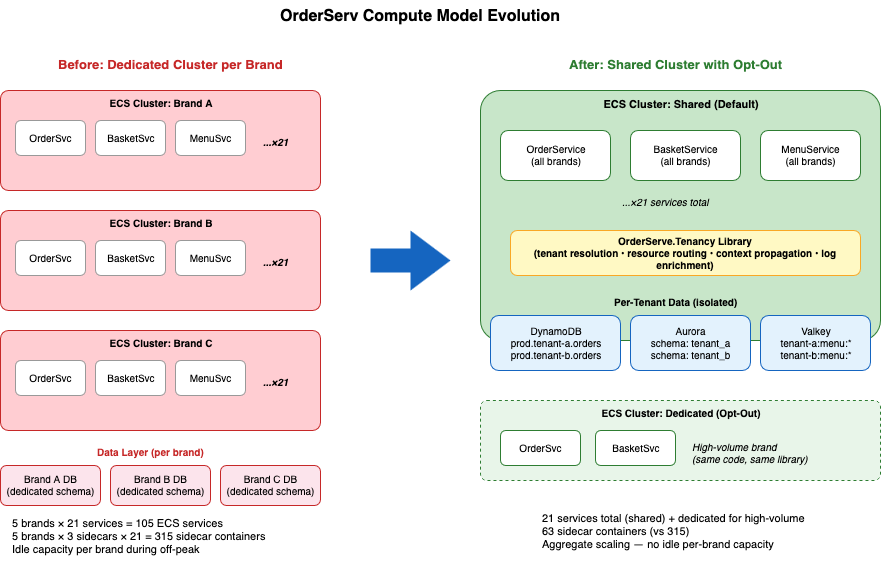
The tenancy library intercepts this header to dynamically route resources, propagate operational context, and apply granular security controls at run time. By calling sts:AssumeRole with the tenant ID as a session tag, the system ensures that application tasks hold dynamic credentials restricted strictly to that specific tenant’s DynamoDB tables, S3 prefixes, and Aurora database schemas. Additionally, Amazon ElastiCache for Valkey enforces role-based access control (RBAC) to ensure that the caching engine itself rejects unauthorized cross-tenant key access.
Sub-Minute Scaling via EC2 Warm Pools and Bottlerocket
While consolidating onto a shared cluster solved the cost-scaling dilemma, it heightened the need for rapid elasticity. Under AWS Fargate, newly provisioned tasks took between five and seven minutes to reach a healthy operational state during traffic surges. The primary bottleneck was not application initialization, but the time required to download and extract the large container images associated with the enterprise microservices. In the fast-paced QSR environment, a five-minute delay leads to saturated containers, soaring latency, and dropped orders.
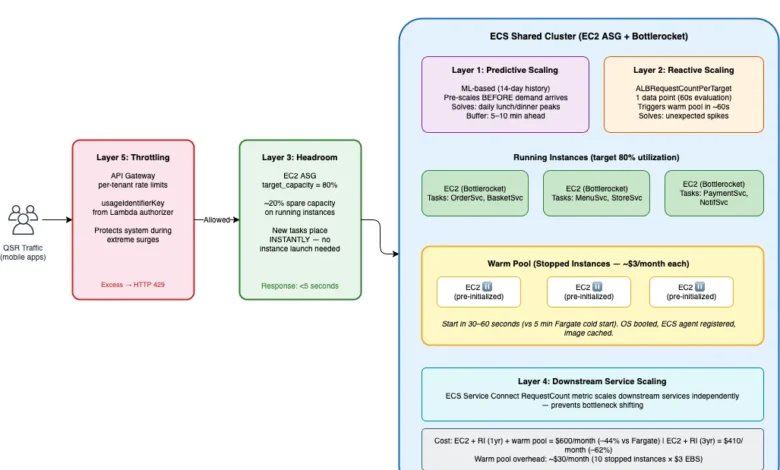
To achieve sub-minute scaling, the engineering team migrated the shared cluster from AWS Fargate to Amazon EC2 Auto Scaling groups running Bottlerocket, a purpose-built container operating system developed by AWS. This infrastructure was augmented with EC2 warm pools, which maintain a pre-initialized buffer of stopped instances ready to accept workloads immediately.
By pairing warm pools with a sophisticated five-layer scaling strategy—incorporating predictive machine learning scaling based on 14-day historical patterns, reactive target tracking on Application Load Balancer request metrics, capacity headroom buffers, downstream service metrics, and per-tenant rate-limiting via AWS Lambda authorizers—Cognizant reduced container scaling time from 5–7 minutes down to a lightning-fast 30 to 60 seconds.
Financial Analysis: Balancing Cost and Performance
The financial implications of moving from AWS Fargate to an EC2-based architecture were profound. Operating 21 microservices in the Asia Pacific (Mumbai) AWS Region under the legacy Fargate On-Demand model incurred an estimated monthly baseline cost of $1,568.
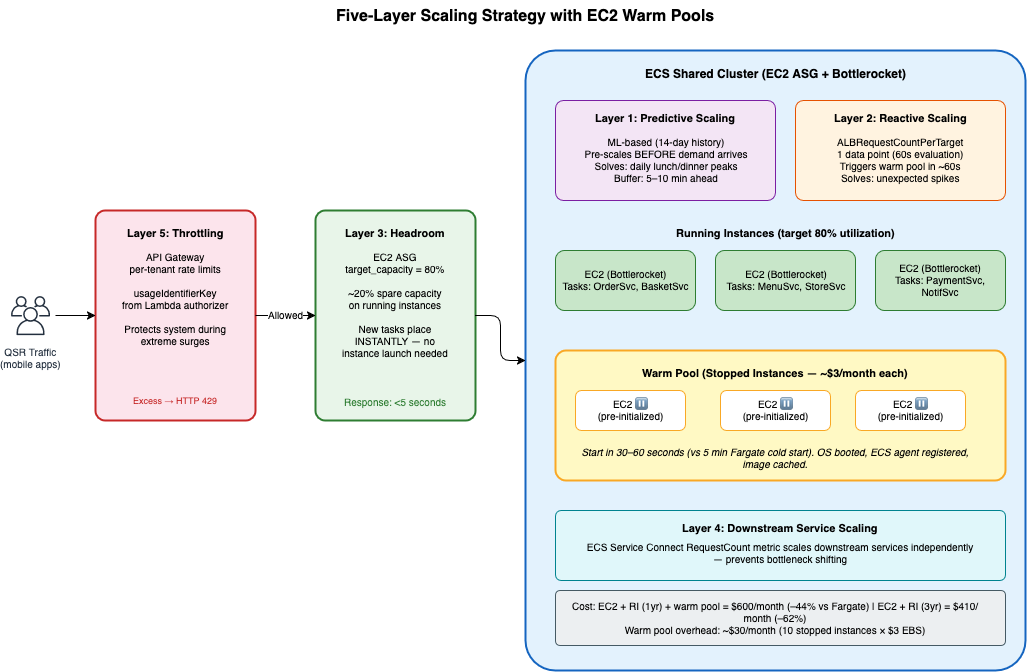
By integrating Amazon EC2 Auto Scaling groups with a one-year Compute Savings Plan and warm pools, monthly expenditures dropped to approximately $832. Opting for a three-year Compute Savings Plan further optimized operating expenses, driving monthly costs down to roughly $568. When factoring in On-Demand Capacity Reservations to guarantee availability during traffic spikes and minor Amazon EBS storage costs for the warm pool instances, the platform achieved a total compute cost reduction between 47 and 64 percent.
Advanced Observability and Passkey Authentication
Beyond compute and scaling optimizations, the modernization initiative overhauled observability and user authentication workflows. Previously, container crashes yielded minimal diagnostic data, often leaving support teams staring at generic exit codes. The new architecture implements a crash observability pipeline utilizing FireLens (Fluent Bit) sidecars running at the container runtime level. Even if an application container suffers an out-of-memory termination, the sidecar survives to route structured JSON logs to Amazon CloudWatch Logs and Amazon S3. Furthermore, the .NET Core runtime automatically writes mini-dumps to an Amazon EFS mount, preserving critical thread call stacks and heap objects for post-mortem analysis.
On the front end, Cognizant addressed the friction and expense associated with traditional SMS one-time password (OTP) logins by integrating passkeys (WebAuthn) natively via Amazon Cognito. Because QSR mobile users demand instant access, replacing SMS OTP with device-bound cryptographic passkeys eliminated recurring messaging fees, reduced login latency from up to 30 seconds down to approximately two seconds, and cut authentication costs by over 80 percent at steady state. A Post-Authentication Lambda function pairs customer profiles in DynamoDB using brand-specific hashes, ensuring complete cryptographic isolation between different restaurant brands.
Broader Impact and Industry Implications
The sweeping architectural modernization of OrderServ demonstrates a vital lesson for enterprise cloud architecture: true multi-tenancy does not universally require physical infrastructure isolation for every tenant. By combining a robust application-level tenancy library with intelligent resource routing, shared compute models can safely replace expensive dedicated clusters without sacrificing security or performance.
For Cognizant, the cumulative results of the transformation are striking. Across compute optimization, scaling acceleration, observability improvements, and authentication cost cuts, the platform achieved annual infrastructure savings exceeding 60 percent. More importantly, OrderServ now possesses the resilience, elasticity, and operational visibility required to support the aggressive global expansion strategies of the world’s leading quick-service restaurant brands, ensuring that every digital order is processed swiftly, securely, and without interruption.