Transforming Industrial Operations: AWS Unveils Offline-First Generative AI Architecture for the Edge to Combat $1.4 Trillion Downtime Costs

Industrial giants are grappling with staggering losses, with Fortune 500 companies facing an estimated $1.4 trillion annually due to unplanned downtime, a figure highlighted in Siemens’ 2024 report, The True Cost of Downtime. This economic drain is frequently exacerbated by a critical skills gap, hindering the rapid detection and resolution of operational issues. In a significant move to address this pervasive challenge, Amazon Web Services (AWS) has introduced an innovative architectural blueprint that deploys the power of generative AI directly to industrial environments, particularly those plagued by unreliable or non-existent cloud connectivity. This "offline-first" approach represents a pivotal shift, moving AI inference to the operational edge while leveraging cloud services for foundational tasks like model customization, deployment orchestration, and continuous improvement, thereby unlocking unprecedented levels of resilience and efficiency for critical infrastructure.
The Pressing Need for Edge AI in Industrial Settings
The digital transformation sweeping through industries, often dubbed Industry 4.0, has seen an explosion of connected devices, sensors, and operational technology (OT) generating vast quantities of data at the edge. However, translating this data into actionable insights has been a persistent hurdle, especially in environments where real-time decision-making is paramount and internet access is a luxury. Manufacturing plants, offshore oil rigs, remote agricultural sites, transportation hubs, and defense installations frequently encounter intermittent or entirely absent cloud connectivity. Traditional cloud-centric AI models, which rely on constant data transfer to remote servers for processing, are simply unfeasible in these scenarios. Furthermore, latency — the delay between an event occurring and a system reacting — can be critical. A millisecond delay in a production line or a safety system can have catastrophic consequences, making local processing not just convenient but essential. The challenge, therefore, lies in democratizing advanced AI capabilities, specifically generative AI, to these distributed, often isolated, operational frontiers without compromising performance or security.
AWS’s Vision: An Offline-First Generative AI Framework
The core tenet of the AWS reference architecture is an "offline-first" paradigm. This means that the generative AI models and their inference capabilities reside directly on edge devices within the industrial facility, capable of operating autonomously even when disconnected from the internet. The cloud’s role is strategically defined: it serves as the intelligent backbone for the heavy-lifting tasks that benefit from scalable compute, such as the initial training, fine-tuning, and sophisticated customization of large language models (LLMs). It also manages the intricate orchestration of model deployments and the critical feedback loops that drive continuous improvement. This division of labor ensures that while the intelligence is local and immediate, its evolution and refinement are globally managed and optimized.
Implementing this pattern necessitates a meticulously coordinated integration of various AWS services across Artificial Intelligence/Machine Learning (AI/ML), Internet of Things (IoT), and storage domains. This approach demands a careful balancing act, requiring deliberate trade-offs between a model’s capabilities, the inherent constraints of edge hardware (such as computational power and memory), and the overall operational complexity of the deployed solution. The benefits, however, are substantial, offering smart applications at the edge numerous potential use cases:
- Real-time Troubleshooting and Maintenance: Operators can query equipment documentation, correlate log data, and receive instant, context-aware troubleshooting guidance directly on the factory floor.
- Predictive Maintenance Explanations: Beyond simply flagging a potential failure, generative AI can explain why a machine is likely to fail, suggest root causes, and recommend specific preventative actions based on historical data and maintenance manuals.
- Quality Control and Anomaly Detection: Systems can analyze visual or sensor data from production lines, identify subtle anomalies, and provide natural language explanations or suggestions for corrective actions.
- Safety Protocol Guidance: In hazardous environments, technicians can receive immediate, voice-activated instructions on safety procedures, emergency protocols, and equipment handling without needing to consult physical manuals or rely on network access.
- Operational Optimization: AI can analyze local production data to suggest minor adjustments to machine settings, optimizing throughput or energy consumption, explained in clear, actionable language.
Architectural Decisions for Robust Offline-First AI
The foundation of an effective offline-first AI architecture begins with the critical decision of how to adapt a language model for a specific domain while ensuring it remains compact enough to run efficiently on resource-constrained edge hardware. These devices typically feature GPUs with 16 GB or more of VRAM, mandating the use of small language models (SLMs). The chosen customization strategy profoundly impacts the architecture’s complexity, cost, and data pipeline requirements.
AWS outlines several strategies, each offering increasing levels of architectural complexity and distinct infrastructure needs:
- Prompt Engineering: The simplest method, involving carefully crafted prompts to guide a pre-trained LLM towards desired outputs. This requires no model modification but offers limited domain specificity.
- Retrieval Augmented Generation (RAG): Enhances an LLM by providing it with external, up-to-date information from a knowledge base (e.g., technical manuals) at inference time. This avoids retraining the model but relies on an effective retrieval mechanism.
- Fine-tuning (FT): Adjusts a pre-trained LLM’s weights using domain-specific labeled data, teaching it to generate more accurate and relevant responses for specific tasks. This requires training data and compute but significantly improves domain understanding.
- Hybrid Approach (FT + RAG): Combines fine-tuning for task-specific behavior with RAG for up-to-date knowledge retrieval, offering a potent balance of domain adaptation and factual accuracy without constant retraining. This is the strategy chosen for the reference architecture.
- Pre-training: Building an LLM from scratch on a massive, domain-specific dataset. This is the most resource-intensive and complex approach, typically reserved for highly specialized and proprietary applications.
The selection of the right strategy is a crucial step, demanding a backward-looking analysis from the specific use case requirements and anticipated outcomes.
A Deep Dive into the AWS Reference Architecture
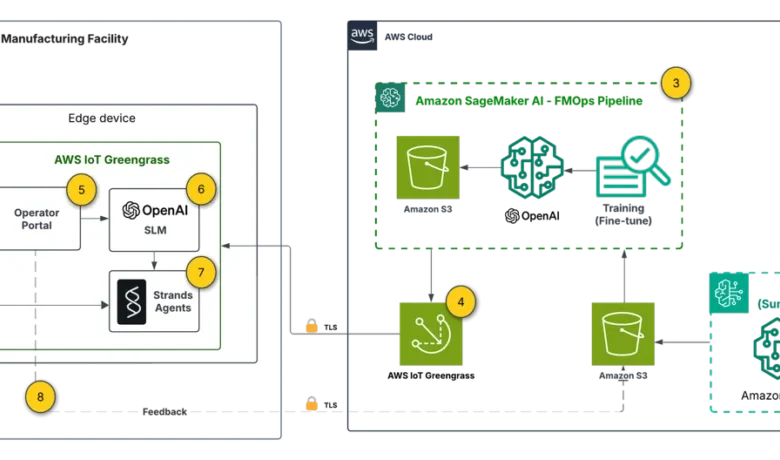
AWS’s reference architecture addresses a critical manufacturing use case where operators require instant access to equipment documentation, log correlation, and troubleshooting guidance, all independent of cloud connectivity. The chosen hybrid approach (Fine-tuning + RAG) effectively balances the need for a compact, task-specific on-device model with the ability to retrieve current knowledge without frequent retraining. This robust architecture spans two distinct trust domains—cloud and edge—each meticulously secured with least-privilege AWS Identity and Access Management (IAM) roles and mutual TLS for all cloud-to-edge communications via AWS IoT Greengrass device certificates.
The architecture is logically segmented into three primary layers:
Cloud-Side Preparation (Steps 1-3): The Intelligent Factory’s Brain
- Document Base Setup: Technical manuals and Standard Operating Procedures (SOPs), which are the lifeblood of industrial operations, are securely stored in Amazon S3. This service acts as the definitive single source of truth, seamlessly feeding both the cloud-side training pipeline and the edge-side RAG knowledge base. S3’s deep integration with SageMaker AI and IoT Greengrass makes it the natural conduit for artifacts flowing between the cloud and the edge.
- Preparing Labeled Data: Instead of manual, time-consuming data curation, AWS leverages the power of Amazon Nova Pro on Amazon Bedrock. This large foundation model processes raw documentation to generate high-quality, structured question-answer-context pairs, purpose-built for fine-tuning. This architectural decision dramatically scales the data preparation process, and Amazon Bedrock’s serverless inference keeps this step cost-effective, with its output directly feeding into the SageMaker AI pipeline.
- Model Customization (FMOps Pipeline): Amazon SageMaker AI Pipelines orchestrates an automated Foundation Model Operations (FMOps) pipeline. This pipeline fine-tunes a specialized Small Language Model (SLM), specifically
gpt-oss-20b(a Mixture of Experts architecture with 21 billion total parameters, 3.6 billion active per token, 32 experts, and a 128k context length) on the newly generated, domain-specific Q&A pairs. This pipeline pattern ensures repeatable, versioned model customization, capable of being triggered automatically whenever new documentation is introduced. The process trains the model to internalize equipment-specific terminology and response formats, subsequently storing the customized model artifact in S3 for downstream deployment.
Deployment Orchestration (Step 4): Bridging Cloud and Edge
- Edge Deployment via AWS IoT Greengrass: The edge device, exemplified by a powerful
g4dn.12xlargeinstance (equipped with 4x NVIDIA T4 GPUs, 16 GiB each for a total of 64 GiB accelerator memory, 48 vCPUs, and 129 GiB system RAM), provides the necessary GPU compute for local inference. The selection of this hardware is a critical architectural constraint, directly influencing model viability and the serving strategy. Withgpt-oss-20boccupying approximately 13 GB per T4 GPU, two distinct deployment strategies emerge, tailored to specific throughput and latency priorities:- Model Replication: Deploying multiple instances of the model across available GPUs, allowing concurrent queries to be processed in parallel. This strategy is ideal for high-concurrency, short-query environments.
- Tensor Parallelism: Splitting the model across multiple GPUs to process a single, large query more quickly. This is suited for scenarios with fewer concurrent users but longer, more complex interactions.
AWS IoT Greengrass serves as the intelligent bridge, packaging, versioning, and securely deploying these models and their dependencies to the edge, managing their lifecycle without requiring persistent connectivity.
Edge-Side Inference (Steps 5-8): Autonomous Intelligence in Action
- Edge Device (Manufacturing Facility): For the actual manufacturing facility deployment, the edge device could be a more compact solution like an NVIDIA Jetson Xavier. This device must provide sufficient VRAM (16 GB or more) to efficiently run the quantized SLM, directly influencing which models are viable for deployment.
- User Interface (Flask Operator Portal): A Flask-based web interface, running locally on the edge device, provides the human-machine interface. This allows maintenance operators and technicians to submit natural language queries about equipment issues, safety procedures, or maintenance tasks. By running the UI on-device, any dependency on external connectivity for the user-facing layer is eliminated, ensuring immediate responsiveness.
- Off-cloud Generative AI (Ollama): The fine-tuned SLM operates on-premises using Ollama as its inference runtime. Ollama offers a lightweight, container-friendly serving layer that supports quantized model formats (GGUF), enabling efficient inference within the device’s memory constraints. This critical component completely decouples the model serving infrastructure from any cloud dependency, guaranteeing uninterrupted operation.
- Generative AI Orchestration (Strands Agents): Strands Agents provides the sophisticated orchestration layer, coordinating the entire query processing workflow. It intelligently routes requests to various "tools," such as querying the on-site RAG knowledge base or collecting real-time device telemetry data. This agent-based pattern offers significant extensibility, allowing new tools and data sources to be integrated without requiring modifications to the core inference pipeline.
Continuous Improvement (Step 9): The Virtuous Cycle of Learning
- Continuous Improvement (Feedback Loop): A vital aspect of the architecture is the asynchronous feedback loop. When cloud connectivity becomes available, user interactions and feedback—such as implicit satisfaction signals, explicit ratings, or corrections—are queued locally and then synchronized back to the cloud. This data feeds directly into the FMOps pipeline, enabling ongoing model refinement and creating a virtuous cycle: edge usage data improves the next model version, which AWS IoT Greengrass then securely deploys back to the edge device. This design ensures the architecture is resilient to connectivity gaps, with learning happening opportunistically.
Robust Security at the Edge: A Shared Responsibility
Moving inference to the edge fundamentally shifts the security perimeter. While AWS manages much of the infrastructure security in a cloud-native deployment, at the edge, organizations assume ownership of the full stack, from physical device access to application-layer controls. Implementing robust security measures is paramount for industrial environments.
- Authentication and Access Control: The local Flask operator portal must integrate with the organization’s identity provider (e.g., SAML/OIDC) or implement certificate-based mutual TLS. Role-based access control (RBAC) should ensure operators, administrators, and maintenance personnel only access interfaces relevant to their functions.
- Encryption at Rest: Model artifacts and the ChromaDB vector database, containing proprietary knowledge, must be encrypted. Full-disk encryption (e.g., LUKS on Linux, BitLocker on Windows) for the edge device’s storage volume is essential, with encryption keys managed via AWS IoT Greengrass secret manager or a hardware Trusted Platform Module (TPM).
- Encryption in Transit: All communication between the edge device and AWS (including IoT Greengrass deployment and feedback synchronization) must use TLS 1.2 or later. Internal communications between edge components (Flask portal to Ollama, Strands Agents to ChromaDB) should also enforce TLS, even on the loopback interface, to prevent local interception.
- Input Validation and Prompt Guardrails: The Strands Agents orchestration layer, accepting natural language input, requires robust input validation to reject malformed or excessively long queries. Prompt guardrails are crucial to detect and block prompt injection attempts, while output content filtering prevents the model from surfacing sensitive information outside its intended scope.
- Network Segmentation: Edge components should be segregated into distinct network zones: the operator-facing portal in a perimeter network, the inference runtime in a restricted zone, and the cloud sync channel on an isolated outbound-only interface. Firewall rules must rigorously enforce expected traffic flows.
- IAM Least Privilege: Each AWS service in the cloud-side pipeline must operate with its own IAM role, scoped to the absolute minimum required permissions. The IoT Greengrass core device role should only access specific S3 prefixes and IoT topics, and SageMaker pipeline execution roles should be restricted from production S3 buckets.
- Logging and Monitoring: AWS CloudTrail and Amazon CloudWatch should be enabled for all cloud services. On the edge device, all operator queries, model responses, and sync events must be logged locally. When connectivity permits, these edge logs should be forwarded to Amazon CloudWatch Logs or Amazon S3 for centralized analysis, with alerts configured for anomalous patterns like unexpected query volumes or unauthorized access attempts.
Quantifiable Performance Gains: The Hybrid Advantage
To validate the efficacy of this hybrid approach, AWS evaluated the fine-tuned gpt-oss-20b model against its base version using 30 domain-specific question-answer pairs. Both configurations utilized a full RAG pipeline (ChromaDB + sentence-transformer embedding model) as the retrieval layer, isolating the variable to the impact of fine-tuning the language model on generation quality given identical retrieved contexts. Three independent LLM judges (Claude 4.5 Haiku, Claude 4.5 Sonnet via Amazon Bedrock, and Amazon Nova Pro) scored responses on a 12-point scale across accuracy, completeness, and relevance.
The results unequivocally supported the hybrid (FT + RAG) architecture:
- Claude 4.5 Haiku: Fine-tuned
gpt-oss-20b+ RAG achieved an average score of 10.20/12 (85%), significantly outperforming the Basegpt-oss-20b+ RAG at 8.20/12 (68.3%). - Claude 4.5 Sonnet: The fine-tuned model scored 9.20/12 (76.7%), compared to the base model’s 7.49/12 (61.7%).
- Nova Pro: The fine-tuned solution achieved 9.90/12 (82.5%), while the base model lagged at 8.70/12 (72.5%).
These results demonstrate that even with a relatively modest fine-tuning dataset, significant performance improvements can be achieved for domain-specific applications at the edge. An 85% accuracy in troubleshooting or procedural guidance can translate directly into reduced downtime, fewer operational errors, and enhanced safety in an industrial setting.
Broader Impact and the Future of Industrial Intelligence
This reference architecture transcends the manufacturing sector, offering profound implications for any environment characterized by intermittent connectivity, stringent latency requirements, or critical data locality constraints. Industries such as offshore energy (oil and gas platforms, wind farms), remote agriculture (smart farming operations in distant fields), transportation (autonomous vehicles, fleet management in areas with patchy coverage), and defense (tactical edge operations) stand to benefit immensely. For these sectors, the ability to perform complex AI inference locally, without reliance on a constant cloud connection, is a game-changer for operational resilience, safety, and efficiency.
The economic implications are substantial. By directly addressing the root causes of unplanned downtime—slow issue detection, lack of readily available expertise, and dependency on cloud connectivity—this architecture provides a powerful tool for Fortune 500 companies to claw back a significant portion of the $1.4 trillion lost annually. It fosters a new era of proactive, intelligent operations, where machines and operators are empowered with immediate, context-aware insights.
The key design decisions—selecting the optimal model customization strategy, precisely sizing edge hardware to model requirements, and judiciously choosing between RAG and fine-tuning—will vary by specific use case. However, the overarching integration pattern, leveraging AWS services as a cohesive framework, remains consistently applicable. This development signals a strategic pivot in industrial AI, moving towards more autonomous, intelligent edge operations that are less vulnerable to network limitations and more responsive to real-time demands. AWS is positioning itself as a critical enabler of this transformation, providing the foundational tools and architectural guidance for businesses to thrive in increasingly complex and distributed operational landscapes. The journey towards fully intelligent, self-optimizing industrial environments has taken a significant leap forward, with the edge emerging as the new frontier for generative AI.
Related posts: