From Fast Food to High Fashion: Why Food Brands Are Trading Logo Tees for Trendy Bag Charms

The landscape of promotional merchandise has undergone a significant structural shift over the past several years, moving away from traditional corporate swag like standard-issue t-shirts, plastic pens, and canvas tote bags toward hyper-personalized, culturally relevant accessories. While the fashion and luxury sectors—ranging from heritage labels like Coach to contemporary trendsetters like Vera Bradley—have long capitalized on the resurgence of purse charms and bag personalization among Gen Z and millennial demographics, fast-moving consumer goods (FMCG) and restaurant chains are now aggressively entering the space.
Food and beverage giants are increasingly transforming their iconic packaging, logos, and mascots into miniature, collectible bag charms. This strategic pivot allows companies to transcend their traditional roles as meal providers or grocery shelf staples, positioning themselves instead as lifestyle brands tightly attuned to contemporary street culture. By tapping into the psychology of personalization, scarcity marketing, and social media virality, food brands are finding innovative ways to maintain consumer engagement far beyond traditional dining or grocery-shopping hours.
The Evolution of Promotional Swag and the Bag-Charm Phenomenon
For decades, corporate merchandise in the food and beverage industry served a straightforward, utilitarian purpose: billboard-style brand awareness. Companies printed their logos on basic apparel or household items, relying on passive exposure to drive recall. However, consumer preferences—particularly among younger cohorts—have shifted dramatically toward utility, irony, aesthetic integration, and self-expression.
Bag charms have emerged as a dominant micro-trend in recent years, functioning as a medium for consumers to broadcast their specific identities, humor, and lifestyle interests directly on the accessories they carry daily. According to marketplace data from Etsy, consumer searches for purse bag charms surged by 27% over a three-month period compared to the corresponding timeframe a year prior, illustrating a sustained consumer appetite for accessorizing handbags, backpacks, and keys. Similarly, pop-culture and toy conglomerate Funko reported during its Q1 earnings call that bag charms and pins were pivotal drivers of double-digit revenue growth for its Loungefly accessories brand.
Recognizing that modern consumers view their accessories as extensions of their identity, food brands have recognized an opportunity. Rather than offering items that consumers might relegate to sleepwear or gym clothes, brands are introducing items that integrate seamlessly into daily urban fashion. This evolution has transformed mundane culinary symbols into coveted cultural commodities.
A Timeline of Culinary Collectibles: How Restaurants and CPG Brands Broke Into Charms
The infiltration of food culture into the accessories market has accelerated rapidly through a series of calculated, highly publicized drops throughout 2025 and 2026.
The movement gained significant momentum in January 2026, when quick-service restaurant chain Jack in the Box introduced "Jibbis"—a blind-bag series of collectible charms featuring the company’s iconic mascot. Capitalizing on the psychological thrill of the blind-box unboxing trend popularized by collectible toy brands, Jack in the Box successfully merged fast-food fandom with toy-culture collecting.
Months later, the trend pivoted toward miniature replicas of everyday packaging. In August 2026, fast-casual Mediterranean chain Cava made waves by shrinking its signature yellow takeout bag into a limited-edition charm available exclusively for one day at participating locations. This followed Cava’s successful 2025 campaign that distributed plush pita-chip bag charms—featuring characters named Peter Chip, Jimmy Harissa, Garlic Gus, and Sweet Sammy—to promote its Hot Harissa Meal.
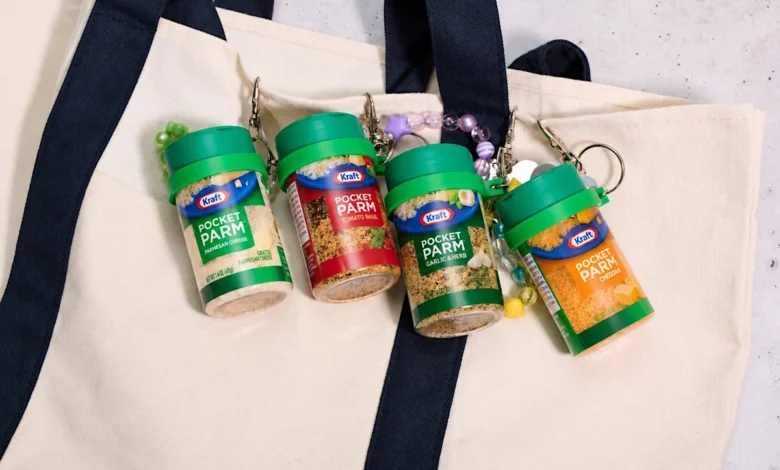
By October 2026, the packaged goods sector joined the movement. Kraft Natural Cheese introduced "Pocket Parm," a miniature, portable, and shelf-stable version of its classic grated parmesan cheese. Designed for on-the-go consumers seeking flavor during visits to movie theaters, malls, or late-night study sessions, the launch combined functional product innovation with collectible marketing, rolling out across select major metropolitan areas via branded food trucks.
Case Studies in Virality: Cava and Kraft Natural Cheese
The strategic deployment of these items relies heavily on manufactured scarcity, experiential marketing, and digital amplification. Cava’s yellow bag charm promotion serves as a prime example of how limited-edition physical drops translate into immediate operational gains and digital engagement.
According to Silmo Bonomi, vice president of brand and creative at Cava, the one-day August drop resulted in a measurable uptick in both store traffic and overall sales on the day of the promotion. Crucially, the initiative generated substantial organic conversation across social media platforms. Cava’s official Instagram announcement regarding the charm garnered nearly 2,000 likes and an influx of humorous, highly engaged user comments, ranging from users plotting mid-workday escapes to those humorously conceding that the keychain would become their entire personality. The cross-brand visibility was further amplified when beauty and skincare brand Bubble chimed in with viral commentary, asking how many barbecue pita chips the miniature bag could hold.
Bonomi emphasized that the brand approaches merchandise with the same level of rigorous design and craftsmanship applied to its culinary offerings. "We look very closely, in terms of trends and what the guests say about us, and it just felt like the right thing to do," Bonomi noted, leaving the door open for future charm releases based on direct consumer demand.
Meanwhile, Kraft Natural Cheese adopted an experiential, mobile tour model to launch its Pocket Parm line. By dispatching branded food trucks to targeted urban centers such as Los Angeles and Orlando—while omitting online sales channels—the company engineered a potent "fear of missing out" (FOMO) dynamic. Fans queued in person to secure the product in its classic parmesan format alongside three experimental flavors: Tomato Basil Parmesan, Garlic Herb Parmesan, and Cheddar.
Dhriti Batra, director of Kraft Natural Cheese at Lactalis Heritage Dairy, highlighted that social media amplification played an indispensable role in driving public awareness. Initial Instagram announcements surpassed 48,000 likes, while real-time video coverage of the food truck tour amassed hundreds of thousands of views. Consumers documented their journeys online, with fans exchanging messages urging friends and family members to secure the items before supplies vanished.
Strategic Implications: Driving Flavor, Testing Markets, and Building Lifestyle Equity
The proliferation of bag charms and elevated merchandise across the consumer packaged goods (CPG) and restaurant landscapes is far more than a passing marketing gimmick; it represents a sophisticated funnel for product testing, brand repositioning, and customer acquisition.
From a product development standpoint, brands like Kraft are utilizing innovative merchandise rollouts to gauge consumer appetite for new formulations before committing to expensive nationwide retail distributions. Pocket Parm acts as a tactile, engaging vehicle to test new flavor profiles—such as Garlic Herb and Tomato Basil—with the ultimate strategic objective of driving consumers toward traditional, full-sized retail bottles in the future. By lowering the barrier to entry through a novel, highly portable format, Kraft addresses contemporary consumer habits characterized by a desire for fast, flavorful meals that require minimal time in the kitchen.
Furthermore, these initiatives allow legacy food brands to shed traditional perceptions and operate within the cultural sphere typically reserved for fashion and lifestyle labels. This trend aligns with a broader historical trajectory seen across the food and beverage sector. Over recent years, companies have generated immense brand equity and auxiliary revenue streams through non-traditional merchandise. For instance, alternative water brand Liquid Death famously generated millions of dollars in annual merchandise sales through unconventional items ranging from branded apparel to high-ticket collectibles, while grocery retailer H-E-B and pickle brand Grillo’s Pickles have successfully cultivated passionate subcultures by positioning their logos as streetwear statements.
Similarly, the boundaries between fashion and food continue to blur through high-profile cross-industry collaborations. Brands like Gap have partnered with celebrated culinary institutions such as New York City’s Los Tacos No.1 for joint apparel drops, while Dunkin’ has collaborated with lifestyle influencers on co-branded beverage and accessory lines.
Conclusion: The Future of Culinary Merchandising
As the market matures, food and beverage brands can no longer rely solely on product quality and traditional advertising to capture the attention of younger, digitally native consumers. By embracing the bag-charm trend and localized experiential drops, companies are successfully embedding themselves into the daily lives, wardrobes, and digital feeds of their target audiences.
Whether through a miniature container of parmesan cheese designed for urban mobility or a stylized replica of a restaurant’s takeout bag, the modern food brand functions increasingly as a lifestyle statement. As long as consumers continue to use their accessories as canvases for self-expression, the intersection of culinary arts and fashion accessories will remain a fertile ground for brand innovation, cultural relevance, and commercial growth.
Related posts: