Architecting Scalable Video Streaming Pipelines with Mux Robots Directives and Laravel Queues

The modern ecosystem of web development and video streaming demands high levels of asynchronous orchestration, particularly when integrating artificial intelligence-driven workloads. When developers construct video streaming applications capable of automated moderation, content summarization, chapter generation, and intelligent thumbnail selection, they quickly encounter the limitations of traditional HTTP request-response lifecycles. Standard web servers cannot sustainably host long-running AI pipelines that require complex dependencies, parallel processing, and external webhook synchronization.
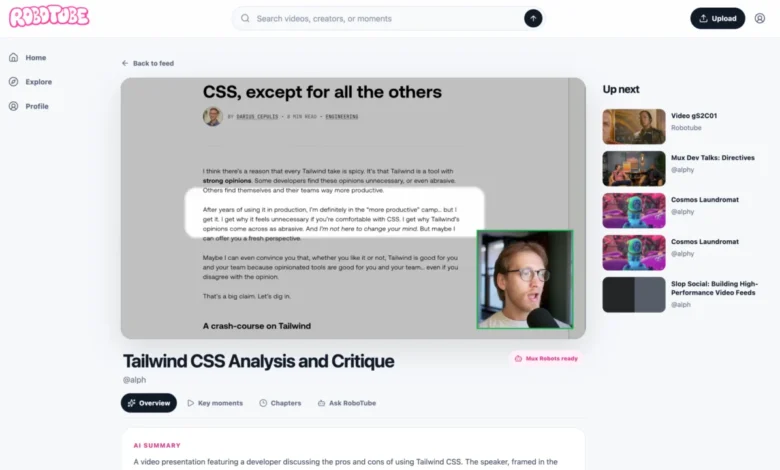
To solve these architectural hurdles, modern software engineers have increasingly turned toward hybrid integration models. A notable example of this architectural evolution can be found in RoboTube, an open-source video streaming demonstration application built to showcase the capabilities of Mux Robots hosted AI workflows integrated with Laravel Queues. By carefully distributing responsibilities between specialized video orchestration services and durable application queues, developers can establish robust, fault-tolerant video processing pipelines.
The Evolution of Video Orchestration in Web Applications
Building a feature-complete video platform involves significantly more than simply accepting a file upload and streaming it back to an end user. The core complexity of modern video infrastructure centers on post-upload processing. When a user uploads a video file, contemporary platforms are expected to automatically execute a cascade of intelligence tasks. These include running automated moderation checks to ensure compliance, generating accurate closed captions, translating audio tracks into multiple languages, extracting key moments, summarizing the video transcript, and selecting optimal preview thumbnails.
None of these resource-intensive processes can comfortably execute within the standard execution window of a typical HTTP request. Factors such as network latency, fluctuating processing durations, and the need for upstream dependencies—such as waiting for a complete caption track to be generated before attempting to extract chapter markers—complicate the architecture further. Furthermore, distributed webhooks can occasionally arrive late, fail entirely, or be lost due to transient network failures.
In the initial architectural iterations of RoboTube, developers frequently relied on application-tier frameworks to serve as the primary video orchestrator. Within this paradigm, every individual Mux Robots workflow was instantiated as a separate background queue job managed by the host application framework, such as Laravel Queues operating on infrastructure like Laravel Cloud. While this approach leveraged durable database states to retry failed API calls, enforce rate limits, and recover from worker crashes, it introduced a significant architectural anti-pattern: forcing the primary application layer to manage complex, video-specific dependency graphs.
For instance, tasks such as automated chapter generation, key-moment detection, and caption translation fundamentally depend on the successful completion and availability of a primary caption track. Requiring the application framework to manually track, sequence, and verify these intricate downstream conditions results in an accumulation of brittle application-layer code. Managing these dependent states manually creates unnecessary maintenance overhead and increases the risk of pipeline fragmentation.
Transitioning to Mux Robots Directives
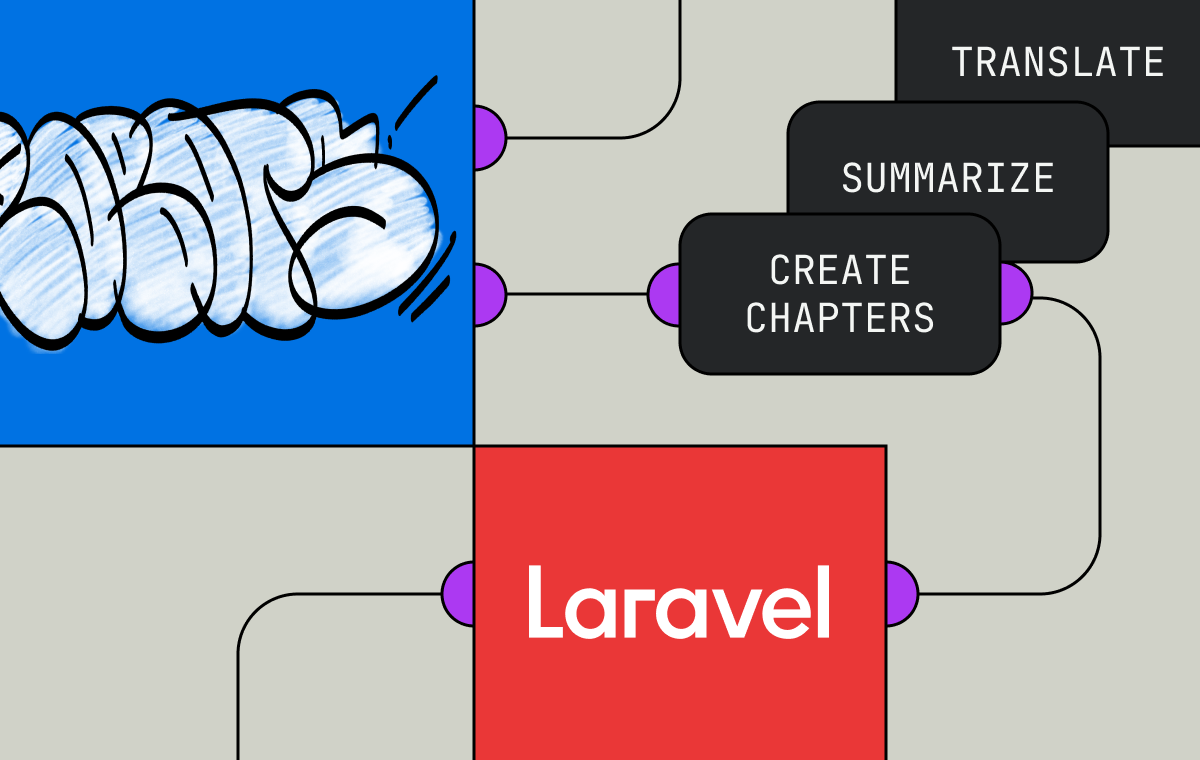
To alleviate the burden of application-tier dependency management, developers have adopted Mux Robots Directives. Directives represent a paradigm shift in how video intelligence workflows are structured, transferring the responsibility of video-specific sequencing and dependency handling away from the application framework and into the specialized video infrastructure layer.
Instead of instructing an application queue to spawn multiple remote jobs and manually coordinate their execution order, the application can trigger a single Directive run via a straightforward API request. For example, a POST request to the Robots Directives endpoint containing a designated asset identifier initiates a unified remote workflow execution plan:
POST /robots/v1/directives/DIRECTIVE_ID/runs
"asset_id": "MUX_ASSET_ID"
By leveraging Directives, the video platform delegates the heavy lifting of workflow sequencing to the video infrastructure provider. Mux handles the underlying fan-out mechanics, ensuring that dependent tasks—such as generating chapters only after caption tracks are fully compiled—execute in the correct sequence without requiring custom orchestration logic within the primary application codebase.
Redefining the Role of Application Queues
The adoption of video processing Directives does not render application-layer queues obsolete. Rather, it refines their operational scope. In a modern, decoupled architecture, application queues transition from managing granular workflow steps to serving as reliable integration boundaries.
Under the optimized pipeline architecture, the workflow operates through a structured sequence of checks and triggers:
- The application queue initiates a moderation Directive.
- The video infrastructure executes the moderation check and returns a webhook payload.
- The application evaluates the moderation outcome. If the content is rejected, the pipeline halts immediately, updating the database record and terminating further processing to save resources and protect users. If the content passes, the application triggers a secondary enrichment Directive.
- The video infrastructure assumes control of the fan-out and caption dependencies.
- Completion webhooks return processed results, which the application synchronizes to its primary data store, such as a Convex database.
Through this division of labor, application queues maintain their core strengths: triggering structural operations reliably, processing incoming webhooks securely, synchronizing state changes to persistent storage layers, and recovering gracefully from missed events or infrastructure outages. Mux orchestrates the specialized video-intelligence workflows, while the application framework provides durable integration with the rest of the software ecosystem.
Architectural Segmentation: Managing Multiple Directives
Rather than consolidating every conceivable video processing task—moderation, summarization, chapter generation, key-moment extraction, and thumbnail selection—into a single monolithic Directive, advanced applications often benefit from a segmented approach. RoboTube, for instance, implements a two-Directive architecture.
The first Directive is strictly dedicated to content moderation. By isolating moderation from the broader structural enrichment pipeline, the application ensures that if an uploaded video fails safety checks, downstream processing steps do not trigger. This structural separation yields multiple concrete benefits: it simplifies infrastructure logic, reduces operational costs by preventing unnecessary AI processing on prohibited content, and automatically safeguards users from inappropriate material.
If moderation succeeds, the application conditionally dispatches a synchronization job and triggers the secondary enrichment Directive:
if ($passed)
    SyncRobotubeResults::dispatch($run->id)
        ->onQueue(Queues::name('sync'));

    RunMuxDirective::dispatch(
        $run->id,
        MuxDirectivePlan::ENRICHMENT,
    );

    return;


$this->skipNonTerminalJobs($run);
$run->update([
    'status' => RobotRunStatus::Rejected,
    'finished_at' => now(),
]);
This decoupled pattern ensures that the initial moderation upload job remains lightweight, compact, and focused solely on loading a durable run state, identifying the appropriate Directive identifier, and executing a single remote API call.
class RunMuxDirective implements ShouldBeUnique, ShouldQueue

    use Queueable;

    public int $tries = 3;
    public int $uniqueFor = 300;

    public function __construct(
        public int $robotRunId,
        public string $stage,
    )
        $this->onQueue(Queues::name('robots'));


    public function uniqueId(): string

        return "$this->robotRunId:$this->stage";
$directiveId = MuxDirectivePlan::directiveId($this->stage);
$remote = $client->trigger($directiveId, $run->mux_asset_id);
Ensuring Durability, Retries, and State Reconciliation
While Directives streamline execution order, maintaining data integrity requires robust error handling at the application boundary. Network partitions, worker crashes, and database unavailability necessitate careful state reconciliation.
When a video processing job is executed, a worker might successfully communicate with the video provider, receive a Directive run receipt containing a unique remote run identifier, and subsequently crash before updating its internal database state. To prevent the system from blindly initiating duplicate expensive operations upon retrying the queue job, the application architecture implements receipt-checking mechanisms.
data_set($input, "mux_directive_runs.$this->stage", [
    'directive_id' => $directiveId,
    'run_id' => $remote['id'],
    'status' => $remote['status'],
    'started_at' => now()->toIso8601String(),
]);

$run->update(['input' => $input]);
Before any retry attempt is executed, the job inspects the stored input data for an existing remote run identifier:
$existingRunId = data_get(
    $run->input,
    "mux_directive_runs.$this->stage.run_id",
);

if ($existingRunId)
    SyncMuxDirectiveRun::dispatch($run->id, $this->stage);

    return;
If a remote run is already recorded as active or completed, the application reconciles the existing state rather than spawning redundant API requests or duplicate workflows.
The Role of Automated Recovery Polling
Even with robust API design and queue-level retries, external webhook delivery failures can occur. A webhook endpoint may experience downtime, an event packet may be dropped in transit, or a database connection may temporarily timeout just as an asynchronous notification arrives.
To bridge potential reliability gaps, robust production architectures frequently incorporate scheduled polling mechanisms. By establishing periodic background commands, applications can actively audit pending operations, reconcile stuck runs, and process delayed or missing webhook events:
Schedule::command('robotube:poll-pending-jobs')
    ->everyFiveMinutes()
    ->withoutOverlapping();

Schedule::command('robotube:repair-stuck-runs')
    ->everyTenMinutes()
    ->withoutOverlapping();

Schedule::command('robotube:retry-dead-webhooks')
    ->everyFifteenMinutes()
    ->withoutOverlapping();
These scheduled tasks query the video infrastructure to recover child job identifiers, evaluate missing completion statuses, and route the retrieved data through the exact same state-transition pipelines utilized by standard webhook controllers. This dual-path approach ensures that webhook handlers and polling mechanisms maintain a unified, consistent understanding of success and failure states.
Handling Dynamic User Inputs and Custom Workflows
While structured Directives excel at managing predictable, uniform post-upload pipelines like automated summaries, chapter markers, and thumbnail generation, real-world applications must also account for highly dynamic, user-selected behaviors.
For instance, platforms that allow users to request custom audio translations or specific caption languages on demand face unique routing challenges. Because users can select arbitrary target languages dynamically at runtime, pre-defining a static Directive configuration for every conceivable translation permutation is impractical unless the platform mandates a uniform, fixed set of output languages for every uploaded asset.
Consequently, modern architectures often embrace a hybrid approach where predictable, standardized product behaviors are managed via Directives, while highly dynamic, request-time user actions continue to be processed as individually queued jobs. This flexibility underscores a fundamental principle of modern software engineering: APIs and integration layers should be adapted to suit the specific behavioral patterns of the application rather than forcing rigid conformity across disparate use cases.
Industry Implications and Future Outlook
The integration of advanced video infrastructure primitives with traditional application queuing frameworks marks a maturation in how complex software systems handle asynchronous workloads. As artificial intelligence models become increasingly embedded in media platforms, the demand for clean boundaries between application business logic and specialized processing infrastructure will only intensify.
By delegating workflow sequencing and dependency resolution to specialized primitives like Mux Robots Directives while retaining application-layer control over durable retries, state synchronization, and recovery polling, developers can avoid the pitfalls of tightly coupled architectures. The resulting systems exhibit enhanced maintainability, improved fault tolerance, and greater resilience against transient network failures.
For developers building next-generation media applications, adopting these hybrid patterns provides a scalable roadmap for managing sophisticated AI pipelines without sacrificing application reliability or incurring unnecessary infrastructure complexity.