The Essential Guide to Answer Engine Optimization and the Rise of AEO Checker Tools

The fundamental architecture of the internet is undergoing its most significant transformation since the invention of the search engine. For over two decades, the digital economy has been built on the "ten blue links" model, where users enter a query and receive a list of URLs to visit. Today, that model is being superseded by answer engines—systems like ChatGPT, Perplexity, and Google’s AI Overviews—that synthesize vast amounts of data to provide a direct, conversational response. As visibility shifts from organic ranking to AI-generated summaries, businesses are increasingly adopting Answer Engine Optimization (AEO) to ensure their brand remains relevant in an environment where the "click" is no longer guaranteed.
The transition toward generative search began in earnest in May 2024, when Google officially rolled out AI Overviews (AIO) to its primary search results. This move followed months of competitive pressure from conversational AI platforms like OpenAI’s ChatGPT and the search-specialized Perplexity. These tools do not simply index pages; they parse content to answer complex questions in real-time. For a business, this creates a "visibility black hole": if an AI provides a comprehensive answer that satisfies a user’s query, the user may never navigate to the source website. To combat this, marketers are turning to AEO checkers—specialized software designed to audit how often a brand is cited, mentioned, or ignored by these emerging platforms.
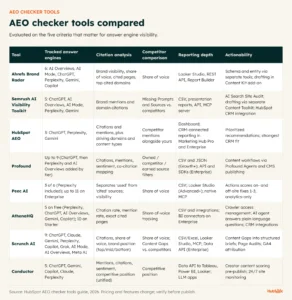
![AEO checker tools that measure answer engine visibility [2026]](https://53.fs1.hubspotusercontent-na1.net/hubfs/53/aeo-checker-1-20260903-3858273.webp)
Understanding the Mechanics of Answer Engines
To optimize for the new era of search, one must first distinguish between traditional Search Engine Optimization (SEO) and AEO. While SEO remains critical for establishing domain authority and crawlability—the very signals AI models use to determine which sources are trustworthy—AEO is focused on the content within the answer.
Answer engines operate on large language models (LLMs) trained on billions of parameters. When a user asks, "What is the best CRM software for a small startup?" the model does not just look for the highest-ranking page. It identifies "entities" (the brands), evaluates the context of the claims, and synthesizes a response. If a company’s website is poorly structured, uses outdated schema, or lacks clear, direct answers to common questions, the model will likely overlook it in favor of a competitor that offers a more parsable, authoritative summary.
The Evolution of Search Visibility: A Timeline
The shift from link-based search to answer-based retrieval has occurred rapidly over the past 24 months:
![AEO checker tools that measure answer engine visibility [2026]](https://no-cache.hubspot.com/cta/default/53/9dd5e54b-fbef-4dd0-bc44-1689feb1ea18.png)
- Late 2022: The public release of ChatGPT demonstrates the potential for conversational interfaces to replace traditional search queries for informational needs.
- 2023: Perplexity gains traction as an "answer engine," prioritizing live, cited information over static links, forcing industry leaders to re-evaluate their reliance on traditional SEO.
- May 2024: Google launches AI Overviews, integrating generative AI directly into the dominant global search interface. This marks the end of the "link-only" era for high-volume informational queries.
- June 2026: Google releases dedicated generative AI performance reports, providing publishers with limited data on how their content performs within AIOs, though many marketers still find this data insufficient for full-scale optimization.
The Role of the AEO Checker
As manual monitoring becomes impossible at scale, AEO checkers have emerged as essential enterprise tools. These platforms perform five critical functions: measurement, diagnosis, prioritization, optimization, and reporting.
An AEO checker identifies which queries trigger an AI response and, crucially, whether your brand is the one being recommended. It analyzes the "citation gap"—the delta between where you should be appearing and where you are currently being excluded. By flagging missing schema, broken entity associations, or poorly formatted content, these tools allow marketing teams to pivot from reactive content creation to precision-targeted updates.
For instance, if an AEO tool detects that a competitor is being cited for a specific product query, it can generate a "gap analysis." This might reveal that the competitor’s page contains a clear, bulleted comparison table that the AI model found easier to parse than your long-form narrative. The fix is then straightforward: restructure the content to meet the engine’s requirements.
![AEO checker tools that measure answer engine visibility [2026]](https://53.fs1.hubspotusercontent-na1.net/hubfs/53/aeo-checker-2-20260903-852936.webp)
Manual Versus Automated Audits
While enterprise-level software is increasingly popular, many organizations begin their AEO journey with manual audits. This involves executing queries in "incognito" or "signed-out" sessions to eliminate the influence of personalized search history.
The manual process requires three distinct steps:
- Defining the Query Set: Focus on high-intent, informational queries. If you are a B2B SaaS company, these are the "how-to" and "best-of" questions your prospects ask during the research phase.
- Recording Citations: Note whether the AI engine provides a direct answer and if it lists your domain as a source. In ChatGPT and Perplexity, look for both "inline citations" (the small numbers within the text) and the "sources panel" (the list of sites provided below the response).
- Cross-Platform Comparison: Results vary significantly between engines. A brand might be the primary source on Perplexity but completely ignored by Gemini or Google’s AIO. Maintaining a log of these inconsistencies is vital for determining where to focus optimization efforts.
However, manual checking is inherently limited by "session volatility." Because AI models are dynamic, the same query can return different results within minutes. Automated AEO checkers mitigate this by running continuous, scheduled audits, providing a trend-line that is far more reliable than a single, manual snapshot.
![AEO checker tools that measure answer engine visibility [2026]](https://53.fs1.hubspotusercontent-na1.net/hubfs/53/aeo-checker-3-20260903-8904553.webp)
Evaluating AEO Tooling: Key Criteria
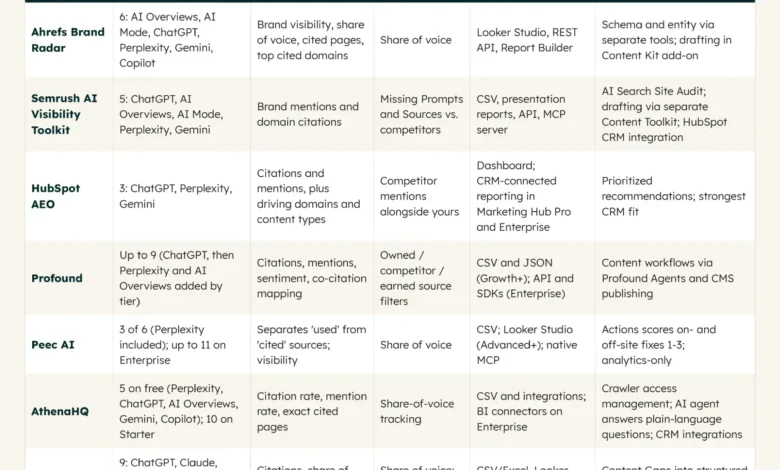
When selecting an AEO checker, businesses should prioritize tools that provide:
- Cross-Engine Coverage: A tool that only monitors Google’s AI Overviews will miss the significant traffic moving through ChatGPT and Perplexity.
- Citation vs. Mention Tracking: It is important to distinguish between a "citation" (a direct link to your site) and a "mention" (your brand name appearing in the text). Both are valuable, but they serve different roles in the customer journey.
- Prioritization Engines: The best software doesn’t just provide data; it ranks the most critical issues. A tool that identifies which content gaps represent the largest share of voice is far more useful than a tool that simply dumps raw logs.
- Integration with CRM: Advanced platforms like HubSpot connect visibility data to actual revenue, allowing teams to see if an AI-referred visit leads to a qualified lead or a closed deal.
Broader Implications for the Digital Economy
The rise of AEO suggests a fundamental change in the value of content. As answer engines become more proficient, the premium on "filler" content—long-form articles designed only to capture keywords—is rapidly declining. Conversely, the value of high-quality, primary-source, and factually dense content is increasing. AI models prioritize content that is "verifiable" and "structured."
Furthermore, the "zero-click" nature of these answers is forcing a shift in how companies measure success. If a user receives their answer from an AI and does not visit a website, that interaction must still be accounted for in the marketing funnel. Industry analysts suggest that brands will need to adopt a two-pronged strategy: optimizing for the "answer" to gain authority, and optimizing for the "click" through highly compelling brand narratives that cannot be fully replicated by an AI summary.
![AEO checker tools that measure answer engine visibility [2026]](https://53.fs1.hubspotusercontent-na1.net/hubfs/53/aeo-checker-4-20260903-6212698.webp)
The Future of Search Strategy
Looking ahead, the divide between those who manage their "AI presence" and those who do not will likely define the next generation of market leaders. As AI engines grow more sophisticated, they will increasingly reward brands that act as "trusted sources." This means that technical SEO, such as the use of structured data (Schema.org) and the maintenance of a clear, logical site architecture, will remain the foundation upon which AEO is built.
For organizations currently struggling to gain visibility in generative search, the consensus is clear: stop relying on outdated SEO playbooks. Start by auditing your current standing, identifying the specific queries where you are being replaced by competitors, and using data-driven AEO tools to close those gaps. The era of the link is not over, but it is no longer the sole arbiter of digital success. To thrive in the age of the answer engine, brands must learn to speak the language of the machines that are now mediating their relationship with the customer.