Eclipse Dataspace Components on AWS: Architecture patterns in production

The digital economy increasingly hinges on the ability of organizations to securely and efficiently exchange data. In this landscape, the concept of "data spaces" has emerged as a transformative paradigm, promising a framework for trusted, sovereign, and interoperable data sharing across diverse entities and sectors. At the heart of this evolution lies the Eclipse Dataspace Components (EDC), an open-source framework designed to facilitate these complex data exchanges. However, transitioning from conceptual models or test environments to production-grade deployments demands meticulous architectural planning, particularly when leveraging cloud infrastructure. Amazon Web Services (AWS) has positioned itself as a critical enabler for such deployments, offering a suite of services and architectural patterns that ensure the scalability, security, and operational resilience required for real-world data space participation. This article delves into the validated architecture patterns for running EDC connectors in production on AWS, exploring the fundamental building blocks, adherence to the AWS Well-Architected Framework, and the broader implications for enterprise data strategy.
The Evolving Landscape of Data Sharing and Data Sovereignty
For decades, data exchange between organizations has largely been a bespoke, point-to-point exercise, often fraught with legal complexities, security concerns, and interoperability challenges. The advent of concepts like data sovereignty, driven by regulations such as the General Data Protection Regulation (GDPR) in Europe and similar initiatives globally, has underscored the need for more structured, governed, and transparent mechanisms for data sharing. This gave rise to the idea of data spaces – ecosystems where participants can share data under mutually agreed-upon terms, maintaining control over their data while unlocking its collaborative potential.
Initiatives like Gaia-X in Europe have championed the creation of a federated, secure data infrastructure, with the International Data Space Association (IDSA) providing the architectural framework and technical specifications. The Eclipse Dataspace Components (EDC) project, an open-source implementation based on IDSA standards, offers the foundational connector technology that allows organizations to participate in these data spaces. EDC connectors act as secure gateways, mediating data exchange, enforcing data usage policies, and managing identity and access.
AWS recognized the strategic importance of this shift towards governed data sharing. Its engagement in this domain, as evidenced by a multi-part blog series, signals a commitment to providing robust, cloud-native environments for EDC deployments. The initial installment in this series, "Part 1: Data Sharing Fundamentals," laid the groundwork by explaining core data space architectures and demonstrating how EDC functionality can be customized for native integration with AWS Cloud services. This included leveraging Amazon Simple Storage Service (Amazon S3) for secure data storage and AWS Secrets Manager for robust credentials management, setting the stage for more advanced production deployments.
Unpacking the Production-Ready EDC Architecture on AWS
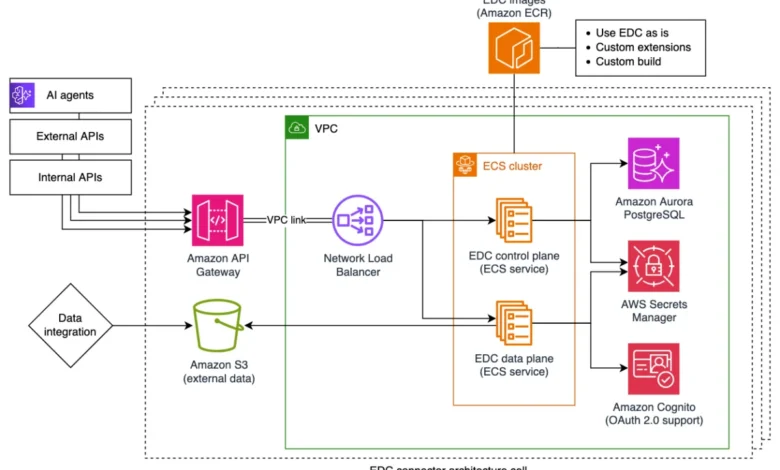
At its core, an EDC connector is a sophisticated piece of software comprising a control plane and a data plane, typically deployed as containerized applications. The control plane handles metadata exchange, contract negotiation, and policy enforcement, while the data plane is responsible for the actual secure transfer of data payloads. Depending on specific data integration requirements, such as supporting OAuth 2.0 client credentials for backend system connections or custom protocols, organizations may need to implement a tailored EDC build process. The resulting container images are then stored in a container registry like Amazon Elastic Container Registry (Amazon ECR), ready for deployment.
A production-ready EDC connector deployment on AWS follows best practices for isolation, managed services, and security layering. The architecture typically segments into four key sub-components (though not explicitly listed in the source, these would be logical separations based on the diagram and description: container orchestration, database, storage, and API gateway/networking). The overarching principle is the creation of an "isolated architecture cell" for each single EDC connector instance. This isolation is paramount for managing failure domains, enforcing data governance, and separating shared and received data effectively, especially for larger enterprises operating multiple EDCs.
Access to this isolated cell is primarily facilitated through two mechanisms: an S3 bucket for data ingress and egress, and an Amazon API Gateway configured to expose selected EDC API resources (management API, data plane API, Dataspace Protocol (DSP) API). Both interaction points are secured using AWS Identity and Access Management (IAM) and the AWS Signature Version 4 (SigV4) protocol, ensuring authenticated and authorized access.
For organizations with diverse data sharing needs, such as those participating in multiple data spaces or requiring distinct governance policies for different use cases, deploying separate connector instances is a common and recommended pattern. This is where Infrastructure-as-Code (IaC) tools like AWS Cloud Development Kit (CDK) become indispensable. CDK enables automated, templated deployment and management of these EDC connector cells, drastically reducing operational overhead and ensuring consistency across deployments. The "Dataspace Connector on AWS" reference implementation, available on GitHub, exemplifies this by allowing a full connector cell to be deployed with a single CDK command, ready for immediate contract negotiation and data transfer.
Further enhancing the capabilities of this architecture, Amazon API Gateway offers Model Context Protocol (MCP) proxy support. This innovative feature enables authorized AI agents and MCP clients to consume EDC APIs, facilitating autonomous data collection and sharing – a glimpse into the future of automated data ecosystems. Beyond agentic systems, many customers integrate EDCs into their cloud-based data environments through workflow-based approaches, interacting with the APIs and the peripheral S3 bucket to securely expose and retrieve external information.
The efficacy of these architecture patterns has been validated in real-world production deployments. A notable example is the Prometheus-X Data Space Connector, tailored for education sector use cases. This implementation leverages the same core architecture principles: Amazon ECS with AWS Fargate for robust container orchestration, S3 for highly available data storage, and event-driven processing powered by AWS Lambda and Amazon EventBridge. This success story underscores the versatility and effectiveness of these patterns across varied industry sectors, demonstrating their maturity and readiness for demanding enterprise environments.
Pillars of Production Readiness: Adhering to the AWS Well-Architected Framework
Building production-grade systems on AWS involves adherence to the AWS Well-Architected Framework, a set of best practices designed to help cloud architects build secure, high-performing, resilient, and efficient infrastructure. For EDC deployments, three pillars—Operational Excellence, Security, and Reliability—are particularly critical.
1. Operational Excellence:
This pillar focuses on running and monitoring systems to deliver business value and continually improving processes and procedures.
- Infrastructure as Code (IaC) for Consistency: In a production environment, manual deployments are prone to errors and inconsistencies. Defining all infrastructure declaratively using IaC tools like AWS CDK ensures repeatable, version-controlled, and testable deployments. This practice also enables automated validation, for instance, with tools like CDK Nag, which helps identify misconfigurations and security issues early in the development lifecycle, effectively shifting security "left." The code itself serves as a living, executable documentation of the architecture, crucial for audits and team collaboration.
- Observability as a First-Class Concern: Proactive monitoring and logging are not optional; they are core infrastructure components. Amazon CloudWatch Container Insights provides deep visibility into the performance and health of containerized applications running on ECS Fargate. Amazon CloudWatch Logs centralizes all application and system logs, enabling analysis and alerting. Furthermore, EDC’s structured health check endpoints can be exposed with restricted access through API Gateway and IAM, providing critical insights into the connector’s operational status. This comprehensive observability supports proactive issue detection, faster troubleshooting, and continuous improvement.
- Managed Services Over Self-Managed Infrastructure: The strategic choice to utilize AWS managed services such as Amazon Aurora (for databases), AWS Secrets Manager, AWS Fargate, and Amazon Cognito (for identity management) instead of deploying and maintaining self-managed solutions is a cornerstone of operational excellence. This approach offloads the "undifferentiated heavy lifting" of infrastructure management to AWS, allowing organizations to focus on their core business logic. Managed services inherently offer high availability, adhere to built-in security best practices, possess compliance certifications, and receive automatic updates, significantly reducing the operational burden and total cost of ownership.
2. Security:
The security pillar emphasizes protecting information, systems, and assets. For data spaces dealing with sensitive information, robust security is non-negotiable.
- Defense in Depth: This principle advocates for implementing security through multiple independent layers rather than relying on a single control point. For EDC on AWS, this translates to network isolation using Amazon VPC private subnets, granular security group segmentation to restrict traffic between components, and the application of IAM least privilege principles to scope permissions for each service. Encryption, both at rest and in transit, forms another critical layer. These independent controls work synergistically, ensuring that if one layer is bypassed, others continue to provide protection, drastically reducing the attack surface.
- Principle of Least Privilege: Every component and user should be granted only the minimum permissions necessary to perform its specific function. This is meticulously applied in EDC deployments by scoping IAM roles precisely to individual services (e.g., separate roles for the control plane and data plane) and restricting security groups to only the necessary ports and trusted sources. The use of an internal-only Network Load Balancer, fronted by an API Gateway with controlled access, prevents unintended public exposure of EDC APIs and data. This granular approach also aids in the security review and approval processes for open-source software like EDC, as APIs can be individually allowlisted and validated.
- Encryption Everywhere: Data protection is maximized by encrypting data by default at every stage of its lifecycle. This includes data at rest in Amazon Aurora databases, Amazon S3 buckets, and AWS Secrets Manager. Data in transit is secured through TLS enforcement and HTTPS-only egress. Even environment variables containing sensitive information are encrypted. This comprehensive encryption strategy provides end-to-end data protection, regardless of where the information resides or traverses within the system, crucial for compliance with data protection regulations.
3. Reliability:
This pillar focuses on the ability of a system to recover from infrastructure or service disruptions, dynamically acquire computing resources to meet demand, and mitigate disruptions such as misconfigurations or transient network issues.
- Fail Fast, Recover Automatically: Production systems must be designed to detect failures quickly and recover without manual intervention. For containerized EDC deployments, Amazon ECS circuit breakers can automatically roll back failed deployments, preventing widespread outages. Automated health checks remove unhealthy targets from load balancers, redirecting traffic to healthy instances. Point-in-time recovery for databases like Amazon Aurora supports rapid data restoration, minimizing Mean Time To Recovery (MTTR) and reducing the scope of failures, even within a single EDC architecture cell.
- Design for Regional Resilience: The architecture is engineered to withstand failures at the Availability Zone (AZ) level within an AWS Region. Cross-zone load balancing distributes incoming traffic across multiple AZs, ensuring that a failure in one AZ does not impact service availability. Amazon Aurora automatically replicates data across multiple AZs for high durability and availability. AWS Fargate tasks can be scheduled in any AZ, providing inherent resilience. This design ensures that the highlighted architecture can tolerate Availability Zone failures without service disruption, maintaining continuous operation.
- Decoupled Components with Clear Boundaries: The control plane and data plane of the EDC connector are deployed as independent services. This architectural separation grants each component distinct responsibilities, security contexts, and scaling characteristics. This decoupling enables independent updates without affecting the other, targeted scaling based on specific workload demands, and crucial fault isolation between the coordination logic of the control plane and the high-volume data transfer operations of the data plane.
The remaining three pillars of the AWS Well-Architected Framework – Performance Efficiency, Cost Optimization, and Sustainability – are equally important for a holistic production strategy. These aspects, particularly cost optimization strategies for running EDC connectors efficiently and maximizing their business value, will be explored in the subsequent installment of this series.
Broader Implications and Future Outlook
The comprehensive architecture patterns for EDC on AWS signify a crucial step in the maturation of data spaces. By providing a secure, scalable, and reliable foundation, AWS is empowering enterprises to move beyond theoretical discussions to practical, impactful data collaboration.
For enterprises, this means unlocking new business models, fostering innovation through trusted data exchange, and achieving greater compliance with evolving data governance standards. The ability to deploy EDC connectors quickly and consistently via IaC reduces time-to-market for data products and services. The integration with advanced capabilities like MCP proxy support hints at a future where AI agents can autonomously and securely participate in data spaces, driving further automation and efficiency.
For AWS, supporting EDC and data space initiatives reinforces its position as a leading cloud provider for complex, mission-critical enterprise solutions. It demonstrates AWS’s commitment to enabling open standards and interoperability, which are vital for fostering a vibrant data ecosystem. This strategic alignment also opens up new avenues for customer engagement, particularly in industries grappling with stringent data sovereignty and sharing requirements, such as manufacturing, healthcare, finance, and public sector.
The "Dataspace Connector on AWS" project on GitHub serves as a powerful accelerator, allowing developers and architects to quickly understand and implement these patterns. Its existence underscores AWS’s dedication to providing practical, hands-on resources that bridge the gap between architectural theory and operational reality.
In conclusion, the journey from setting up an EDC for testing to deploying it in a production environment is marked by significant architectural considerations. Production environments demand timely and successful transmission of confidential information, making fault tolerance, scalability, and security non-negotiable. The architecture patterns detailed here, combining EDC deployment best practices with AWS’s robust recommendations, achieve these critical objectives while minimizing operational complexity. As organizations continue to embrace the paradigm of data spaces, these proven cloud-native patterns will be instrumental in building the trusted, interconnected digital future. The forthcoming "Part 3" of this series will further equip practitioners with the knowledge to optimize these production-ready connectors for cost efficiency, ensuring sustainable growth and maximum return on investment in the burgeoning data economy.