Meta and Panmnesia Unveil Revolutionary Data Center Architecture to Unify Thousands of AI Accelerators

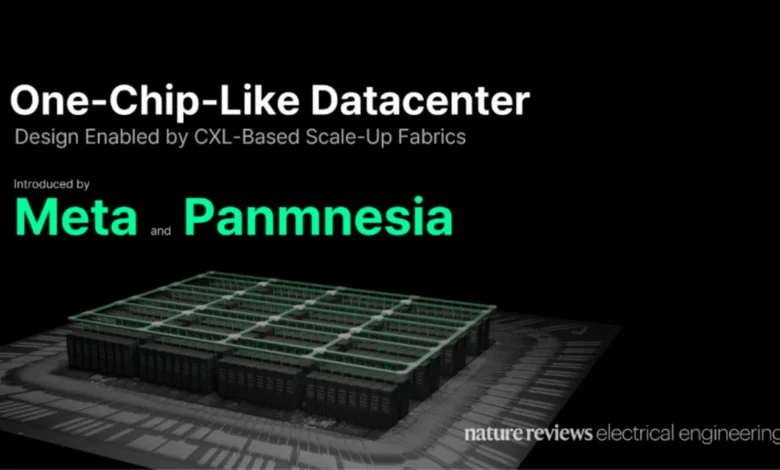
Meta has entered into a strategic collaboration with Panmnesia to redefine the structural foundations of artificial intelligence data centers by developing a system capable of operating thousands of processors within a single coherent environment. This initiative aims to dismantle the traditional silos that have historically limited the scalability of massive AI training clusters. By leveraging Compute Express Link (CXL) technology, the partnership seeks to create a unified fabric that connects CPUs, specialized AI accelerators, and high-speed memory across multiple server racks, effectively bypassing the bottlenecks inherent in conventional network-based architectures like Ethernet or InfiniBand.
The proposed architecture is designed to support up to 960 AI accelerators within a single coherence domain, essentially creating a massive, virtualized supercomputer composed of nearly 1,000 GPUs working in lockstep. This represents a significant leap forward in high-performance computing (HPC) design, addressing the "synchronization wall" that currently plagues large-scale AI model training.
Addressing the Latency and Synchronization Challenge
In modern AI training environments, the efficiency of the entire system is dictated by its slowest component. As models expand to encompass hundreds of billions of parameters, the computational workload is partitioned across vast arrays of processors. Because these processors must complete specific computational stages before moving on to the next, any delay in data transmission—known as "jitter" or "latency tail"—can force the entire cluster to idle, wasting both time and energy.
Traditional data centers rely on Ethernet or InfiniBand to facilitate communication between server racks. While these networking standards are robust, they require significant software overhead, including packet encapsulation, routing, and protocol translation. Each of these steps introduces micro-delays that aggregate as the workload expands. When thousands of accelerators are forced to wait for network packets to be processed through the standard software stack, the performance gains of adding more hardware diminish exponentially.
Panmnesia’s approach shifts the paradigm by utilizing CXL to create a shared, coherent memory and processing space. By treating the entire data center as a single system—rather than a collection of discrete servers—the design minimizes the need for software-heavy networking. Instead, it employs hardware-level management to maintain consistency across the fabric, ensuring that every accelerator has near-instant access to the memory and data it requires.
The Anatomy of the Panmnesia Fabric
The architecture proposed by the team utilizes a sophisticated hierarchy of hardware components, drawing inspiration from the internal design of semiconductor chips. The system is organized into modular trays, pods, and a central fabric, allowing for granular control over how data flows between units.
Key components of this design include:
- High-Fan-Out Switches: These facilitate high-speed, low-latency connectivity across the fabric, acting as the primary routers for CXL traffic.
- Link Acceleration Units: These units offload the burden of protocol management from the host CPUs, ensuring that data movement is optimized at the hardware level.
- Fabric Controllers: These act as the orchestrators of the entire ecosystem, managing memory coherence and traffic routing to prevent congestion.
Panmnesia has confirmed that both the fabric controller and the link acceleration unit have successfully completed silicon validation, a critical milestone in the development cycle. Furthermore, the high-fan-out switch has moved past the design phase and into physical fabrication, with pre-release silicon reportedly being deployed for ongoing testing and optimization.
Comparative Performance Metrics
The industry standard for current high-end AI training is exemplified by systems like NVIDIA’s GB200 NVL72, which utilizes NVLink-C2C to allow a CPU to coordinate a limited set of accelerators with extremely high bandwidth. While effective for localized clusters, the reach of these proprietary connections is typically limited to a single server rack.

Panmnesia’s design significantly expands this scope. Under their proposed model, a single CPU can coordinate 16 accelerators—an eightfold increase over the current reference configurations seen in many contemporary deployments. By chaining 60 of these groups together, the architecture achieves a cohesive domain of 960 accelerators.
Perhaps most importantly, the design promises to slash cross-rack access latency. By transitioning from the microsecond-level delays associated with traditional network fabrics to several hundred nanoseconds, the system achieves an order-of-magnitude reduction in latency. This shift is transformative for training large language models (LLMs), where the speed of gradient synchronization directly impacts the time-to-market for new AI capabilities.
Overcoming Physical Constraints
One of the most significant challenges in CXL-based networking is the physical limit of electrical signaling. At high speeds, such as 128 GT/s, electrical signals degrade rapidly, typically reaching a maximum distance of approximately seven meters even with the use of retimers.
To overcome this physical barrier, Panmnesia has integrated optical CXL links into the proposed architecture. Optical transmission allows for significantly greater reach without the signal degradation associated with copper cabling. The company reports that it has already completed a hardware proof-of-concept for this optical approach, ensuring that the coherence domain can span the length of a large data center aisle rather than being confined to a single row of racks.
Implications for Data Center Maintenance and Scalability
Beyond raw performance, the proposed architecture offers a structural advantage in terms of maintenance. In current server designs, a failure in one component—such as an accelerator or a memory module—often requires the removal or decommissioning of an entire server node. This results in significant downtime and the potential waste of functioning hardware.
In the Panmnesia-designed fabric, individual failed devices can be isolated and swapped without requiring the entire node to be taken offline. This modularity not only increases system availability but also allows for more sustainable hardware management. As Myoungsoo Jung, CEO of Panmnesia, stated during the project announcement, "CXL enables the entire data center to operate as a single computing system." This vision of a "disaggregated" data center allows for the independent scaling of memory, compute, and storage, ensuring that Meta and other operators can upgrade specific components without replacing their entire infrastructure.
Industry Outlook and Future Trajectory
The collaboration between Meta and Panmnesia marks a shift toward the "composable data center." As the demand for generative AI continues to surge, the industry is increasingly focused on how to scale infrastructure without succumbing to the limitations of traditional networking.
Industry analysts suggest that the success of this architecture will depend on the maturity of the CXL ecosystem. While the standard is gaining broad support from major chip manufacturers and cloud providers, the transition from proof-of-concept to large-scale, enterprise-ready deployment remains a complex engineering hurdle.
If successful, this architecture could serve as a blueprint for the next generation of hyperscale AI infrastructure. By moving away from standard networking protocols and toward a unified, memory-coherent fabric, Meta is positioning itself to handle the exponentially increasing computational requirements of future AI models. The ability to treat 960 accelerators as a single, unified entity will likely provide a competitive edge in training efficiency, cost-per-inference, and overall system reliability.
As the project moves from the laboratory into real-world validation, the focus will likely shift to software compatibility. Ensuring that existing AI frameworks—such as PyTorch and TensorFlow—can effectively leverage a distributed, CXL-connected environment will be the final hurdle in making this revolutionary vision a standard reality for the modern data center.