FedEx Cargo Jet Overruns Runway at Miami International Airport Amid Severe Weather, Triggering Temporary FAA Ground Stop

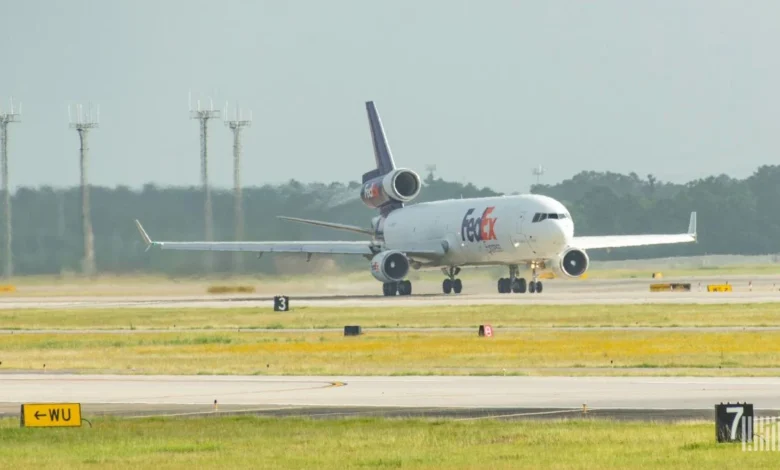
Severe weather conditions at Miami International Airport led to a tense situation on Wednesday evening when a FedEx Corp. McDonnell Douglas MD-11 cargo freighter overshot Runway 26R while attempting to land amid heavy rain and thunderstorms. The dramatic incident forced the Federal Aviation Administration (FAA) to implement a temporary ground stop across the facility, disrupting flight operations during a notoriously busy holiday travel period.
According to airport authorities and aviation monitors, the large widebody tri-jet—arriving directly from FedEx’s primary global hub in Memphis, Tennessee—missed the targeted landing zone on the tarmac. As the aircraft lost traction on the rain-soaked surface, the flight crew executed a slight left turn upon leaving the pavement. This decisive maneuver successfully avoided a critical localizer antenna before the plane finally came to a complete halt near the facility’s perimeter fence.
Fortunately, despite the dramatic final resting place of the massive aircraft, disaster was averted. Miami-Dade Fire Rescue units were dispatched to the scene immediately following the alert. Officials later confirmed that there were only two pilots on board the MD-11, and remarkably, neither sustained any injuries. The temporary ground stop implemented by the FAA was lifted relatively quickly once first responders secured the area, allowing other airfield operations to gradually resume, although runway closures remained in place to facilitate initial investigations.
Chronology of the Incident and Immediate Response
The sequence of events unfolded rapidly on Wednesday night as meteorological conditions deteriorated in the Miami area. The timeline highlights the swift response of aviation authorities and emergency services:
- 8:40 p.m. EST: FedEx Flight 910, operating an MD-11 tri-jet from Memphis, touches down on Runway 26R at Miami International Airport during heavy thunderstorms and low visibility.
- Immediately following touchdown: The aircraft fails to decelerate within the remaining runway bounds, overrunning the pavement and veering slightly left into the grass to avoid ground infrastructure.
- Post-excursion: The plane comes to an abrupt halt near the airport’s perimeter fence, prompting an immediate emergency response.
- Night of the event: The FAA issues a temporary ground stop for all arriving and departing flights at Miami International Airport to ensure airfield safety and manage the chaotic airspace during peak holiday travel.
- Subsequent hours: Miami-Dade Fire Rescue confirms zero injuries among the two crew members. The FAA lifts the ground stop, while all airport runways except for the south runway (9R) are temporarily closed to accommodate inspections and clearance procedures.
Official Statements and Stakeholder Reactions
Corporate and municipal entities responded promptly to the emergency, emphasizing safety protocols and cooperation with federal regulators.
In an official statement released shortly after the incident, Miami International Airport outlined the operational status: “A FedEx aircraft overran Runway 26R at Miami International Airport at approximately 8:40 p.m. All runways are closed except for the south runway (9R). Miami-Dade Fire Rescue units have responded, and there are no reported injuries. There were two pilots on board the aircraft.”
Meanwhile, leadership at FedEx issued a concise and reassuring update regarding the well-being of their flight crew and their commitment to transparency with investigative bodies. “FedEx Flight 910 from Memphis to Miami experienced an issue upon landing Wednesday evening at Miami International Airport. We are grateful that our crew is safe and there are no reported injuries. We are coordinating closely with investigating authorities, and any additional questions should be referred to the FAA,” the company stated.
The Aviation Herald provided critical operational details regarding the aircraft’s final trajectory, noting that the pilots’ quick-thinking adjustment kept the plane from striking sensitive navigational equipment near the runway boundary, which could have significantly worsened the severity of the accident.
Heightened Scrutiny: A Troubling Trend for Cargo Operations in Miami
Wednesday night’s runway excursion does not exist in a vacuum; rather, it compounds an already alarming series of cargo aviation incidents at Miami International Airport over the latter half of the year. The concentration of runway and ground mishaps involving major freight carriers has placed the airfield under intense regulatory and public scrutiny.
Just weeks prior to the FedEx incident, a UPS Boeing 767-300 freighter sustained noticeable structural damage during a low-speed ground collision. That mishap occurred when the cargo aircraft’s flight crew navigated too close to an active taxiway intersection, resulting in a passenger jet clipping the freighter’s wing tip as it taxied toward its designated gate.
However, the most severe recent aviation disaster at the airport occurred less than three months prior, when an Amazon Air Boeing 767 freighter—operated by third-party carrier 21 Air—suffered a catastrophic runway excursion. In that deadly accident, the aircraft plowed past the tarmac, struck a physical vehicle, smashed completely through the airport’s security fence, and crossed an adjacent public road before coming to a violent stop. The tragedy claimed five lives and left several others with severe, life-altering injuries.
The National Transportation Safety Board (NTSB) remains actively engaged in investigating the Amazon Air disaster. Preliminary findings released by the agency paint a concerning picture of high-speed landing dynamics. According to the NTSB report, the flight crew approached the runway at an excessive speed and struggled to deploy the aircraft’s flaps to the correct landing configuration.
Furthermore, the aircraft was positioned significantly above the standard glide slope during its final approach. In an effort to correct their altitude, the crew pushed the aircraft’s nose downward, an action that inadvertently caused the plane to accelerate further rather than stabilize. Rather than executing a mandatory go-around procedure, the pilots attempted to salvage the landing, touching down long on the runway on a single main landing gear. It took several crucial seconds for the remaining wheels to make contact with the pavement. By the time all landing gear was down, the available stopping distance was exhausted, sending the multi-ton freighter careening past the runway threshold.
The MD-11 Fleet Context and Maintenance History
The involvement of a McDonnell Douglas MD-11 in the Miami incident adds another layer of complexity for FedEx, given the aircraft type’s recent operational history. The tri-jet, long a workhorse of the global air cargo industry, has faced rigorous safety assessments following previous structural and mechanical concerns.
Late last month, industry executives reported that the vast majority of FedEx’s active fleet of 27 MD-11 tri-engine jets had successfully returned to regular service. This return followed extensive fleetwide modifications designed to address and rectify a specific design flaw. Federal investigators and aerospace engineers had previously linked this design vulnerability to a fatal accident involving an MD-11 operated by rival carrier UPS late last year.
The latest incident in Miami means that the specific FedEx MD-11 involved in Flight 910 will likely remain grounded for an indefinite period. Federal investigators from the FAA and potentially the NTSB will need to thoroughly examine the airframe, download flight data and cockpit voice recorders, and evaluate braking systems, thrust reversers, and weather data at the exact time of touchdown.
Logistical Implications for FedEx During Peak Shipping Season
The temporary loss of a widebody cargo aircraft creates an immediate operational challenge for logistics providers, particularly when it occurs on the cusp of the year’s busiest retail shipping period. With holiday e-commerce volumes reaching their annual peak, cargo airlines operate on extraordinarily tight schedules where every aircraft frame is vital to maintaining network integrity.
Nevertheless, industry analysts suggest that FedEx is well-positioned to absorb the temporary capacity loss without causing widespread delivery delays for customers. The shipping giant maintains a vast, highly flexible multimodal network. To compensate for the grounded MD-11, FedEx can strategically utilize reserve aircraft positioned across its domestic network, charter capacity from trusted outside partner carriers, or temporarily route additional freight volume through its robust ground-based trucking and linehaul network.
Broader Safety Implications and Future Outlook
The recurring nature of runway excursions and ground incidents at major freight hubs like Miami International Airport highlights systemic operational pressures facing the cargo sector. As global supply chains demand unrelenting speed and efficiency, commercial and cargo pilots frequently navigate challenging meteorological phenomena, including sudden convective storm activity, heavy downpours, and shifting crosswinds.
Aviation safety experts emphasize that these incidents serve as vital, albeit alarming, reminders of the thin margins for error in commercial aviation. While technological advancements and rigorous crew resource management continue to prevent loss of life in many runway overruns—as demonstrated by the safe evacuation of the two pilots aboard the FedEx flight—the frequency of recent events underscores the necessity for heightened vigilance.
As the FAA and local authorities continue their forensic review of FedEx Flight 910, the findings are expected to provide critical data regarding the interaction between heavy precipitation, braking efficiency, and pilot decision-making during high-stress approaches. For FedEx, the immediate focus remains on supporting the ongoing safety inquiry while safeguarding service reliability for millions of holiday packages moving through its global network.