Decoding the Continuous Descent: How Video AI Systems Process Complex Visual Media Through Granular Segmentation


The integration of artificial intelligence into video analysis has long grappled with a fundamental operational bottleneck: scale. A standard one-hour video recorded at 30 frames per second yields approximately 108,000 distinct images. Subjecting every single frame to heavy computational vision models is economically inefficient and computationally prohibitive. To address this challenge, video infrastructure platforms have increasingly turned to granular segmentation techniques. By breaking down high-definition content into manageable, context-aware building blocks—ranging from individual frames to expansive narrative scenes—engineers can optimize processing workflows, reduce latency, and lower the costs associated with multimodal AI model deployment.
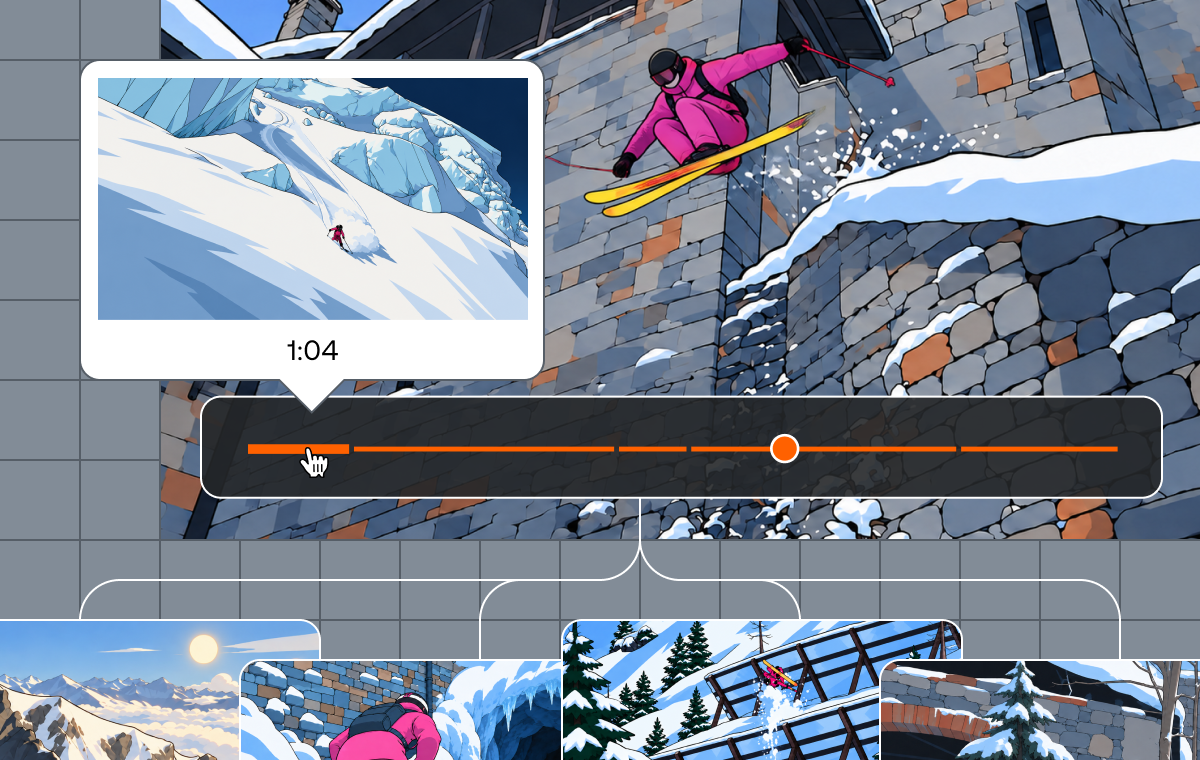
To illustrate how these structural hierarchies function in practice, software engineers often turn to high-velocity visual media as a benchmark. A prominent example frequently cited in video processing research is Markus Eder’s acclaimed 2021 freeskiing production, The Ultimate Run. Spanning roughly ten minutes, the piece presents a seamless, uninterrupted descent that transitions dynamically through high-alpine powder fields, subterranean ice caves, glacial crevices, abandoned architecture, and urban snow parks. Because the production moves rapidly across vastly different topographical and stylistic environments without standard narrative pauses, it serves as an optimal stress test for automated video parsing architectures. Analyzing such dense content requires a sophisticated approach to determining how much of a video file an AI system actually needs to inspect to answer a specific query.
The Operational Framework of Video Segmentation
Modern video intelligence systems do not treat a media asset as a homogenous block of data. Instead, they apply a tiered analytical approach, beginning with the least expensive computational signal required to narrow the search parameters. Only when deeper context is demanded do systems introduce more resource-intensive vision and audio models. This foundational principle governs how automated platforms handle tasks ranging from automated content moderation and thumbnail selection to complex semantic search and clip discovery.
The fundamental components of this architectural hierarchy typically include frames, shots, scenes, moments, and chapters. Each tier serves a distinct analytical purpose, dictating how data flows through machine learning pipelines.
Frames: Precision at a Single Instant
At the most microscopic level of video analysis is the individual frame. A single frame is sufficient when a query relies entirely on a solitary visual snapshot. Tasks such as automated thumbnail generation, facial recognition, logo detection, and visual moderation inherently rely on frame-level analysis.
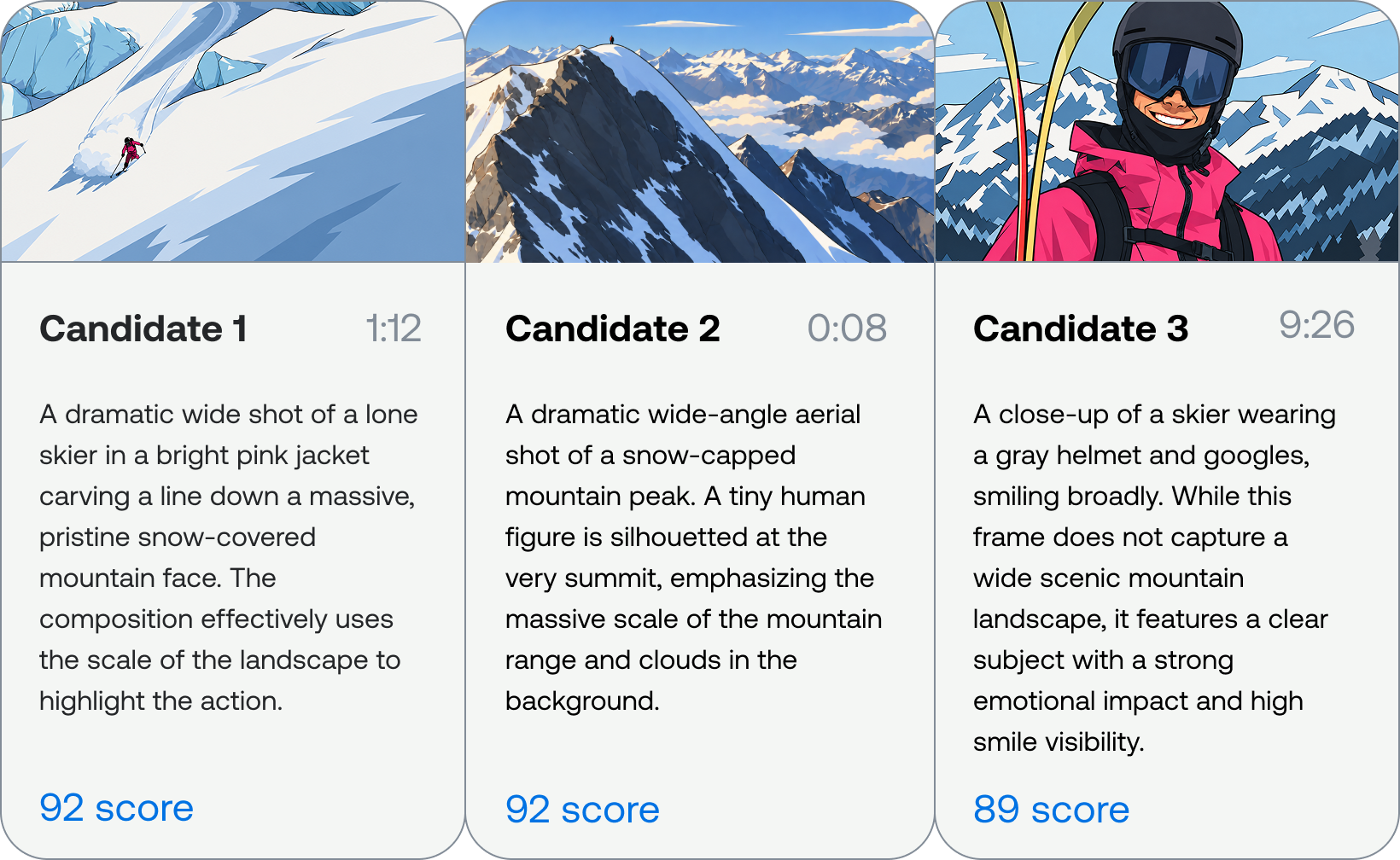
In automated thumbnail generation, algorithms evaluate candidate frames based on composition, clarity, subject placement, and actionable visual cues to select the most compelling representation of a scene. Similarly, visual moderation workflows scan individual frames at regular intervals to detect policy violations, such as unintended graphic content or safety infractions. However, frames represent a poor analytical fit when an inquiry depends on temporal sequence or kinetic progression. While a single frame can capture an athlete at the apex of a rotational jump, it cannot ascertain whether the landing was successful or how the subject entered a specific physical environment. Relying solely on a uniformly sampled set of frames rapidly increases processing costs and latency without yielding proportional contextual gains.
Shots: Capturing Visual State Changes
Moving upward in scale, a shot represents a continuous take bounded by two distinct camera cuts or visual transitions. Shot-detection algorithms rely on relatively inexpensive pixel-level comparisons between consecutive frames to identify where visual states change.
In fast-paced, highly edited visual content—such as extreme sports footage or action sequences—fixed-interval sampling frequently skips brief camera angles, rapid terrain shifts, or sudden trick executions. Shot-aware sampling circumvents this issue by maintaining a record of visual boundaries without forcing a vision model to inspect every underlying frame. By generating an ordered list of shot boundaries alongside representative reference images, downstream AI systems receive a precise map of visual continuity. Despite their utility for tracking visual state changes, shots alone cannot establish broader narrative context or thematic coherence; they merely delineate where one visual perspective ends and another begins.

Scenes: Establishing Narrative and Thematic Coherence
When an application requires a complete, recognizable section of a video rather than a momentary visual state, engineers rely on scene-level segmentation. A scene groups neighboring shots that share visual, auditory, or narrative continuity.
Unlike shots, which can be detected primarily through pixel changes, scene boundaries require higher-level contextual reasoning. Advanced video AI workflows combine visual boundary markers with transcript data and audio cues to group adjacent segments that describe the same overarching section of a media asset. In content characterized by minimal spoken dialogue—such as cinematic sports productions—multimodal models must rely heavily on visual consistency, tracking how distinct camera positions and environments combine into a singular, recognizable sequence. For enterprise applications, scene-level segmentation provides a compact, structured map that facilitates efficient browsing, timeline editing, and advanced search indexing.
Product-Facing Architecture: Moments and Chapters
While frames, shots, and scenes describe the intrinsic contents of a video file, higher-level abstractions like key moments and chapters are engineered to answer specific product and user experience questions.

Key-moment discovery algorithms synthesize shot boundaries, transcript data, and frame samples to isolate standalone excerpts that hold editorial value. Rather than simply capturing a hero image of an action sequence, a key moment encompasses the entire narrative arc—including the setup, execution, and resolution—making the resulting clip viable for independent distribution or social media integration.
Conversely, chapter generation addresses navigational requirements. By dividing an extended video into named, sequential sections, chapters establish a structured table of contents that allows viewers to jump directly to desired segments. While chapters in lecture recordings or conversational podcasts are heavily driven by spoken transcripts, visually driven media require multimodal models to infer chapter breaks from dramatic shifts in setting, environment, and visual tone.
Implications for Modern Video Infrastructure
The broader implication of this hierarchical approach is that efficient video AI processing relies fundamentally on granularity management. Developers and engineers must tailor their pipeline inputs to the specific nature of the content and the precise objectives of the end-user application. Treating a podcast, a corporate webinar, and an action sports film with a uniform analytical framework introduces unnecessary computational overhead.
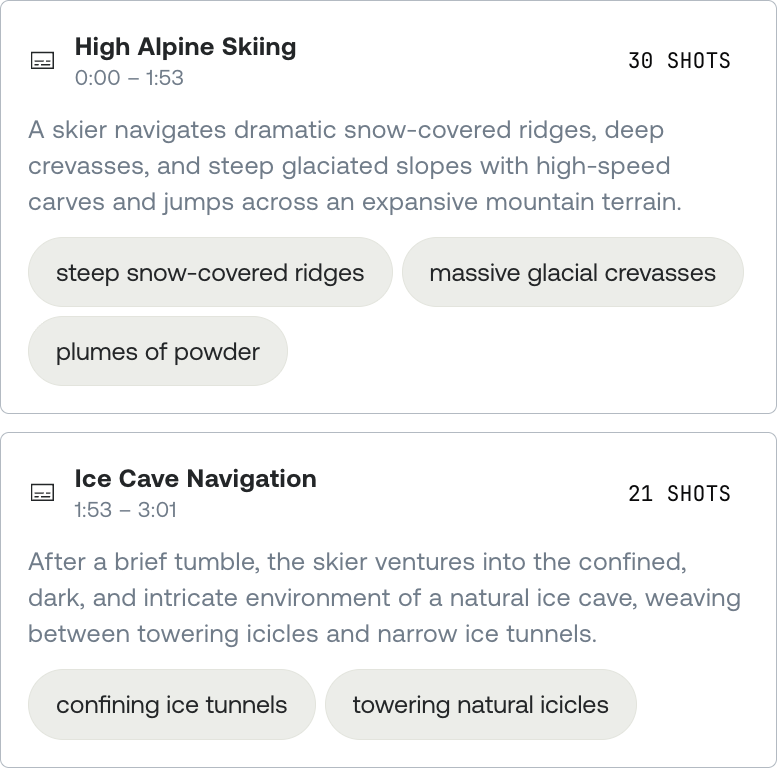
As video platforms continue to scale, the integration of multimodal embeddings—which translate text, images, and audio into unified vector spaces for semantic retrieval—further underscores the necessity of precise segmentation. Whether a user queries a database for a specific visual event, an ice cave navigation sequence, or a broad thematic overview, the underlying retrieval mechanism must operate at a scale appropriate to the question asked. By ensuring that systems utilize the smallest possible slice of video required to generate an accurate answer, modern video infrastructure can balance computational economy with high-fidelity output.