Can Adding One Simple Prefix Force ChatGPT to Sound Human? A Comprehensive Test of the Viral Prompt Hack


The rapid integration of generative artificial intelligence into daily administrative and professional workflows has simultaneously highlighted a persistent linguistic hurdle: the distinct, often mechanical cadence of large language models (LLMs). Despite significant updates designed to make tools like OpenAI’s ChatGPT sound more conversational, users frequently encounter predictable phrases—such as "increasingly," "that distinction matters," and rigid conditional structures like "if X, then Y"—that immediately identify a piece of text as machine-generated.
As professionals increasingly rely on AI to draft corporate communications, social media updates, and interpersonal messages, a workaround has gone viral across social media platforms. By simply prefixing a prompt with the command "/human," users claim they can bypass ChatGPT’s algorithmic writing habits and elicit a far more natural, organic response. To determine the validity of this viral trick, AI researchers and technology analysts have put the method through a series of structured writing tasks to evaluate its efficacy, reliability, and underlying mechanics.

The Mechanics of Context and Prompt Engineering
To understand why a simple command like "/human" might alter an AI’s output, it is necessary to examine how large language models process textual inputs. LLMs operate by predicting the next most probable token based on patterns observed during their extensive training phases. When a prompt is submitted without specialized framing, the model defaults to a generalized, highly polished corporate tone that mirrors the vast corpus of professional writing found online.
By introducing a contextual anchor such as "/human," the user effectively shifts the probability distribution of the model’s vocabulary and syntax. While not an official API parameter or a native system instruction embedded within ChatGPT’s core architecture, prefix cues act as soft constraints. They guide the neural network toward conversational rhythms, looser sentence structures, and reduced structural symmetry, which humans naturally employ in informal and semi-formal writing.
Empirical Testing Across Five Everyday Scenarios
To assess the practical value of the "/human" prefix, evaluators subjected ChatGPT to five distinct writing scenarios, comparing standard outputs against those generated with the prefix applied.

1. The Awkward Work Email
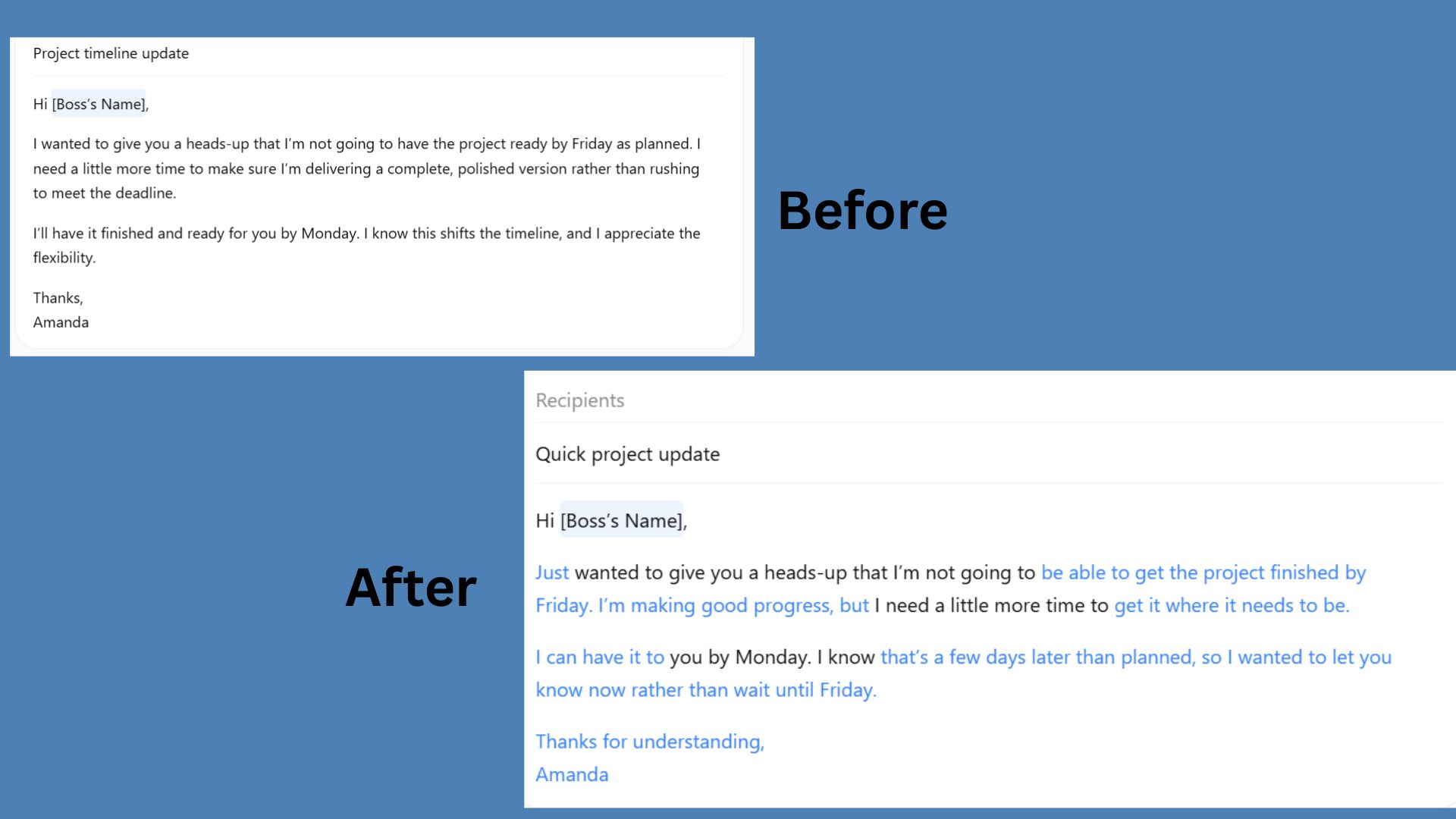
The first test involved a common professional dilemma: drafting a notification to a supervisor explaining that a project would miss a Friday deadline and require an extension until Monday, without sounding either overly apologetic or careless.
When prompted conventionally, ChatGPT produced a text characterized by careful diplomatic padding—phrases designed to cushion the delay while maintaining rigid corporate decorum. When the exact same prompt was preceded by "/human," the model discarded the engineered politeness. The resulting draft read like a straightforward, early heads-up that a real employee would realistically send to a manager, characterized by directness and a noticeable absence of corporate jargon.
2. The Personal Birthday Text
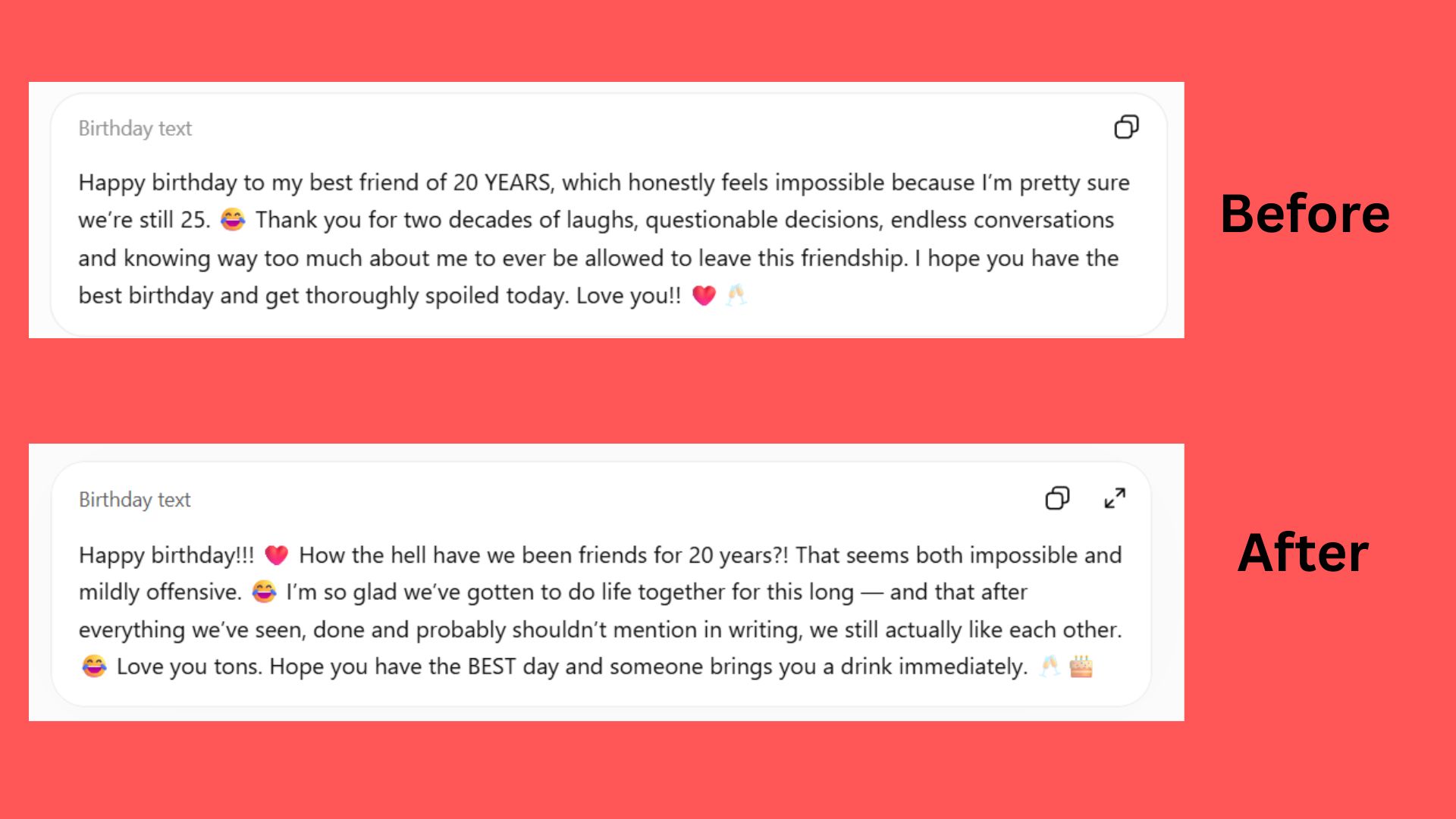
The second test evaluated personal communication: writing a birthday text message for a lifelong friend of twenty years that balanced warmth and humor without crossing into excessive sentimentality.
The standard prompt generated a cohesive, polished, yet unmistakably artificial message. In contrast, the "/human" variant adjusted the cadence and structural flow rather than the core sentiment. The output favored a deliberately looser rhythm—alternating short statements with casual punchlines and varied sentence lengths—mimicking the imperfect, authentic cadence of a text message sent between close friends.
3. The Product Recommendation
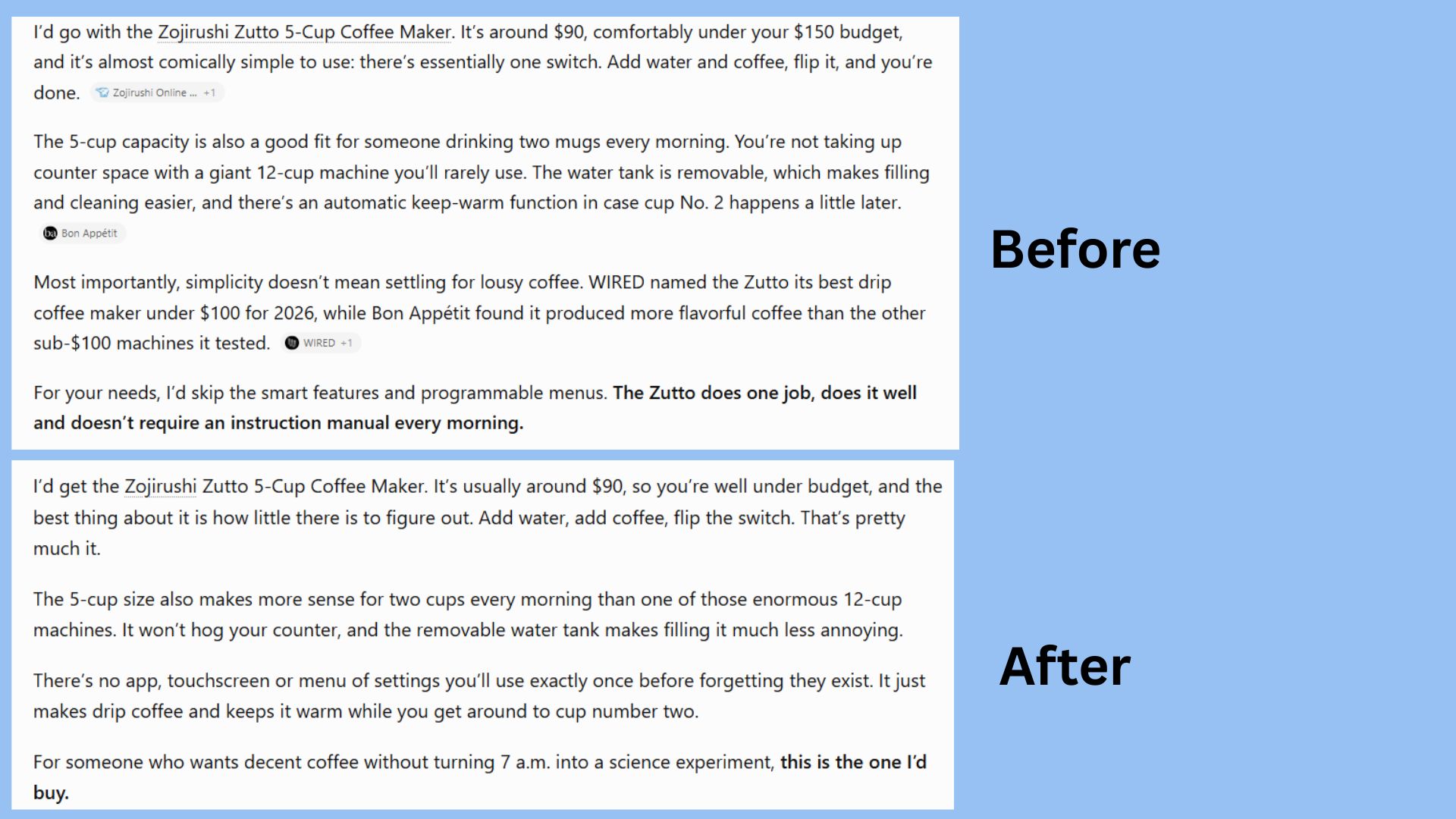
The third scenario tested consumer guidance: recommending a straightforward coffee maker within a $150 budget for an individual who consumes two cups every morning and dislikes complex appliances, constrained to approximately 150 words.
The conventional output bore a strong resemblance to promotional copy generated directly by a manufacturer’s marketing department, utilizing predictable transitions like "more importantly" and "for your needs." The "/human" version removed these transitional fillers, resulting in a direct, experience-based recommendation that read less like an advertisement and more like advice from a knowledgeable peer.
4. The Emotional Narrative
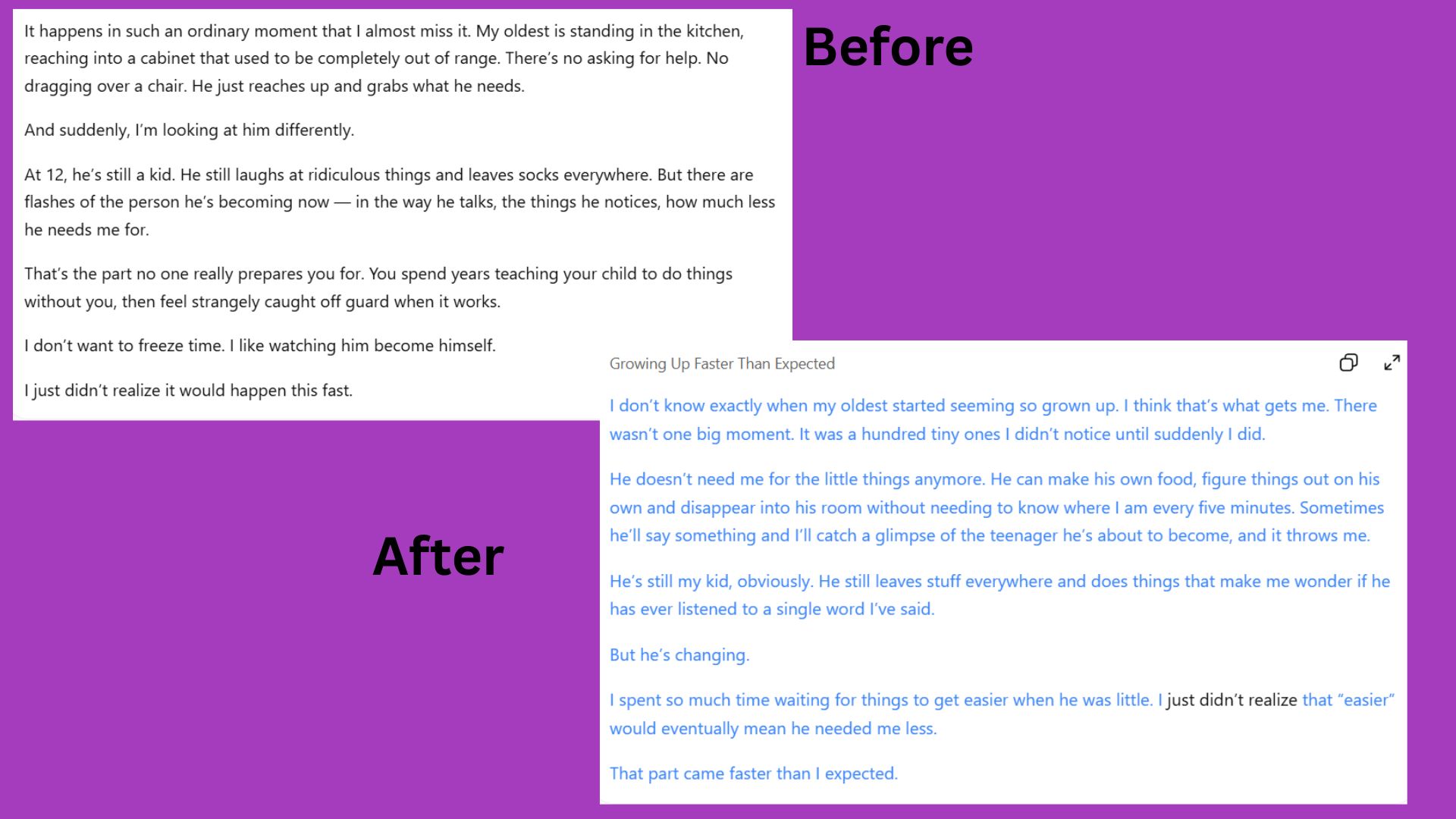
The fourth evaluation challenged the AI with a creative and emotional prompt: writing 150 words capturing the realization that an oldest child is growing up faster than anticipated, maintaining emotional depth without slipping into cliché.
While the standard AI output relied on symmetrical phrasing and neatly summarized emotional conclusions, the "/human" iteration favored specificity and restraint. By replacing polished imagery with slightly messier observations and allowing uncertainty to color the narrative, the text adhered to the narrative principle of showing rather than telling.
5. The Professional Announcement
The final and most rigorous test involved drafting a LinkedIn post announcing a transition to a new job while actively avoiding the platform’s ubiquitous clichés.
LinkedIn posts generated by AI are notoriously formulaic, frequently relying on triumphant declarations and structured bullet points. The "/human" variant successfully dismantled this structure, introducing human vulnerabilities such as first-day wardrobe anxieties and mild self-doubt. The looser sentence architecture transformed a self-aggrandizing professional announcement into a relatable personal update.
Broader Implications and Expert Consensus
The results of these tests confirm that the "/human" prefix is more than a mere internet superstition; it yields observable shifts in tone, pacing, and vocabulary. However, technology analysts emphasize the limitations of relying entirely on prompt hacks for professional writing.
Even when modified by contextual cues, AI-generated text retains underlying statistical patterns that can be detected by discerning readers or dedicated detection software. Consequently, industry experts recommend a hybrid workflow: drafting core content organically from a human perspective, and subsequently utilizing AI tools strictly for copyediting, structural refinement, or tone adjustment. Starting with an unassisted human foundation remains the most reliable method for preserving authenticity, whereas beginning with an AI draft often leaves an indelible robotic imprint that superficial prompt modifications cannot fully erase.
As generative AI tools continue to evolve, users will likely see more sophisticated native controls for tone and style, reducing the reliance on viral workarounds. Until then, techniques like the "/human" prefix offer a useful, albeit imperfect, bridge toward more natural human-AI collaboration.