
Decoding the Digital Descent: How Granular AI Workflows Are Revolutionizing Video Analysis Through Markus Eder’s The Ultimate Run


The intersection of artificial intelligence and digital video processing has long faced a fundamental computational paradox: while high-resolution media offers unprecedented visual fidelity, processing it in its entirety remains inefficient, cost-prohibitive, and functionally redundant. Modern computer vision models processing standard high-definition footage at 30 frames per second must contend with more than 100,000 individual images for every hour of content. Feeding this raw data indiscriminately into advanced neural networks leads to sluggish processing times and skyrocketing inference costs. To resolve this bottleneck, video infrastructure engineers are increasingly adopting hierarchical analytical frameworks that break continuous media down into context-specific building blocks.
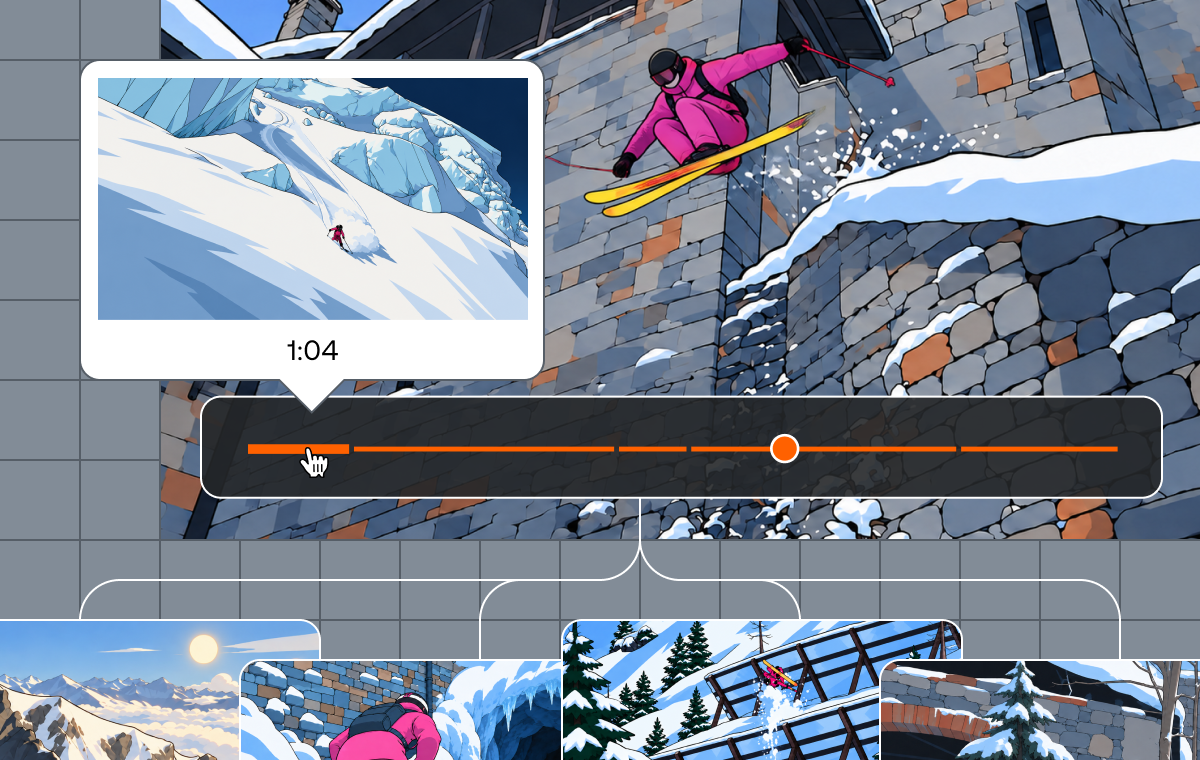
A prime case study for this computational challenge is Markus Eder’s acclaimed 2021 freeskiing film, The Ultimate Run. Produced in collaboration with Production Company and widely celebrated as a masterwork of sports cinematography, the ten-minute video compresses a vast geographical descent into what appears to be a single, unbroken ski run. Eder seamlessly transitions from high-alpine powder fields through glacial ice caves, urban snow parks, historic castle ruins, and ultimately into the bed of a moving truck before reaching the valley floor. For engineers developing AI-driven video analysis tools, such as the development team behind Mux Robots, this visually dense and rapid-fire content serves as an ideal stress test. It demonstrates precisely why artificial intelligence cannot rely on a one-size-fits-all approach when parsing complex digital assets.
The Architectural Necessity of Granular Segmentation
In the realm of video technology, the core objective of modern machine learning workflows is to supply a model with the smallest possible slice of video data that still retains sufficient context to answer a specific query. Rather than treating a video file as a monolithic block of data, advanced parsing systems evaluate the fundamental nature of the question being asked before determining the appropriate level of granularity.
This multi-tiered approach relies on a structural hierarchy ranging from single frames and continuous shots to overarching scenes, editorial moments, and structured chapters. According to technical documentation and platform engineering metrics released by video infrastructure providers, optimizing input sizes through targeted segmentation can reduce redundant computational processing by up to 80% in large-scale enterprise media archives.
The historical evolution of automated video tagging highlights the urgency of this transition. Early computer vision systems relied primarily on uniform frame-sampling techniques—extracting an image every few seconds regardless of visual activity. While functional for static archives, this method frequently fails when applied to modern dynamic content, where critical actions can begin and end within the span of a fraction of a second. By shifting toward intent-driven architecture, automated workflows can dynamically select whether an analysis requires a pixel-level image, a temporal boundary, or a narrative grouping.
Frames, Shots, and Scenes: Defining the Visual Vocabulary
To effectively process a complex visual narrative like The Ultimate Run, modern AI architectures deploy distinct analytical layers, each designed to answer specific operational questions.
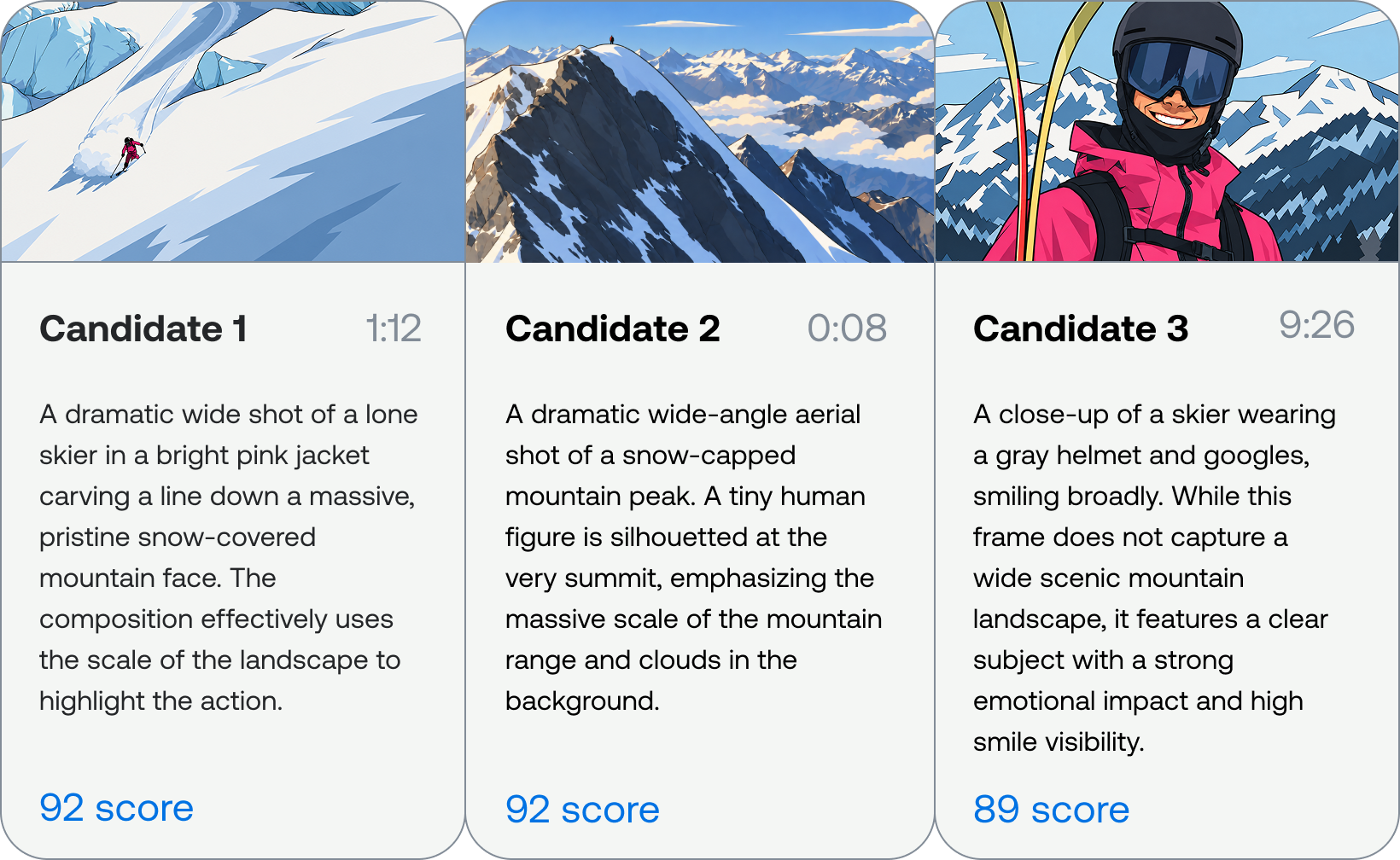
When a query demands the identification of a single precise instant—such as determining the exact moment an athlete achieves maximum elevation during a jump, verifying the presence of a corporate logo, or conducting automated content moderation—the system utilizes a frame-level analysis. Single-frame processing evaluates candidate images based on composition, clarity, facial recognition, and actionable visual signals. However, frame-level analysis remains inherently limited when sequence, velocity, or trajectory matters. A single image can capture Eder mid-rotation, but it cannot independently verify whether the maneuver culminated in a successful landing.
To track temporal transitions and changes in visual state without inspecting every individual image, workflows turn to shot detection. A shot represents a continuous take between two distinct camera cuts. By utilizing low-cost pixel comparison algorithms, video processing platforms automatically map out the structural boundaries of a production. In fast-paced athletic content characterized by rapid camera angles and sudden shifts in terrain—such as Eder’s transition from an alpine ridge to a dark subterranean ice cave—shot-aware sampling ensures that fleeting visual changes are preserved for subsequent models without overwhelming the computational pipeline.

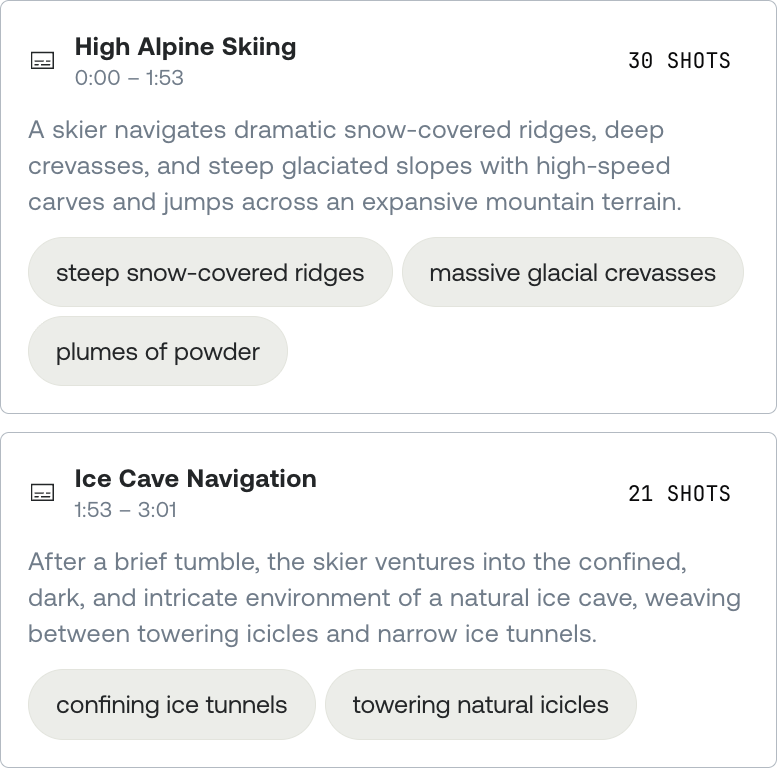
Moving beyond individual shots, scene detection groups neighboring visual takes that share a common narrative or spatial context. While pixel changes define a shot, understanding a scene requires broader contextual reasoning. In content with minimal spoken dialogue, such as cinematic sports films, multimodal AI systems rely heavily on visual consistency to bind multiple camera angles into a single recognizable sequence, such as an entire glacial traversal or a terrain park run. This segmentation provides applications with a structured, timed map that facilitates advanced browsing, timeline editing, and agent-driven search capabilities.
Product-Level Intelligence: Moments, Chapters, and Embeddings
Beyond foundational technical metadata, advanced media workflows must address high-level product and consumer requirements through key moments, automated chapters, and vector embeddings.
Key moments bridge the gap between technical boundaries and editorial value. By synthesizing shot edges, audio transcripts, and frame evaluations, automated systems can isolate standalone excerpts—such as the complete approach, takeoff, and landing of a specific ski trick—that possess enough internal context to function as independent clips. Conversely, automated chapter generation addresses viewer navigation by dividing extended video files into a structured table of contents. While chapters in lecture series or podcasts frequently rely on spoken transcripts, visually driven assets require multimodal systems to infer structural divisions based on dramatic shifts in environment and visual motifs.

Furthermore, the integration of vector embeddings has fundamentally transformed how users interact with large media repositories. Rather than depending on rigid keyword metadata, embedding models translate text queries, visual frames, or multimodal chunks into mathematical vectors that allow systems to retrieve relevant content based on semantic meaning. A user searching for the specific phrase "ice tunnel navigation" can be directed precisely to the relevant sequence within a multi-hour archive, balancing search breadth with exact spatial precision.
Broader Implications for the Media and Technology Sectors
The systematic shift toward granular, question-driven video analysis carries profound implications for digital media production, streaming platforms, and enterprise asset management. As global video consumption continues to expand exponentially, organizations are increasingly forced to automate the labor-intensive processes of content curation, accessibility compliance, and highlight generation.
Industry analysts project that the integration of automated video intelligence will save media enterprises billions of dollars in manual annotation and metadata tagging costs over the coming decade. By allowing artificial intelligence to selectively interrogate media assets at the most efficient level of granularity—whether evaluating a single frame for brand safety or analyzing an entire scene for automated trailer assembly—developers can bridge the gap between raw digital data and actionable human intent.
Ultimately, the technical challenges illuminated by analyzing high-speed cinematic athletic feats underscore a universal truth for modern software engineering: more data does not automatically equate to better context. By deploying precise, modular building blocks tailored to specific analytical questions, the next generation of video AI workflows promises to make massive audiovisual archives as searchable and navigable as plain text.