Critical Memory Corruption Flaw in Google Brotli Decoder Exposes Major Software Runtimes to Remote Code Execution

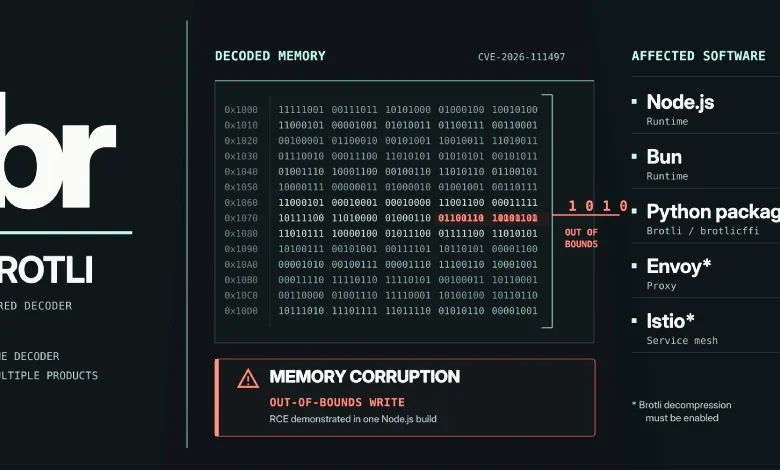
A severe memory-corruption vulnerability, cataloged as CVE-2026-111497, has emerged as a significant threat across the global software ecosystem. The flaw resides within the widely utilized Brotli compression library—a project originally developed by Google to optimize web traffic through efficient data compression. Because the Brotli decoder is embedded directly into the C-based source code of numerous language runtimes, proxy servers, and data-processing packages, the vulnerability creates a widespread attack surface that allows for potential memory overwriting, application crashes, and, in worst-case scenarios, the execution of arbitrary, attacker-controlled code.
The vulnerability was brought to light through the collaborative efforts of security researchers at OpenAI, specifically Khai Tran and Sylvie Mayer of the organization’s Codex Security team. Their disclosure has triggered a cascading series of security patches across the software supply chain, as each individual project that bundles the Brotli library must independently integrate the fix into their own codebase.
The Mechanism of the Flaw and Potential Impact
At its core, CVE-2026-111497 is a classic buffer overflow scenario. The Brotli decompression engine fails to properly sanitize or validate certain crafted compressed data streams. When a vulnerable application attempts to decompress a malicious payload, the decoder writes data past the intended memory buffer limits. This "out-of-bounds" write capability is the catalyst for the security risk; by overwriting adjacent memory, an attacker can manipulate the internal state of the program.
The implications of this memory corruption are severe. While common outcomes include a segmentation fault—which would result in a denial-of-service (DoS) condition—more sophisticated exploits could leverage the memory corruption to bypass security controls, hijack control flow, or execute arbitrary commands on the host machine. The Imperva Red Team, which dubbed their internal research effort "Node2Shell," successfully demonstrated the ability to execute code on an unpatched Node.js build. This proof-of-concept underscores that while the barrier to entry for an exploit is high, the potential for remote code execution (RCE) is technically viable.
Chronology of Discovery and Remediation
The history of this vulnerability is unusual in that the patch existed long before the danger was fully realized. On February 27, 2026, a code change was committed to the Brotli source repository that inadvertently addressed the underlying logic error. However, at that time, the change was not classified as a security fix, and no formal release of the library was issued to include it.

It was not until the security research community identified the broader implications of the unaddressed logic that the risk was formalized. The timeline of the disclosure and subsequent remediation is as follows:
- February 27, 2026: The fix is committed to the Brotli C library source code but remains unreleased.
- October 21, 2026: Official disclosure occurs. Google and Node.js release emergency patches, and the vulnerability is officially assigned the CVE identifier.
- October 22–23, 2026: A flurry of downstream projects, including Bun, Envoy, and various Python package maintainers, issue their own security updates.
- October 23, 2026: Regulatory and security bodies, including CISA and various Linux distributions, begin issuing formal guidance and security advisories to users.
Broad-Spectrum Impact on Modern Runtimes
The ubiquity of the Brotli format means that the impact is not limited to a single application type. Because Brotli is the industry standard for compressing HTTP traffic, the bug permeates the stack from the network edge to the application server.
Language Runtimes and Environments
Node.js and Bun are particularly exposed because their internal fetch() APIs and HTTP request-handling libraries automatically decompress Brotli-encoded content by default. In a typical scenario, a web server might receive a POST request with a compressed body; if the server uses a vulnerable version of a library to process that input, the malicious payload could be triggered without the application developer ever explicitly invoking a decompression function.
Proxy and Infrastructure Software
Infrastructure components like Envoy and Istio are also at risk, provided they have been configured to perform Brotli decompression on behalf of backend services. Since these tools are often positioned at the very perimeter of a data center, a successful exploit could grant an attacker an initial foothold in the network, potentially leading to lateral movement.
Python and the Ecosystem
In the Python ecosystem, the risk is distributed through libraries such as brotli and brotlicffi. The danger here is that these packages are often dependencies of higher-level HTTP clients like requests, httpx, or aiohttp. Developers might be unaware that their application is using a vulnerable library until an automated security scan flags the underlying dependency. Unlike server-side software that can be patched with a single update, Python developers must ensure that their virtual environments are updated and that all packages are rebuilt to incorporate the secure version of the decoder.
Assessment of Severity and Exploitation Risk
The severity rating of CVE-2026-111497 has become a point of discussion within the industry. Google has assigned it a "Critical" rating with a CVSS 4.0 score of 9.2, citing the potential for unauthenticated RCE. Other organizations, such as Red Hat, have adopted a more conservative "Important" rating of 8.1.

This variance often arises from the difficulty of mounting an exploit in a real-world environment. While the theoretical risk is high, the "Node2Shell" exploit demonstrated by researchers is complex and has not been observed in the wild. Cybersecurity agencies, including CISA, have confirmed that as of late October 2026, there are no reports of active exploitation. Furthermore, there is no widely available, reliable, or public "exploit kit" for this vulnerability, which limits the immediate threat to highly motivated and sophisticated threat actors.
Mitigation Strategies and Best Practices
The primary defense against this vulnerability is updating the affected software. Given that the fix is contained within the Brotli library itself, every project that statically or dynamically links to this library must be patched.
- Direct Updates: Users should prioritize updating to the fixed versions of their software stack. For Node.js, this means moving to 22.23.4, 24.22.1, or 26.12.1. Similar updates are available for Bun (v1.4.4) and Envoy (1.40.0 and others).
- Container Rebuilds: Simply updating a host system is often insufficient in modern, containerized environments. Once the base images have been updated, developers must rebuild their containers to ensure the new, patched binaries are fully integrated into the production environment.
- Disabling Brotli: For systems where patching is delayed due to legacy constraints, the most effective mitigation is to disable Brotli decompression. This can involve configuring proxies to ignore
Content-Encoding: brheaders or modifying application code to refuse Brotli-encoded input. However, this may result in a performance degradation or compatibility issues with some clients. - Monitoring and Auditing: Organizations should utilize Software Bill of Materials (SBOM) tools to audit their dependencies. Because CVEs for libraries like
brotlicffimay not be automatically caught by all scanners, manual verification of installed versions is highly recommended.
Conclusion and Future Outlook
The emergence of CVE-2026-111497 serves as a poignant reminder of the fragility of the modern software supply chain. When a foundational library—one used for a task as common as data compression—contains a vulnerability, the downstream effects are both vast and difficult to track.
The fact that the initial fix sat dormant in the source code for months highlights a critical gap in communication between core library maintainers and the broader developer community. Moving forward, the industry may need to refine how "silent" security fixes are communicated, ensuring that even minor changes to critical C-based libraries are treated with the appropriate level of security oversight.
For now, the absence of active, in-the-wild exploitation provides a window of opportunity for security teams to patch their infrastructure. However, as the technical details of the vulnerability become more widely understood, the window for proactive defense will narrow. Stakeholders are urged to review their dependencies, apply the recommended patches, and ensure that their monitoring systems are prepared to detect anomalous behavior that might indicate an attempt to trigger a memory-corruption event. The security of the web depends on the integrity of its lowest-level components, and this incident reinforces the necessity of continuous vigilance in the management of open-source dependencies.