AWS Announces Enhanced Custom Event Bus for Amazon EventBridge to Streamline Multi-Account Scalability

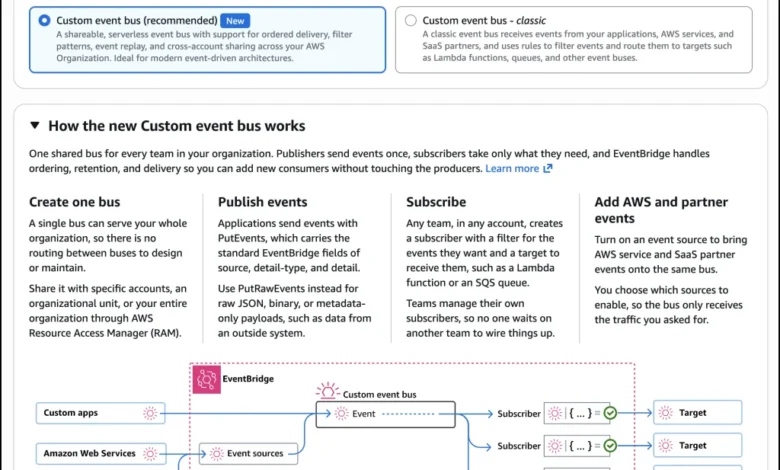
Organizations building event-driven applications on Amazon EventBridge have historically faced significant operational friction when scaling beyond a single-account architecture. As enterprises transition toward complex, multi-account environments to meet security and isolation requirements, the reliance on fragmented, interconnected custom event buses has often reintroduced the very complexity that serverless computing aims to eliminate. Today, Amazon Web Services (AWS) is addressing these systemic challenges by launching an enhanced custom event bus for Amazon EventBridge, designed specifically to serve as a centralized, organization-wide event backbone.
The Evolution of Event-Driven Complexity
The foundational architecture of Amazon EventBridge has long been lauded for its flexibility and ease of use. In the early stages of development, a single custom event bus within a single AWS account is sufficient for most engineering teams. However, as organizations adopt the AWS best practice of multi-account strategies—where each team or microservice operates within its own dedicated account for security and billing isolation—the event-driven architecture becomes increasingly labyrinthine.
Previously, to route events across these account boundaries, engineers were forced to implement a mesh of cross-account rules or complex bus-to-bus configurations. This approach resulted in several operational burdens: platform teams lost visibility into the subscriber graph, routing charges compounded as events traversed multiple buses, and the lack of native event ordering forced developers to build brittle, custom workarounds using secondary services like Amazon SQS. The new enhanced custom event bus arrives as a response to these specific pain points, offering a unified infrastructure that manages the routing, filtering, and delivery of events across an entire AWS Organization.
Key Technical Enhancements and Capabilities
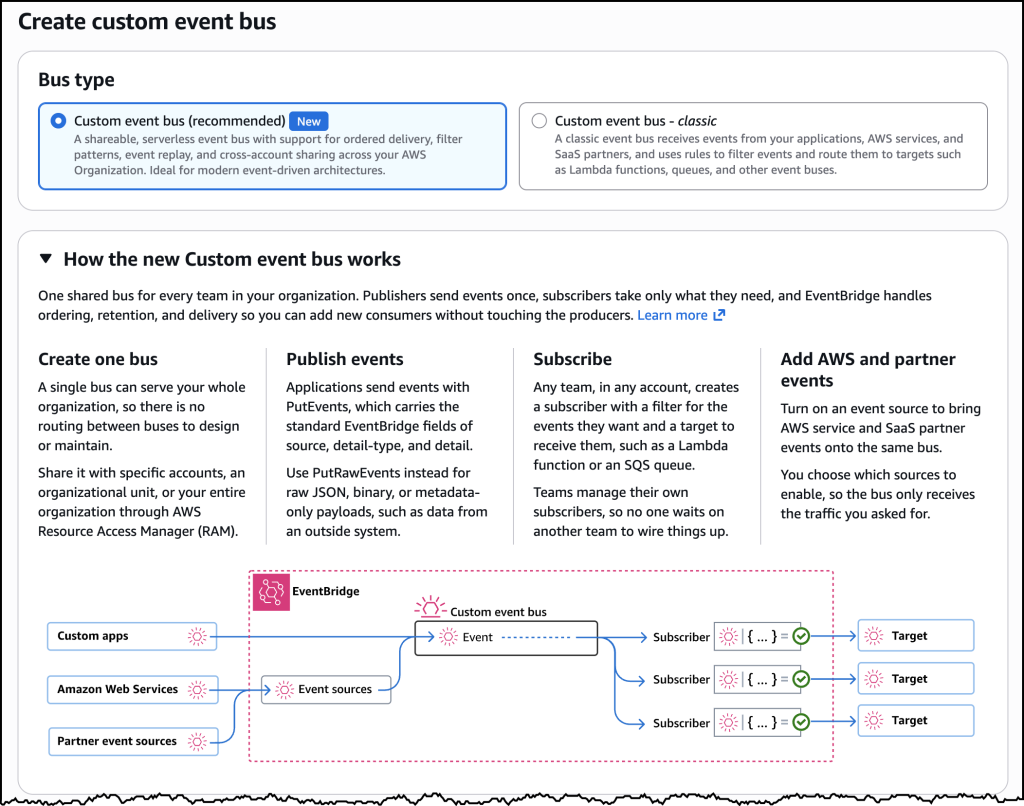
The newly announced architecture simplifies the developer experience by moving away from decentralized bus management. Central to this update is the ability to deploy a single, centralized event bus that is shared across all AWS accounts within an organization. This is facilitated through seamless integration with AWS Resource Access Manager (AWS RAM), which removes the need for manual cross-account permission management or complex routing logic.

Advanced Event Ordering
Perhaps the most significant technical hurdle resolved by this release is the implementation of native event ordering. In many distributed systems, such as logistics tracking or financial transaction processing, the sequence of events is critical to data integrity. Out-of-sequence events can cause downstream systems to make incorrect decisions based on stale information.
The enhanced bus introduces an EventGroupId parameter. When publishers assign this ID to events, EventBridge ensures that events sharing the same group are delivered in strict sequence to subscribers. Furthermore, this is bolstered by a new synchronous invocation mode for targets such as AWS Lambda. By confirming successful processing before acknowledging the event, the system eliminates the common architectural pattern of inserting message queues between an event bus and compute resources simply to ensure reliability.
The Subscriber Resource
The introduction of the "Subscriber" resource marks a shift in how EventBridge manages downstream consumption. Previously, achieving reliable delivery required configuring disparate rules, targets, retry policies, and dead-letter queues. The new Subscriber resource aggregates these components into a single, manageable unit. This consolidation allows for easier onboarding of new consumers, granular control over retry behaviors, and simplified hydration of new applications via variable start-time options.
Content-Based Deduplication and JSONata
For systems prone to network retries or partial failures, the enhanced bus now offers content-based deduplication. EventBridge will automatically hash the payload and collapse duplicate events arriving within a five-minute window, providing "exactly-once" delivery semantics for sources that cannot inherently generate idempotency tokens. Additionally, the integration of JSONata allows subscribers to reshape, filter, and transform event payloads at the bus level, reducing the need for custom transformation logic within target services.
Economic Implications and Scaling
The transition to a centralized event bus model is accompanied by a restructured pricing model. Under the previous architecture, costs could become unpredictable as inter-bus traffic and cross-account routing fees accrued. The new model adopts a simplified ingress and egress throughput pricing structure. Publishers are charged based on the volume of events ingested, while subscribers pay for the volume of events delivered. This shift creates a clearer cost-allocation path, allowing platform teams to accurately attribute costs to specific business units or product teams based on their actual consumption patterns.

With a default quota of 10,000 subscribers per bus, the new architecture is built for extreme scale. This higher limit reduces the need for "bus sharding," where organizations previously had to split their event traffic across multiple buses simply to avoid hitting account-level quotas.
Industry Context and Strategic Direction
The launch of the enhanced custom event bus reflects a broader trend in cloud-native development: the move toward platform-centric infrastructure. Industry analysts have noted that as serverless adoption matures, the primary focus for cloud providers is shifting from basic service availability to the operational maturity of the platform. By abstracting the "plumbing" of cross-account event routing, AWS is effectively enabling platform engineering teams to act as internal service providers for their development organizations.
This release does not deprecate existing infrastructure. Amazon EventBridge will continue to support the "Classic" custom event bus, ensuring that legacy workloads remain functional without requiring immediate migration. Organizations can adopt the enhanced bus at their own pace, treating it as a new resource that can coexist with existing event-driven setups.
Implementation and Regional Availability
For organizations looking to integrate this into their current workflows, the implementation process is streamlined through the AWS Management Console, the AWS CLI, or EventBridge APIs. By selecting the "Enhanced" option during the creation of a new custom event bus, administrators can define the scope of sharing—whether it be an entire organization, specific organizational units, or individual IAM principals.
The service is available immediately in a wide range of AWS regions, including US East (N. Virginia, Ohio), US West (Oregon), and multiple locations across Europe and the Asia-Pacific region.
Broader Impact on Enterprise Architecture
The impact of this update on enterprise-level event-driven architecture cannot be overstated. By providing a hardened, ordered, and centralized event bus, AWS is removing a significant barrier to entry for complex, distributed applications. Engineering teams that were previously deterred by the operational overhead of maintaining multi-bus meshes can now move toward a unified event-driven strategy.
Furthermore, the integration of native ordering and content-based deduplication allows architects to simplify their application codebases. By shifting the responsibility of sequencing and deduplication to the infrastructure layer, developers can focus on business logic rather than defensive coding against out-of-order messages. This development represents a maturing of the serverless ecosystem, where the infrastructure is increasingly capable of handling the nuances of high-scale, distributed state, and consistency.
As enterprises continue to embrace microservices and event-driven patterns, the demand for such centralized, highly-reliable event backbones will likely grow, setting a new standard for how event-driven systems are designed, deployed, and governed within the cloud.