Building Fortress Cloud: How ReadyOn Redefined Multi-Tenant Security on Amazon EKS

The modern enterprise software landscape has increasingly converged on multi-tenant architectures as a primary vehicle for achieving economies of scale, operational efficiency, and rapid feature deployment. However, this architectural consolidation has historically introduced severe vulnerabilities, particularly within cloud-native environments powered by Kubernetes. ReadyOn, an AWS Partner and leading provider of intelligent labor orchestration platforms for Fortune 100 enterprises, has confronted this challenge head-on. Operating a high-stakes multi-tenant platform on Amazon Elastic Kubernetes Service (Amazon EKS) that processes sensitive payroll data, organizational hierarchies, and operational analytics for hundreds of thousands of employees, ReadyOn realized that conventional isolation paradigms were fundamentally insufficient for enterprise-grade workloads.
To understand the gravity of ReadyOn’s architectural evolution, one must examine the baseline security posture of Kubernetes itself. By design, upstream Kubernetes is not secure out of the box. Historically, default deployments permit anonymous requests to reach the API server, where they are filtered exclusively by Role-Based Access Control (RBAC). Furthermore, pods run as root by default, and network policies are completely absent until explicitly authored by cluster administrators. While hardening a single-tenant Kubernetes cluster is a well-documented engineering hurdle, the threat model undergoes a radical shift when multi-tenancy is introduced. The central security concern transcends the traditional question of whether an unauthorized external actor can penetrate the cluster perimeter; instead, the existential threat becomes whether Tenant A can laterally pivot and access the proprietary data of Tenant B.
Historically, the cloud-native ecosystem has relied heavily on Kubernetes namespaces as the primary mechanism for tenant isolation. Yet, core Kubernetes designers never intended namespaces to serve as a robust security boundary. Recognizing that a cross-tenant data breach would trigger immediate regulatory obligations across multiple jurisdictions and irrevocably shatter the trust enterprise clients place in their technology infrastructure, ReadyOn’s engineering leadership concluded that relying on a single isolation barrier was entirely unacceptable. The stakes demanded a compound defense model—one that would eliminate the single points of failure inherent in standard Kubernetes implementations.
The Genesis of the Four Walls Architecture
To address these vulnerabilities, ReadyOn engineered a sophisticated defense-in-depth framework known internally as the "Four Walls" model. Deployed across their Amazon EKS infrastructure, this architecture establishes four independent, overlapping barriers between tenants. Each wall operates at a completely distinct layer of the technology stack, requiring a fundamentally different technical methodology to compromise.
The power of this multi-layered approach lies in its compounding complexity. To successfully execute a lateral movement attack and breach a tenant boundary, an unauthorized user or compromised workload must simultaneously defeat the Kubernetes API, the node scheduler, the AWS software-defined network, and the underlying data layer. Because certain components share underlying control planes—such as admission controllers, GitOps pipelines, the EKS control plane, and AWS Identity and Access Management (IAM)—ReadyOn treats these controls strictly as a coordinated defense-in-depth strategy rather than assuming isolated mathematical probabilities of failure.
Wall 1: Logical Foundation via Namespace Isolation and GitOps Enforcement
The first wall of ReadyOn’s architecture operates at the most visible boundary in Kubernetes: the namespace. While acknowledging the inherent limitations of namespaces as hard security perimeters, ReadyOn utilizes them as the logical foundation upon which subsequent physical and network layers are constructed.
To eliminate configuration drift and ensure absolute consistency across hundreds of tenant environments, ReadyOn abandoned manual cluster management. Every tenant namespace is provisioned and managed exclusively through Argo CD ApplicationSets driven by GitOps principles. When a new tenant is onboarded, engineers simply add a single entry to a configuration manifest stored within a secure Git repository. The automated pipeline instantly generates all required cluster resources: the namespace itself, fine-grained network policies, restrictive RBAC bindings, strict resource quotas, and isolated secret configurations. Consequently, there are no "legacy" tenants operating under outdated or weaker security policies. Every single tenant receives an identical, hardened security posture by construction.
Within this layer, stringent RBAC and admission control frameworks restrict API access strictly to a tenant’s own resources. Tenant principals are programmatically barred from listing, getting, or modifying resources situated in foreign namespaces. An automated admission control framework inspects all incoming resource definitions, evaluating them against a rigid policy set that enforces security contexts, blocks privileged container configurations, and prevents the unauthorized creation of cluster-scoped resources such as DaemonSets, ClusterRoles, and custom admission webhooks.
To maintain this immaculate state, the GitOps controller continuously reconciles live cluster conditions against the declarative state defined in Git. Any manual modification—whether introduced via accidental misconfiguration or attempted exploitation by an attacker who has acquired limited API access—is automatically detected and reverted within seconds. Human operators are strictly prohibited from executing commands like kubectl apply directly against production clusters.
Wall 2: Compute Isolation and Dedicated Workload Placement via Karpenter
Moving downward from the Kubernetes API layer, Wall 2 addresses the physical and virtual compute infrastructure where tenant application code actually executes. In ReadyOn’s Harmony platform, tenants never share underlying compute nodes.
This absolute separation is achieved through an advanced dual-taint strategy powered by Karpenter, an open-source, high-performance Kubernetes cluster autoscaler built for AWS. Karpenter-managed provisioners generate worker nodes stamped with two distinct taints: a unique tenant-identifier taint (such as tenant=acme-corp) and a specific workload-type taint (such as workload=frontend). For a pod to be successfully scheduled, it must explicitly tolerate both taints. Consequently, Tenant A’s frontend compute nodes are entirely distinct from Tenant A’s batch-processing nodes, and both are completely segregated from Tenant B’s underlying infrastructure.
Even if a rogue container were deployed with forged tolerations, a secondary admission controller validation layer intercepts the request, cross-referencing the toleration claims against the calling namespace’s verified tenant identity. This ensures the Kubernetes scheduler can never be manipulated into cross-tenant placement.
Furthermore, all application nodes enforce Instance Metadata Service Version 2 (IMDSv2) with a reduced hop limit, effectively neutralizing attempts by containerized workloads to reach the instance metadata endpoint. The IAM role attached to each worker node is tightly scoped exclusively to a single tenant’s resources, strictly bounding the potential blast radius of a theoretical container escape. Meanwhile, dedicated platform infrastructure nodes operate on separate managed node groups protected by taints that no tenant workload can ever tolerate.
Wall 3: Infrastructure-Level Network Isolation at the Amazon VPC Layer
While the first two walls operate entirely within the Kubernetes abstraction layer, Wall 3 drops below Kubernetes, enforcing robust security boundaries at the Amazon Virtual Private Cloud (VPC) and security group levels. This infrastructure is entirely unmanaged by the Kubernetes control plane, meaning that a compromised pod possessing limited internal access has no capability to manipulate these underlying network rules.
At the core of this network architecture lies a system of per-tenant security groups. Each tenant’s dedicated Amazon Aurora database cluster is protected by an AWS security group that permits inbound TCP connections exclusively from the specific security group attached to that exact tenant’s application worker nodes. Tenant A’s compute nodes are physically and programmatically incapable of opening a TCP connection to Tenant B’s database. Because this is enforced at the AWS software-defined network layer, bypassing it would require subverting the foundational networking architecture of the cloud provider itself.
The underlying VPC is meticulously segmented into four distinct tiers: a public perimeter tier housing load balancers exclusively; an application tier containing EKS worker nodes deployed across private subnets; a database tier consisting of isolated Aurora clusters completely devoid of internet routing capabilities; and a highly secured control plane tier featuring private EKS API endpoints accessible solely via VPN connections authenticated through OIDC and multi-factor authentication (MFA).
Complementing these physical subnets, Kubernetes network policies enforce a strict default-deny posture for all inter-namespace traffic. Tenant pods are permitted to communicate solely with pods residing within their own designated namespace and explicitly authorized platform services. All unauthorized traffic is dropped and logged, while Amazon VPC Flow Logs continuously capture network telemetry for real-time anomaly detection.
Wall 4: Ultimate Data Protection via Dedicated Amazon Aurora Clusters
The fourth and final wall addresses the ultimate target of any malicious actor: the data itself. While the preceding three walls are designed to prevent an unauthorized user from ever reaching another tenant’s infrastructure, Wall 4 ensures data isolation is preserved even in the catastrophic event that all perimeter layers fail.
In many conventional multi-tenant architectures, applications rely on a shared database model where isolation is delegated entirely to application-layer query logic. In such systems, a single developer oversight—such as a missing WHERE tenant_id = ? clause in a SQL query—can result in catastrophic data disclosure. ReadyOn systematically eliminated this vulnerability by provisioning dedicated Amazon Aurora database clusters for every individual tenant. In this architecture, there are no shared tables and no reliance on row-level security filters that can be inadvertently bypassed. Tenant A’s application code cannot construct a network connection to Tenant B’s database because it lacks the correct endpoint address, the authentication credentials, and the underlying network route.
This dedicated database model further facilitates the implementation of unique AWS Key Management Service (AWS KMS) encryption keys per tenant. Every tenant’s data at rest is encrypted with a distinct, customer-managed KMS key. Consequently, even in the highly improbable event that raw cloud storage volumes were physically compromised, one tenant’s encryption key is mathematically incapable of decrypting another tenant’s sensitive records. Achieving equivalent cryptographic separation in a shared database environment is exceptionally complex, as multi-tenant rows typically share underlying storage pools and rely heavily on application-enforced boundaries.
To eliminate long-lived credentials across the stack, ReadyOn implements IAM Roles for Service Accounts (IRSA). Every workload authenticates to AWS APIs using short-lived credentials issued dynamically by the AWS Security Token Service (AWS STS) via OIDC federation between the EKS cluster and IAM. Workloads assume narrowly scoped IAM roles granting access exclusively to that specific tenant’s resources, with credentials expiring automatically within minutes. Furthermore, per-tenant observability pipelines route metrics, logs, and traces to dedicated backends via OpenTelemetry, ensuring that operational telemetry and error spikes remain entirely invisible across tenant boundaries.
Adversarial Validation and Continuous Security Engineering
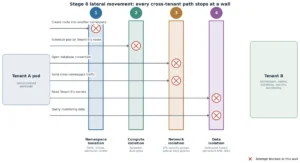
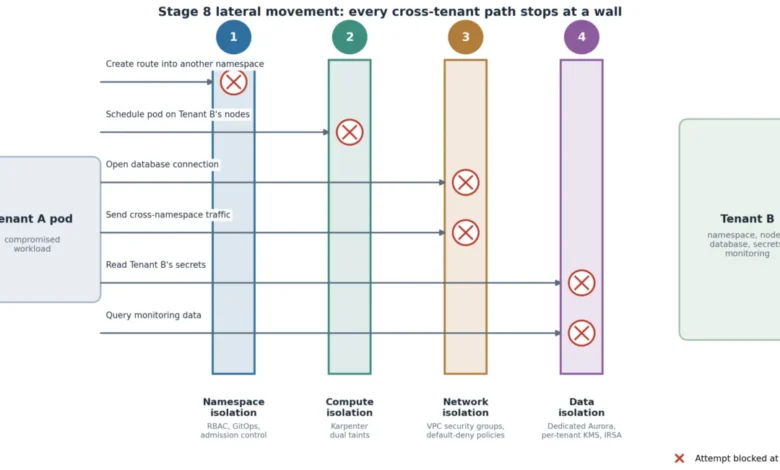
To verify the resilience of this multi-layered defensive posture, ReadyOn maps its security controls directly against its internal 10-stage multi-tenant threat model, aligning each phase with standardized MITRE ATT&CK techniques. The critical inflection point within this model occurs at Stage 8: lateral movement. During this phase, simulated adversaries operating within a compromised Tenant A pod attempt to cross administrative and network boundaries to access Tenant B’s resources.
ReadyOn subjects its infrastructure to rigorous, recurring adversarial simulation exercises where security teams assume a compromised tenant pod with elevated local access and attempt every conceivable lateral movement vector. To date, these comprehensive penetration testing exercises have consistently yielded a zero-failure rate: no unauthorized path has ever successfully breached a tenant boundary. Every attempted vector—whether attempting to query foreign Kubernetes APIs, schedule rogue pods onto alien worker nodes, open cross-tenant database sockets, or exfiltrate isolated monitoring data—terminates harmlessly at the specific numbered wall designed to block it.
This defensive rigor extends inward to container hardening. Every container running within the Harmony platform adheres strictly to the "restricted" profile of Kubernetes Pod Security Standards. Containers are explicitly configured to run as non-root users, prohibit privilege escalation, mount root filesystems as read-only, drop all Linux kernel capabilities, and enforce default seccomp profiles. These measures ensure that even if an attacker successfully executes a container escape vulnerability, they are left without binaries, tools, or kernel interfaces required to establish persistence or acquire node-level credentials.
Broader Implications for Enterprise Cloud-Native Architecture
The architectural model pioneered by ReadyOn offers profound implications for the broader enterprise software industry. As organizations increasingly migrate mission-critical, highly regulated workloads—spanning financial services, healthcare, human resources, and government operations—to managed Kubernetes environments like Amazon EKS, the industry can no longer afford to treat multi-tenancy as an afterthought solved exclusively by software namespaces.
By proving that rigorous defense-in-depth can be successfully engineered by harmonizing native cloud services across independent abstraction layers—Kubernetes RBAC at the API layer, Karpenter at the scheduling layer, AWS security groups at the network layer, and IAM-backed dedicated databases at the data layer—ReadyOn has established a definitive reference architecture for zero-trust enterprise multi-tenancy. For chief information security officers and cloud architects navigating the delicate balance between operational velocity, infrastructure cost efficiency, and uncompromising data protection, the Four Walls model demonstrates that security and scale are not mutually exclusive, but can instead be engineered into a cohesive, unyielding fortress.
Related posts: