How ReadyOn Reengineered Multi-Tenant Security on Amazon EKS Using the Four Walls Architecture

The enterprise software landscape has experienced an unprecedented migration toward multi-tenant cloud architectures, driven by the compelling economics of resource sharing and the operational velocity of cloud-native orchestration platforms. However, this architectural efficiency introduces profound security complexities, particularly for organizations handling sensitive data on behalf of Fortune 100 enterprises. ReadyOn, an AWS Partner and a leading provider of intelligent labor orchestration platforms, has confronted these challenges head-on by reengineering its infrastructure security model. Running a high-stakes multi-tenant platform on Amazon Elastic Kubernetes Service (Amazon EKS), the company processes vast amounts of confidential workforce intelligence, including intricate payroll records, deep organizational hierarchies, and comprehensive operational analytics spanning hundreds of thousands of corporate employees.
The core challenge of modern cloud security lies in the inherent design of upstream Kubernetes. Historically, default Kubernetes distributions are not secure out of the box. Anonymous requests can reach the API server where they are initially defended only by Role-Based Access Control (RBAC); containers routinely execute as the root user by default; and network isolation policies do not exist until administrators explicitly define them. For single-tenant clusters, hardening these surfaces is a well-documented engineering hurdle. Yet, when multi-tenancy is introduced, the threat model undergoes a fundamental paradigm shift. The primary security concern transitions rapidly from determining whether an unauthorized external actor can penetrate the cluster perimeter to deciding whether Tenant A can inadvertently or maliciously access the proprietary data of Tenant B. Traditionally, most multi-tenant Kubernetes platforms have relied heavily on a single isolation mechanism: the namespace. Nevertheless, Kubernetes architects never designed namespaces to serve as robust security boundaries. Recognizing that a cross-tenant data breach would trigger severe regulatory compliance obligations across multiple jurisdictions and irrevocably damage the trust enterprise clients place in their technology partners, ReadyOn determined that a single wall of defense was entirely insufficient for its Harmony platform.
To eliminate these systemic risks, ReadyOn engineered an innovative, multi-layered security framework designated as the Four Walls model. This architecture establishes four independent, overlapping barriers between distinct tenants, with each wall operating at a fundamentally different layer of the technology stack and requiring an entirely distinct technical exploit to compromise. By combining Kubernetes namespaces, Karpenter-managed dedicated node pools, Amazon Virtual Private Cloud (Amazon VPC) security groups, and per-tenant Amazon Aurora databases, ReadyOn has constructed a compound defense mechanism. Under this robust paradigm, to successfully cross a tenant boundary, an unauthorized user or compromised process would need to simultaneously and concurrently defeat the Kubernetes API, the underlying node scheduler, the AWS software-defined networking layer, and the isolated data persistence layer.
The Foundation of Logical Isolation: Namespace Management and GitOps Enforcement
The first barrier in ReadyOn’s security hierarchy operates at the most visible boundary within Kubernetes: the namespace. While acknowledging the technical limitations of namespaces as standalone security perimeters, ReadyOn utilizes them as the critical logical foundation upon which all subsequent physical and infrastructure-layer controls are erected. To ensure absolute consistency and eliminate human configuration error, every tenant namespace within the Harmony platform is provisioned exclusively through Argo CD ApplicationSets using a rigorous GitOps methodology.
When ReadyOn initiates the onboarding sequence for a new enterprise tenant, engineers simply introduce a single configuration manifest entry into a centralized Git repository. This automated pipeline instantaneously generates all required underlying resources: the dedicated namespace, associated network policies, granular RBAC bindings, strict resource quotas, and secure secret configurations. Consequently, the architecture contains zero "legacy" tenants burdened by weaker historical security postures. Every single tenant receives an identical, hardened security posture by direct construction.
Furthermore, namespace-level RBAC configurations strictly restrict API access, ensuring that tenant-specific principals can only view, get, or modify resources residing precisely within their designated namespace. No tenant principal possesses the privileges required to list or alter resources in an adjacent tenant boundary. Simultaneously, an advanced admission control framework evaluates all incoming resource requests against a stringent policy set that actively blocks privileged container configurations, enforces secure runtime contexts, and prevents the unauthorized creation of cluster-scoped resource types such as DaemonSets or ClusterRoles. To maintain absolute operational integrity, the GitOps controller continuously reconciles live cluster states against declared states in Git. Any manual modification—whether stemming from an administrative misconfiguration or an unauthorized user who has somehow acquired limited API access—is automatically detected and reverted within seconds. Operational personnel never execute manual commands directly against production clusters, ensuring total immutability.
Compute Layer Segregation: Eliminating Shared Infrastructure via Karpenter
While namespace isolation operates strictly at the Kubernetes API abstraction layer, ReadyOn’s second wall drops directly into the physical and virtual compute layer, governing the actual underlying virtual machines where tenant code executes. Within the Harmony platform, active tenants are strictly prohibited from sharing compute nodes.
To achieve granular compute segregation without sacrificing elasticity, ReadyOn leverages Karpenter, an open-source, high-performance Kubernetes cluster autoscaler built for AWS. Karpenter provisioners dynamically configure worker nodes utilizing a sophisticated dual-taint strategy. Every provisioned node features two distinct taints: a specific tenant-identifier taint (such as tenant=acme-corp) and a specific workload-type taint (such as workload=frontend). Consequently, for any containerized workload to be successfully scheduled, its pod configuration must explicitly declare tolerations for both taints. Tenant A’s frontend execution nodes remain entirely distinct from Tenant A’s backend batch-processing nodes, and both sets of infrastructure are physically and logically segregated from Tenant B’s compute environment.
To safeguard against malicious configuration bypasses, an admission controller validates that pod toleration claims precisely match the namespace’s authenticated tenant identity, ensuring that the Kubernetes scheduler can never be manipulated into cross-tenant placement. Moreover, all application worker nodes enforce the Instance Metadata Service Version 2 (IMDSv2) with a reduced hop limit, effectively neutralizing container attempts to reach the instance metadata endpoint. The AWS Identity and Access Management (IAM) role attached to each individual compute node is strictly scoped to a single tenant’s specific cloud resources, drastically limiting the blast radius of any hypothetical container escape. Dedicated platform nodes operate on separate managed node groups secured by unique taints that standard tenant workloads cannot tolerate.
Network-Level Defense: Amazon VPC and Security Group Enforcement
Moving deeper into the infrastructure stack, ReadyOn’s third wall bypasses Kubernetes abstractions entirely, enforcing hard perimeter isolation at the Amazon VPC and security group level. This infrastructure layer is completely unmanaged by the Kubernetes control plane, meaning that a compromised pod possessing limited API privileges possesses zero capability to modify or circumvent these network rules.
Every individual tenant’s Amazon Aurora database cluster is wrapped in a dedicated Amazon VPC security group configured to accept inbound database connections exclusively from the security group attached to that specific tenant’s application worker nodes. As a direct result, Tenant A’s compute nodes are physically incapable of opening a TCP connection to Tenant B’s database backend. This security control is enforced directly by the underlying AWS software-defined network. Crossing this barrier would require an attacker to subvert the fundamental routing and security mechanics of the AWS cloud networking layer itself.
The broader Amazon VPC architecture is meticulously segmented into four distinct security tiers: a public perimeter tier housing only load balancers; an application tier containing EKS worker nodes residing in private subnets; a database tier comprising Aurora clusters completely devoid of internet access; and a control plane tier housing private EKS API endpoints accessible exclusively via secure VPN connections authenticated through OIDC and Multi-Factor Authentication (MFA). Additionally, Kubernetes network policies enforce a strict default-deny posture for all inter-namespace traffic. Tenant pods are permitted to communicate solely with pods residing within their exact namespace and authorized platform utilities, while all extraneous traffic is summarily dropped and logged to Amazon VPC Flow Logs for continuous anomaly detection.
Data Persistence Isolation: Zero Shared State via Amazon Aurora and AWS KMS
The ultimate objective of any enterprise security architecture is the absolute protection of data assets. ReadyOn’s fourth and final wall ensures that data isolation remains uncompromised even in the catastrophic event that all preceding infrastructure layers experience simultaneous failure.
In conventional multi-tenant architectures, utilizing a shared database places the entire burden of data security on application-layer query logic, where a single developer oversight—such as a missing WHERE tenant_id = ? clause—can result in catastrophic data disclosure. To completely eliminate this systemic vulnerability, ReadyOn deploys dedicated Amazon Aurora clusters for every single tenant. Within this architecture, there are no shared tables and no row-level filters to misconfigure. Tenant A’s application code cannot even construct a valid connection string to Tenant B’s database, as it lacks the required network endpoint, operational credentials, and underlying network path.
Furthermore, dedicated Aurora clusters facilitate the implementation of unique AWS Key Management Service (AWS KMS) encryption keys on a per-tenant basis. Each tenant’s data-at-rest is encrypted using a distinct, customer-managed KMS key. Consequently, even in the highly improbable scenario of raw underlying storage media being accessed, one tenant’s cryptographic key cannot decrypt the data of another. Achieving an equivalent level of per-tenant cryptographic separation in a shared database environment remains exceptionally difficult, as shared storage models typically force all tenants to rely on identical master encryption keys.
To eliminate long-lived static credentials, every workload within the platform authenticates to AWS APIs using short-lived security tokens issued by the AWS Security Token Service (AWS STS) via OIDC federation between the EKS cluster and IAM. Through IAM Roles for Service Accounts (IRSA), each tenant’s workloads assume a uniquely scoped IAM role restricted exclusively to that tenant’s designated resources, with session credentials expiring automatically within minutes. Supplementary operational telemetry is similarly segregated; every tenant’s metrics, logs, and traces are routed to dedicated observability backends via OpenTelemetry, ensuring that even anomalous spikes in error rates remain entirely invisible to competing enterprise clients.
Threat Modeling and Adversarial Validation
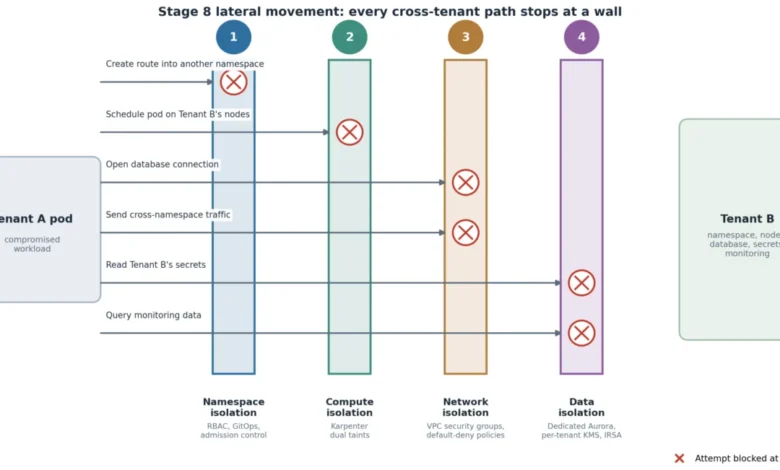
To rigorously evaluate the resilience of this architecture, ReadyOn maps its security controls directly against its internal 10-stage multi-tenant threat model, correlating each phase with standard MITRE ATT&CK techniques. The critical inflection point within this threat lifecycle occurs at Stage 8: lateral movement. During this phase, an hypothetical adversary who has successfully compromised a container running inside a Tenant A pod attempts to cross the structural boundary to access Tenant B’s resources.
ReadyOn’s comprehensive testing confirms that an unauthorized process attempting lateral movement faces an insurmountable sequence of active blockades. Attempting to forge routes into another namespace is immediately terminated at Wall 1. Trying to schedule rogue pods onto another tenant’s compute nodes fails at Wall 2. Attempting to establish unauthorized database connections or transmit cross-namespace network packets is blocked at Wall 3. Finally, attempts to exfiltrate encrypted secrets or query cross-tenant monitoring streams are neutralized at Wall 4.
To continuously validate these theoretical guarantees, ReadyOn conducts regular, rigorous adversarial red-team exercises. During these controlled simulations, security engineers assume the persona of an internal attacker possessing a compromised tenant pod with elevated local privileges and execute comprehensive exploit paths across the environment. To date, internal audits confirm that zero simulation tests have successfully breached the multi-tenant isolation boundaries.
Implications and Industry Significance
The engineering blueprint established by ReadyOn offers profound implications for the broader enterprise software industry. As regulatory frameworks surrounding data privacy, cross-border data transfers, and corporate governance become increasingly stringent, organizations operating software-as-a-service (SaaS) platforms can no longer rely on superficial logical barriers or single-layer security controls.
By demonstrating that defense-in-depth can be systematically achieved on Amazon EKS through the native orchestration of independent AWS services—combining Kubernetes RBAC at the API layer, Karpenter at the compute layer, Amazon VPC security groups at the network layer, and IAM at the data persistence layer—ReadyOn provides a definitive reference architecture for zero-trust multi-tenancy. This model proves conclusively that enterprises do not need to sacrifice operational velocity, administrative scalability, or cost-efficiency to achieve uncompromising data security. As cloud-native adoption continues to mature among Fortune 100 corporations, the Four Walls architectural pattern establishes a new gold standard for secure, enterprise-grade multi-tenant platform engineering.
Related posts: