The Quality Control Crisis: How Adland Is Grappling with AI-Driven Automation, Brand Degradation, and the Shift to a Two-Audience Internet

As the advertising industry enters the peak of its annual autumn event cycle across the United States and Western Europe, a notable shift in tone has overtaken the conference circuit. What began years ago as an unbridled celebration of technological novelty and operational efficiency has matured into a sobering reckoning. The omnipresent buzzword “AI” no longer commands automatic applause; instead, it is increasingly uttered with a mixture of fatigue, caution, and profound anxiety.
While early-stage AI adoption promised a utopian era of streamlined workflows and hyper-productive creative development, the reality on the ground has proven far more complex. Across major holding companies, boutique agencies, and global brands alike, the relentless push toward automation has coincided with widespread workforce reductions. Yet, as headcount has shrunk, so too has the baseline standard of creative output. Marketers are waking up to a stark reality: trading human oversight for algorithmic speed has introduced severe vulnerabilities, threatening brand equity, diluting messaging, and eroding consumer trust.
Against this backdrop of industry-wide disruption, leaders are grappling with the urgent need to establish rigorous new standards. The objective is no longer merely to see how fast a campaign can be deployed, but rather how to build a resilient, high-caliber talent base capable of navigating the unprecedented challenges of the contemporary digital ecosystem.
The Inaugural AI Marketing Strategies Event: A Turning Point
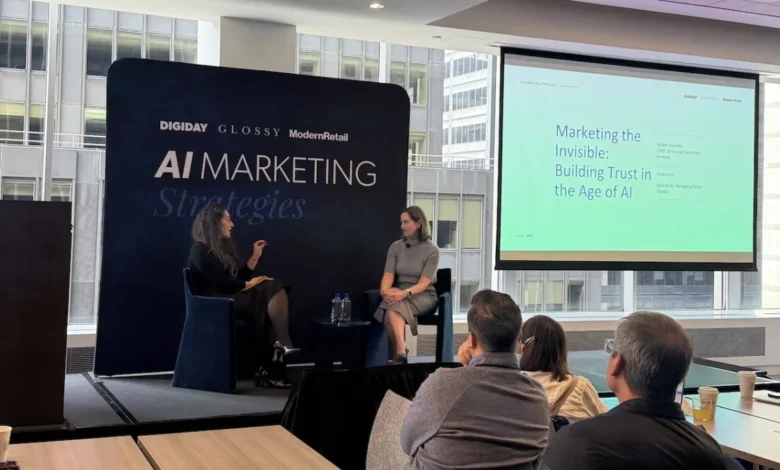
This tension took center stage on September 24, during the inaugural AI Marketing Strategies event, co-hosted by industry publication Digiday alongside sister titles Glossy and Modern Retail. Gathering some of the sharpest minds in digital commerce and brand management, the conference served as a pressure valve for an industry struggling to reconcile automation with artistic and operational integrity.
Throughout the day-long summit, the recurring refrain among attendees was “change management.” Behind closed doors, brand-side marketers engaged in candid, frank discussions held under the Chatham House Rule. The primary concern unifying these enterprise leaders was the alarming degradation of quality control across digital supply chains. As corporations default to automated workflows to offset AI-driven job cuts, the safeguards that traditionally protected premium brand positioning have begun to fray.
Participants did not mince words regarding the inherent risks of prioritizing volume over value. Several executives argued that an uncritical reliance on generative AI tools directly threatens the prestige and exclusivity associated with luxury and premium consumer goods. When digital platforms pump out vast quantities of content without sufficient human filtration, the resulting dilution can cause irreparable harm to a brand’s long-term market standing.
The 10/80/10 Dilemma: The Breakdown of Quality Control
One prominent voice at the town hall—representing a globally recognized premium beauty brand—offered a scathing critique of current industry practices. “The quality control is so bad,” the executive noted, highlighting the immense friction brands face when trying to force AI-driven advertising platforms to respect established brand guidelines.
To cope with this deficit, the executive outlined a personal operational framework known as the “10/80/10 formula.” According to this model, only 10 percent of an expert marketer’s time is spent upfront, prompting and directing the AI tool toward the desired strategic objective. The algorithm then executes roughly 80 percent of the heavy lifting in the middle of the workflow. However, the final 10 percent requires exhaustive human intervention—scrutinizing, refining, and correcting the output to ensure it meets acceptable professional standards.
The problem, according to multiple brand-side marketers in attendance, is that agency partners are frequently failing to invest that crucial final 10 percent of effort. Many agencies, eager to maximize profit margins in a contracting economic environment, have delegated the supervision of advanced AI platforms to junior, inexperienced employees. For premium brands where visual and narrative precision is paramount, this delegation of oversight has proven disastrous.
“It’s like there’s a growing acceptance of ‘good enough — go,’” lamented another brand-side executive during the session. The participant recounted numerous instances where creative executions delivered by external agencies contained glaring errors, such as misrendered corporate logos or tone-deaf messaging. Consequently, these brands are now forced to institute mandatory human approval gates, strictly forbidding campaign deployment until senior professionals have personally audited the digital assets.
Navigating the Human Element and the Fear of Obsolescence
In a separate, parallel session focused on organizational transformation, industry leaders emphasized that successful change management requires a delicate, empathetic approach to the workforce. Implementing automation without accounting for the psychological toll on employees risks dismantling company culture entirely.
Agency leaders acknowledged that the timeline of campaign production has compressed drastically. Where campaigns once required weeks of collaborative ideation, storyboarding, and execution, generative tools now yield functional assets in mere hours. This profound compression forces a fundamental existential question for modern creative professionals: What is the distinct value of human labor when an algorithm can replicate the mechanics of content creation instantaneously?
“People are going to feel very threatened,” conceded the chief executive of a small digital agency during the panel. However, the executive urged peers to view the current transition not as a terminal phase for human employment, but as a structural evolution comparable to the digital migration of the late 2000s and early 2010s. Just as the birth of social media and programmatic advertising rendered certain traditional roles obsolete while birthing entirely new disciplines, the AI era demands proactive leadership to help employees discover their evolving place within the enterprise.
Redefining Metrics in a Bot-Driven Internet
The macro-level implications of this technological shift extend far beyond individual creative slip-ups. During a keynote address, Isabel Perry, Global Executive Vice President of Strategy at digital agency DEPT, challenged the audience to rethink foundational marketing paradigms developed during the early “digital-first” era.
Perry pointed out a monumental structural shift currently underway: human internet traffic is steadily being eclipsed by automated bot- and agent-driven internet traffic. In a landscape dominated by autonomous software agents acting on behalf of consumers, traditional metrics are no longer fit for purpose.
“We are drowning in measurement,” Perry told the audience. “Instead of just measuring numbers, we need to measure gaps. If you’re measuring the gap, you can start actually allocating budgets to the pieces that really matter, instead of just chasing semi-generic industry metrics, which are useful but not actually strategic.”
Perry argued that modern marketing budgets must undergo a rigorous reallocation process. Brand leaders must meticulously analyze consumer journeys to determine which touchpoints genuinely benefit from human empathy and creativity versus those that can be efficiently delegated to machine intelligence. Chasing vanity metrics inherited from the Web2 era will no longer suffice in securing a competitive advantage.
The Zero-Click World and the Internet of Two Audiences
Complementing Perry’s strategic insights, Rajiv Ragu, Vice President of Digital at health and wellness brand Thorne, addressed the complex reality of product discovery in what he termed a “zero-click world.” As consumers increasingly rely on AI-powered search engines, conversational assistants, and autonomous shopping agents, brands are forced to navigate the “internet of two audiences.”
In this dual-reality web, marketers must simultaneously appeal to human emotional sensibilities and algorithmic parsing parameters. This systemic migration requires a comprehensive, labor-intensive curation of legacy online content.
“You need to see what content is still being picked up,” Ragu explained during the interactive Q&A session. Maintaining and optimizing expansive digital content libraries requires dedicated financial investment—updating author credentials, refreshing factual data points, and ensuring narrative accuracy. While maintaining legacy content can feel tedious, Ragu warned that neglecting these digital archives introduces severe reputational risks. If an autonomous AI agent retrieves outdated, inaccurate, or poorly formatted brand content to present to a prospective buyer, the resulting damage to brand credibility can be swift and severe.
Broader Industry Implications and the Road Ahead
As the advertising industry digests the lessons emerging from gatherings like the Digiday AI Marketing Strategies event, the trajectory for the remainder of the decade is becoming increasingly clear. The initial honeymoon phase of generative AI—characterized by a reckless rush to cut costs and inflate content volume—is giving way to a more mature, governance-focused era.
The events of Fall 2026 highlight a maturing marketplace where quality is reclaiming its throne over sheer quantity. Brands that successfully navigate this transition will be those that reject the complacency of the "good enough" mindset. By enforcing strict quality control protocols, investing in the continuous curation of digital assets, and reallocating marketing budgets toward genuine human-centric touchpoints, forward-thinking enterprises can harness the undeniable power of automation without sacrificing their hard-earned brand equity.
Ultimately, the rise of artificial intelligence in advertising has not eliminated the need for human talent; rather, it has raised the stakes. As algorithms handle the heavy lifting of the middle 80 percent, the ultimate responsibility of the modern marketer is to master the vital 10 percent at both ends of the creative spectrum—directing the vision with strategic brilliance and safeguarding the execution with uncompromising human care.
Related posts: