Intuit Mailchimp Data Reveals AI and Personalisation as Primary Drivers for Retail Success During the Golden Quarter

The retail sector’s most critical period—often referred to as the "golden quarter"—has undergone a profound transformation, shifting from a reliance on broad-spectrum promotions to a sophisticated, data-driven ecosystem. According to the latest research from Intuit Mailchimp, titled Breaking Through Peak Season Noise, the period stretching from Halloween to New Year’s Day has evolved into a testing ground where artificial intelligence, automation, and deep personalisation determine which brands thrive and which struggle to be heard.
As digital saturation increases, the study indicates that businesses that successfully leveraged intelligent marketing platforms experienced higher conversion rates, increased customer retention, and significantly better return on investment (ROI) compared to those relying on traditional, manual marketing tactics.
The Anatomy of the 2025 Peak Season
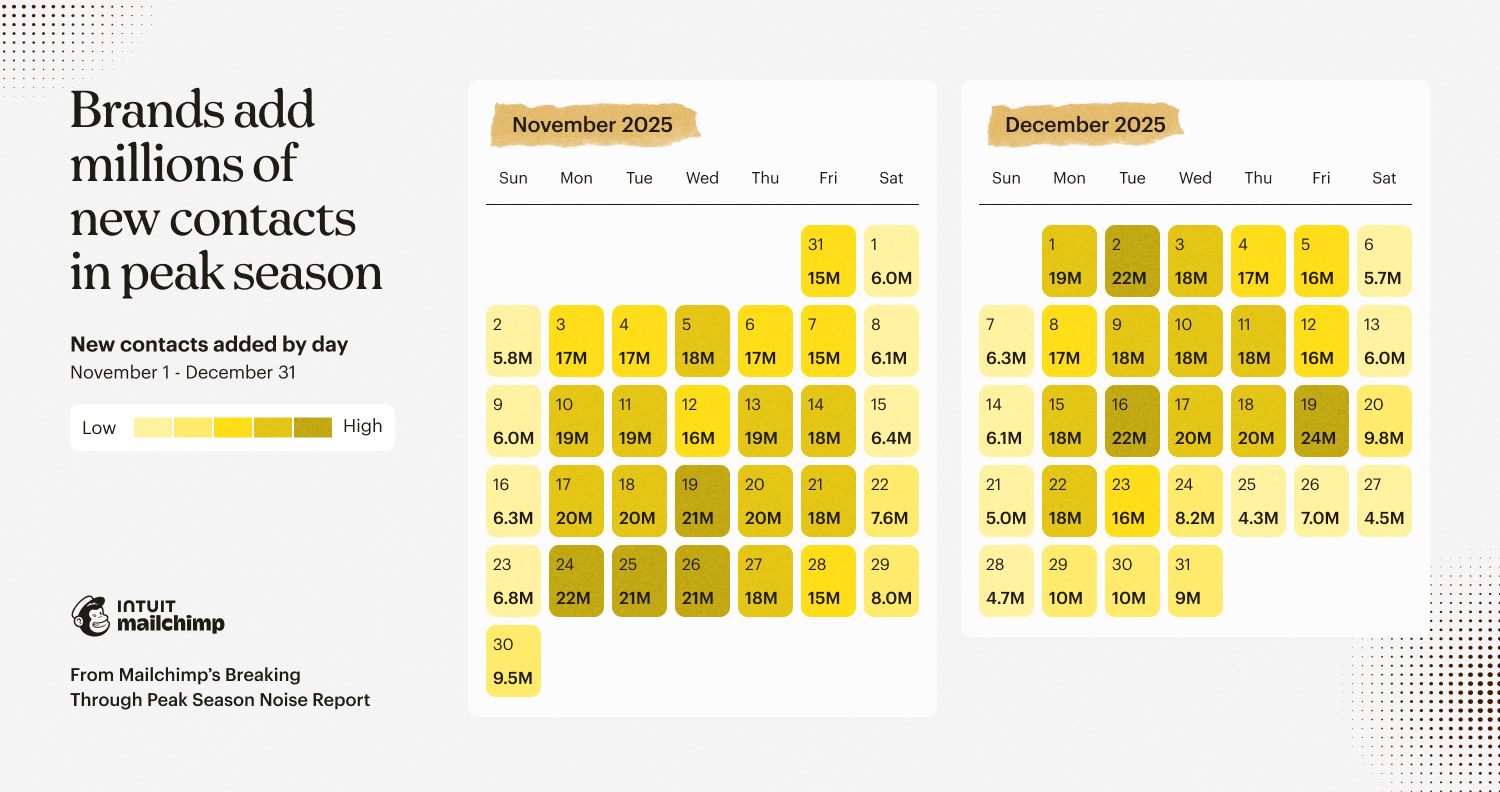
The 2025 peak season was defined by a massive influx of consumer data. Mailchimp’s findings reveal that its global customer base added more than 500 million new contacts to their marketing audiences during the final months of the year. This surge was not merely organic; it was the result of highly targeted acquisition campaigns that ramped up specifically as the Black Friday Cyber Monday (BFCM) weekend approached.
A clear trend emerged in communication preferences during this timeline: email sign-ups saw a steady incline leading into the final weeks of November, whereas SMS opt-ins experienced a sharp, vertical spike in the immediate days preceding Black Friday. This suggests that while consumers are willing to engage with email for long-term brand discovery, they reserve the direct, intrusive nature of SMS for time-sensitive, high-impact flash sales.
First-Time Buyers and Post-Holiday Retention
One of the most telling metrics in the report concerns the acquisition of new customers. During the BFCM period in the UK, first-time buyers accounted for 63 per cent of all email-driven orders and 61.8 per cent of SMS-driven orders. These figures underscore the role of the golden quarter as the primary engine for customer base expansion.

Crucially, the data challenges the notion that peak-season shoppers are purely "deal-seekers" who vanish after the sales end. The research found that 16.6 per cent of customers who made their first purchase during the 2025 peak season returned to make a second purchase by the first quarter of 2026. The median time for these repeat purchases was 26 days, indicating that effective post-purchase nurture sequences—automated emails triggered after a holiday delivery—were successful in bridging the gap between holiday gifting and long-term brand loyalty.
The Efficacy of AI and Personalisation
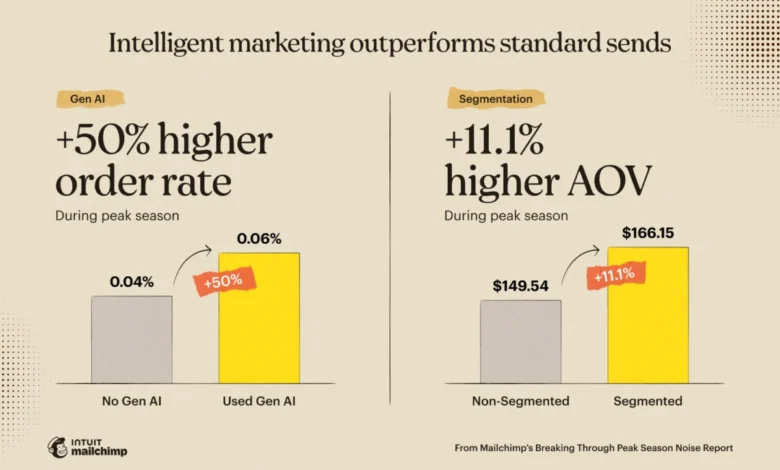
The shift toward generative AI (Gen AI) in marketing content was perhaps the most significant technological development in the 2025 retail landscape. Globally, businesses utilized Gen AI to craft or optimize over 450 million emails throughout the peak season.
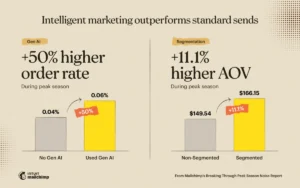
The performance metrics for these AI-assisted campaigns were markedly superior to those created through manual processes. In the UK, emails incorporating Gen AI achieved a 9 per cent higher order rate and a 5 per cent higher conversion rate compared to non-AI counterparts. This suggests that AI is no longer a peripheral tool for efficiency but a core component of conversion strategy.
Furthermore, dynamic content—the practice of personalizing email blocks based on specific user behavior—proved to be a major differentiator. UK retailers who implemented dynamic content during the BFCM period realized a 10 per cent increase in average order value (AOV). Similarly, the use of abandoned cart automation proved essential in mitigating lost revenue; campaigns utilizing these automated content blocks saw open rates climb by 36 per cent and click-through rates rise by 28 per cent.
Strategic Timing: The Paradox of Weekend Engagement
The report also sheds light on a counterintuitive trend regarding the timing of marketing messages. Throughout the 2025 season, weekends remained the most fertile ground for consumer engagement. Data indicated that order rates were twice as high on weekends compared to weekdays, even though brands sent approximately 60 per cent fewer marketing messages during those two-day windows.
This "less is more" phenomenon suggests that consumers are suffering from message fatigue during the work week. When brands sent fewer, higher-quality communications on weekends, they achieved better cut-through.
This trend was also observed during the BFCM weekend. While Black Friday remained the peak of activity, the "shoulder days" surrounding the event showed surprising resilience. Conversely, the Sunday between Black Friday and Cyber Monday saw a significant drop in volume—59 per cent fewer emails and 82 per cent fewer text messages than Black Friday—highlighting a strategic "breathing room" that savvy marketers exploited to re-engage customers who had been bombarded with offers just 48 hours prior.
Industry Case Study: Gymwrap
The practical application of these insights is best exemplified by the fitness apparel brand Gymwrap. Founded by actor Nicole Ari Parker, the brand sought to synchronize its email and SMS efforts to create a unified customer journey. By consolidating these two channels within the Mailchimp ecosystem, the brand achieved a 142x return on investment for its first full SMS campaign.
Hume Merritt, chief marketing officer at Gymwrap, emphasized the strategic advantage of data consolidation: "Having our email and SMS data in one place gives us a much clearer view of our customers. We can see how they prefer to engage with us and use that information to reach them in the right place." This unified view allows for a "channel-agnostic" approach to marketing, where the brand follows the customer’s preferred communication style rather than forcing the customer into a one-size-fits-all funnel.
Analysis: The Implications for Future Retail Cycles
The findings from the Breaking Through Peak Season Noise report signal a permanent shift in how retail marketing must operate. As competition for consumer attention reaches an all-time high, the "spray and pray" method of email marketing has become obsolete.
Several key implications for the 2026 and 2027 seasons are evident:
- AI as a Baseline, Not a Luxury: The performance gap between AI-driven content and static content is too wide to ignore. Future retail planning will likely require AI integration for dynamic personalization as a standard requirement for maintaining market share.
- The Rise of the Omnichannel Ecosystem: The success of brands like Gymwrap confirms that data siloing is a primary risk. Future retail success will rely on the seamless integration of CRM, email, SMS, and website analytics.
- Audience Retention over Acquisition: With 16.6 per cent of new holiday shoppers returning within 26 days, the focus for many retailers will likely shift toward "post-peak" retention strategies. The initial purchase is merely the start of a lifecycle that requires automated, personalized follow-up to convert a holiday shopper into a brand advocate.
- Strategic Restraint: The data regarding weekend engagement proves that volume is not a proxy for success. Brands that adopt a more disciplined, high-value communication strategy—choosing quality over quantity—are poised to win in an increasingly noisy digital marketplace.
As retailers look toward the remainder of 2026, the message from the Intuit Mailchimp report is clear: the most successful brands will be those that use the data they collect not just to send more messages, but to send the right messages. By utilizing generative AI to tailor content and automation to manage the timing and relevance of these interactions, businesses can cut through the noise of the golden quarter and build lasting relationships with their customers.