Navigating Enterprise Cloud Migration: How a Global Payments Provider Successfully Transferred 382 AWS Accounts Without Disrupting Service Continuity

Managing cloud infrastructure at a global enterprise scale involves constant adaptation to corporate evolution. When organizations undergo mergers, divestitures, or structural realignments, their underlying cloud architectures must shift accordingly. For enterprises utilizing Amazon Web Services (AWS), moving accounts between AWS Organizations is a routine administrative task during such corporate events. However, these migrations carry hidden complexities, particularly when managing fine-grained data permissions, cross-account resource sharing, and strict corporate deadlines.
Recently, a leading United States-based global provider of payment technology and software solutions successfully orchestrated a massive and complex cloud migration. The enterprise transferred 382 AWS accounts across organizational boundaries while racing against a rigid Transitional Service Agreement (TSA) expiration date in April 2026. The project highlights critical technical hurdles associated with AWS Resource Access Manager (AWS RAM) and AWS Lake Formation, offering a blueprint for large-scale cloud architectural transitions.
Background Context and Corporate Realities
The complex cloud migration took place against a backdrop of sweeping corporate restructuring. The payment processor, which delivers critical payment solutions and software to merchants and financial institutions worldwide, found itself separating from its former parent company—a major US-headquartered financial technology provider catering to global banking and capital markets clients. This corporate separation necessitated the complete migration of the payment processor’s AWS estate to a new, independent AWS organization before the binding TSA expired in April 2026.
Adding to the operational urgency, the migration coincided with another monumental corporate transaction. In January 2026, the payment processor was itself acquired by a prominent global payments technology company. This transaction transformed the acquiring entity into a pure-play commerce solutions provider capable of serving small businesses and massive multinational enterprises alike. Included in the migrating cloud estate was the payment processor’s embedded payments platform, a specialized US-based engine providing embedded payment solutions and automated onboarding tools for software-as-a-service (SaaS) platforms.
With multiple corporate milestones converging, engineering teams faced intense pressure to execute the account transfers seamlessly, ensuring that merchant services, data pipelines, and core transaction flows suffered zero downtime.
The Technical Dilemma: Unseen Control Plane Failures
The core technical challenge centered on how AWS RAM manages resource sharing within an AWS Organization. Normally, when resources are shared within an organization, AWS RAM establishes an implicit trust relationship through organization membership. Accounts consume shared resources automatically as long as they reside under the same organizational umbrella.
However, when an AWS account leaves its source organization, AWS RAM automatically severs these organization-bound principal associations. While the data plane for most services often continues to operate uninterrupted—meaning existing workloads, network traffic, and virtual machines keep running—the control plane loses accessibility.
This latent vulnerability came to light during a production migration wave in February 2026. Cloud engineers executing routine infrastructure updates via Terraform encountered permission errors when attempting to modify shared resources such as an AWS Transit Gateway. Although network traffic flowed smoothly without triggering alarms, engineers could no longer provision new infrastructure, update DNS resolver rules, or manage certificates.
Further complicating the migration was the heavy reliance on AWS Lake Formation and AWS Glue Data Catalog databases and tables, which were shared across multiple accounts to support analytics and the embedded payments platform. Without a specialized intervention, these permissions would instantly evaporate upon crossing the organizational boundary.
Chronology of the Migration and Execution Waves
To mitigate these risks, the payment processor’s cloud engineering team collaborated closely with AWS specialists to design, test, and validate a robust migration pattern in just two weeks.
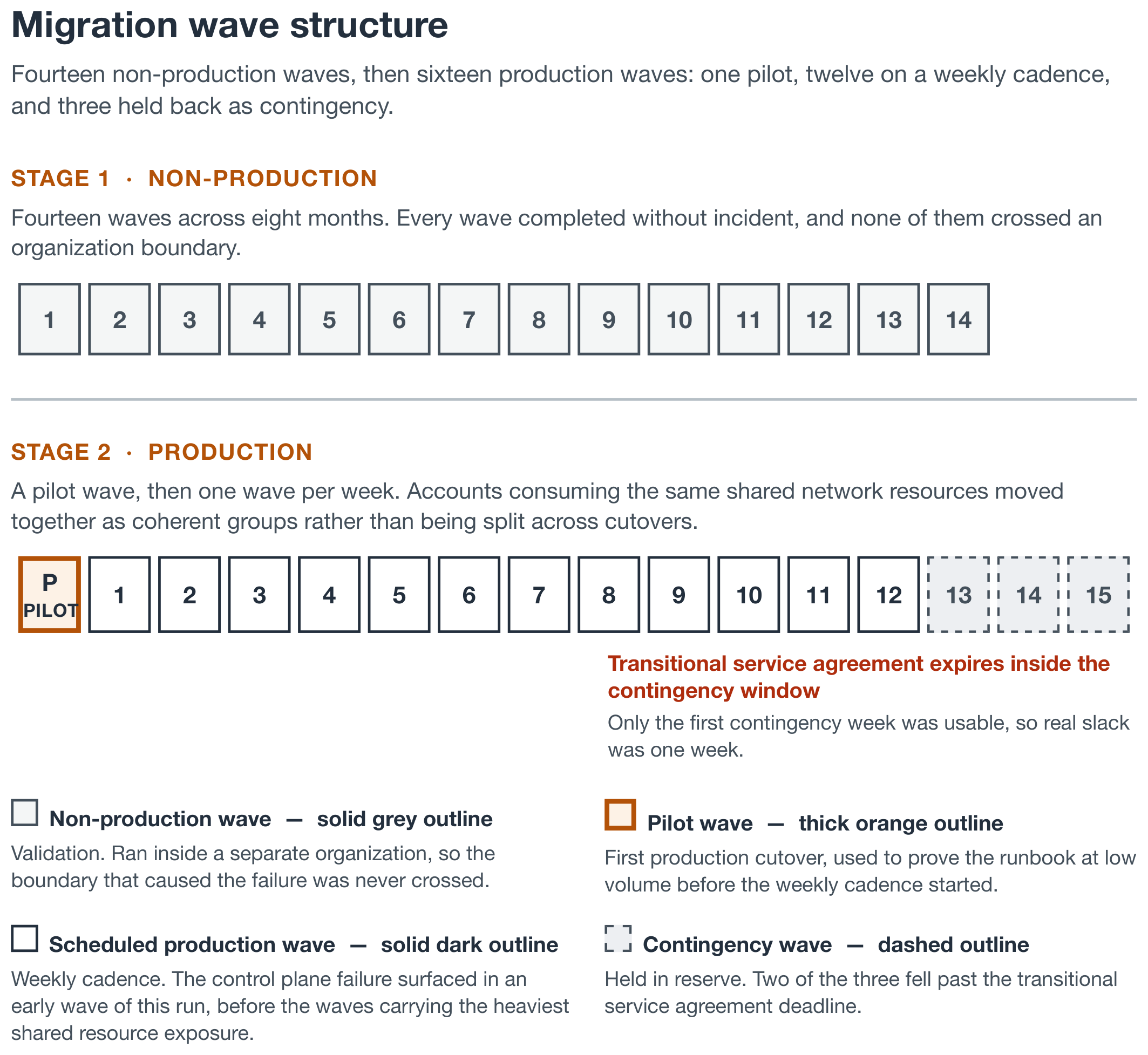
The execution strategy was structured into a rigorous sequence of testing and production waves to ensure safety and predictability:
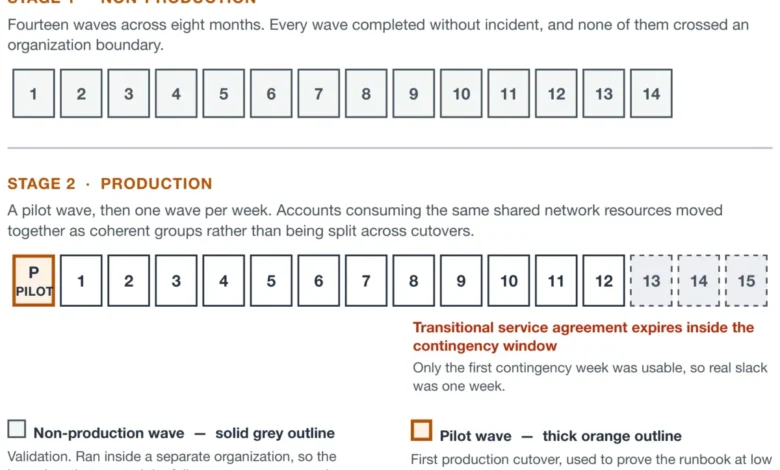
- Non-Production Waves: The team executed 14 non-production migration waves over an eight-month period. However, because these non-production accounts already resided in separate organizations, they did not cross the specific organizational boundary required to trigger the AWS RAM permission drop, masking the control plane vulnerability until production deployment began.
- Production Pilot: A controlled production pilot wave was launched to test real-world behavior under live operating conditions.
- Scheduled Weekly Production Waves: Following the pilot, the team initiated 12 scheduled weekly production waves to systematically transition the remaining bulk of the 382 accounts.
- Contingency Waves: Three contingency waves were reserved for unexpected delays. The strict April 2026 TSA expiration date left only the first week of the contingency window usable, creating an unforgiving operational timeline.
The Solution: The Retained Bridge Share Pattern
To prevent control plane disruptions without leaving permanent technical debt, AWS and the customer developed the "bridge share" architectural pattern.
Because an AWS resource can belong to multiple resource shares simultaneously, engineers created a parallel, retained "bridge" share alongside the original organization-bound share prior to each account move. This bridge share was explicitly configured as an external association by inviting the consumer account and requiring prior acceptance.
When the account subsequently migrated to the new organization, AWS RAM stripped away the original organization-bound association, but the external bridge share maintained continuous access.
Crucially, the bridge share served strictly as a temporary migration vehicle. Leaving parallel shares active indefinitely creates permission drift, complicates administrative audits, and obscures the true authoritative source of data governance. Once an account successfully arrived in its destination organization, automation logic verified that the original, AWS Lake Formation-managed share was restored as the primary source of truth, and only then was the temporary bridge share safely deleted.
Industry Implications and Lessons Learned
The successful migration concluded in July 2026 when the embedded payments platform completed its final production transition. The entire enterprise—spanning production environments, non-production accounts, and analytics platforms—was successfully unified into a single landing zone, granting the organization complete autonomy over its security guardrails, compliance posture, and change management processes.
Industry analysts reviewing the project have highlighted several key takeaways for enterprises planning complex multi-account cloud migrations:
- Environmental Parity in Testing: Test environments must accurately replicate the exact trust boundaries and organizational structures of production environments to surface hidden permission dependencies early.
- Comprehensive Dependency Inventories: Utilizing tooling such as the Account Assessment for AWS Organizations helps engineering teams catalog AWS RAM dependencies, shared Transit Gateways, Route 53 resolver rules, and AWS Private CA configurations before drafting migration schedules.
- Proactive Control Plane Monitoring: Leveraging Amazon EventBridge to capture AWS RAM state-change events and monitoring AWS CloudTrail for disassociation calls ensures that cloud administrators maintain visibility throughout the transition window.
Through strategic engineering collaboration, meticulous wave planning, and innovative use of temporary bridge shares, the global payment technology provider met its strict corporate deadlines, avoided any customer-facing service degradation, and established a proven, reproducible framework for future enterprise cloud migrations.
Related posts: